English
  日本語
日本語  한국어
한국어  français
  Deutsch
  Español
  русский
  العربية

Apr
Learn More
06

In the high-stakes worlds of aerospace, medical technology, and consumer electronics, the margin for error is zero. A component that deviates by a few microns can lead to catastrophic failure, a life-threatening device malfunction, or a consumer product that simply doesn't work. For engineers and procurement specialists tasked with sourcing these mission-critical parts, understanding the manufacturing process is as important as the design itself.
While many machining processes exist, one technology consistently stands out for producing complex, miniature components with unparalleled precision: the Swiss-type lathe. But what is it about this specific method of CNC Swiss lathe machining that makes it the gold standard?
In this deep dive, we’ll move beyond marketing buzzwords and explore the fundamental engineering principles of Swiss lathes. We’ll break down the mechanics of how they maintain extreme accuracy, provide tangible examples from key industries, and explain why our CNC swiss lathe machining services are engineered for success where others fall short.
To appreciate the Swiss lathe, we must first understand the primary limitation of a conventional lathe. In a standard CNC lathe, the workpiece is held at one end by a chuck and is supported only by itself as the cutting tool machines the opposite end. As the tool applies force, especially on long, slender parts, the unsupported section of the workpiece can bend or deflect.
This deflection is the arch-nemesis of precision. It causes:
Inconsistent Diameters: The part bends away from the tool, resulting in a part that is not perfectly round (out-of-round) and has dimensional inaccuracies.
Tool Chatter: The varying pressure leads to vibration, which leaves a poor surface finish and can prematurely wear or break the cutting tool.
Geometric Errors: Features like true position and concentricity are nearly impossible to hold over long, unsupported lengths.
This is where the revolutionary design of the Swiss-type lathe comes into play.

The single most critical component that defines a Swiss lathe and enables its superior performance is the guided bushing. This is not just a minor design tweak; it's a fundamental paradigm shift in how the workpiece is managed.
How it Works:
The bar stock is fed through a precision-guided bushing, typically located just millimeters away from the point where the cutting tool contacts the material.
This bushing acts as a rigid support wall, completely eliminating workpiece deflection at the cutting zone.
As the tool machines the part, the material is fed out of the bushing, always remaining supported directly behind the cut.
The Engineering Advantage:
Elimination of Deflection: By supporting the workpiece at the point of cut, the issues of bending, chatter, and dimensional inaccuracy are virtually eliminated.
Superior Length-to-Diameter Ratios: This method is exceptionally effective for parts with high L:D ratios (e.g., 10:1 or greater)—a domain where conventional lathes struggle immensely.
Simultaneous, Complex Machining: Swiss lathes are not simple turning centers. They are multifunctional turning centers with live tools and secondary spindles, allowing for complex swiss lathe machining operations in a single setup.
Let's look at the specific subsystems within a modern CNC Swiss lathe that contribute to its legendary precision.
Unlike a conventional lathe where the tool moves and the workpiece rotates in a fixed position, a Swiss lathe features a sliding headstock. The headstock moves the bar stock in and out of the guided bushing along the Z-axis. This design is crucial for maintaining the consistent, minimal distance between the bushing and the tool, which is the core of the stability.
Modern CNC Swiss lathe machining is not limited to turning. Machines are equipped with powered, rotating tools (live tooling) on the main tooling platform. Coupled with a C-axis (controllable rotary axis) on the main spindle, this allows for milling, drilling, cross-tapping, and slotting—all without removing the part from the machine. This "done-in-one" philosophy is critical for accuracy, as it avoids the cumulative errors introduced by multiple setups.
A back-working spindle can pick the part from the main spindle once the primary operations are complete. This allows the machine to complete the back side of the part—drilling, tapping, milling—in the same cycle. Again, this eliminates a second, less-accurate setup and ensures features on both ends of the part are perfectly concentric and located.
The theoretical advantages of Swiss lathes translate directly into real-world performance in the most demanding sectors.
Aerospace components operate under extreme stress, temperature, and vibration. Reliability is paramount.
Example Components: Fuel injector nozzles, hydraulic actuator pins, sensor housings, fasteners.
Accuracy Demands: Tight-tolerance threads, critical surface finishes to prevent crack initiation, and exotic, hard-to-machine materials like Inconel, Titanium, and Waspaloy.
How Swiss Machining Delivers: The guided bushing ensures stable cutting even in these tough materials, preventing tool deflection that could compromise tolerances. The single-setup capability guarantees that the complex internal and external geometries of a fuel nozzle are perfectly aligned.
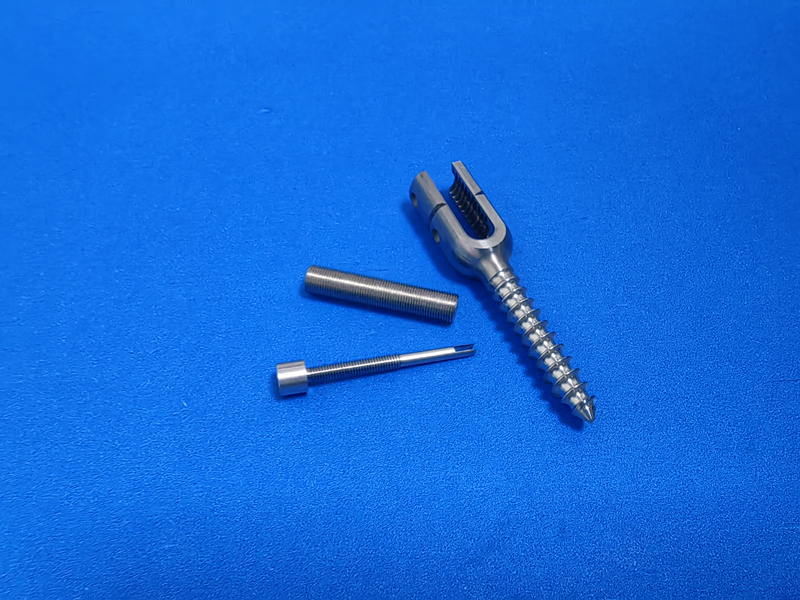
The medical device industry demands not only extreme precision but also flawless surface finishes and complete biocompatibility.
Example Components: Bone screws, surgical drill bits, orthopedic pins, dental implant abutments, components for minimally invasive surgical tools.
Accuracy Demands: Mirror-like surface finishes to prevent bacterial adhesion, complex organic geometries, and absolute consistency across production runs of thousands of parts.
How Swiss Machining Delivers: The vibration-dampening effect of the guided bushing produces the required superior surface finishes directly from the machine. The ability to machine intricate features from biocompatible materials like Titanium Ti-6Al-4V ELI and 316LVM stainless steel in one clamping ensures patient safety and device efficacy.

The drive for smaller, more powerful electronics requires incredibly tiny and complex components. This is a prime application for swiss lathe machining for electronics.
Example Components: Connector pins, micro-screws for device assembly, shafts for micro-motors, ferrule connectors for fiber optics.
Accuracy Demands: Often sub-millimeter dimensions, high concentricity, and excellent electrical conductivity properties.
How Swiss Machining Delivers: Swiss lathes excel at micro-machining. They can produce these tiny, delicate cnc lathed parts from brass, copper, and aluminum alloys with tolerances that other processes cannot achieve at scale. The single-setup process protects these fragile parts from being damaged in handling between multiple machines.
Owning a Swiss lathe does not guarantee perfect parts. The machine is a tool, and its output is a direct reflection of the expertise behind it. This is where the concept of E-E-A-T (Experience, Expertise, Authoritativeness, and Trustworthiness) becomes critical. When you partner with Falcon CNC Swiss, you are not just buying machine time; you are leveraging deep engineering knowledge.
Our Engineering-Led Process Ensures Your Success:
Design for Manufacturability (DFM) Review: Our engineers analyze your part drawings before production begins. We identify potential challenges related to tool access, tolerances, and material behavior, offering constructive feedback to optimize your design for the Swiss machining process without compromising its intent.
Advanced Tooling Selection: We don't use a one-size-fits-all approach. We select specialized tool geometries, coatings, and substrates specifically matched to your material and feature requirements, maximizing tool life and surface quality.
Precision Programming: The CNC program is the "brain" of the operation. Our programmers possess a profound understanding of tool paths, speeds, and feeds unique to the Swiss process, ensuring efficient, reliable, and accurate production cycles.
Rigorous In-Process Metrology: We integrate precision measurement equipment, such as in-process probing and laser tool setters, to automatically compensate for tool wear and verify critical dimensions in real-time, ensuring every batch of lathed parts meets your strict specifications.
Whether you are a startup developing a groundbreaking medical device or a large aerospace contractor looking for a reliable wholesale lathed parts factory, the principles remain the same. Precision, reliability, and expertise are not optional.
At Falcon CNC Swiss, we have built our reputation on providing CNC swiss lathe machining services that empower engineers to push the boundaries of innovation. We understand the "why" behind the precision, not just the "how."
Ready to see the difference that true engineering partnership makes?
Explore our comprehensive Swiss Machining Services to see our full capabilities.
View our [Consumer Electronics Device Manufacturing ] to see how we power modern consumer electronics.
Learn about our [Medical Device Manufacturing] expertise and our commitment to quality standards like ISO 13485.
Contact us today for a free, no-obligation DFM analysis on your next project. Let our team of experts become an extension of your own.