English
  日本語
日本語  한국어
한국어  français
  Deutsch
  Español
  русский
  العربية
Mar
Learn More
28

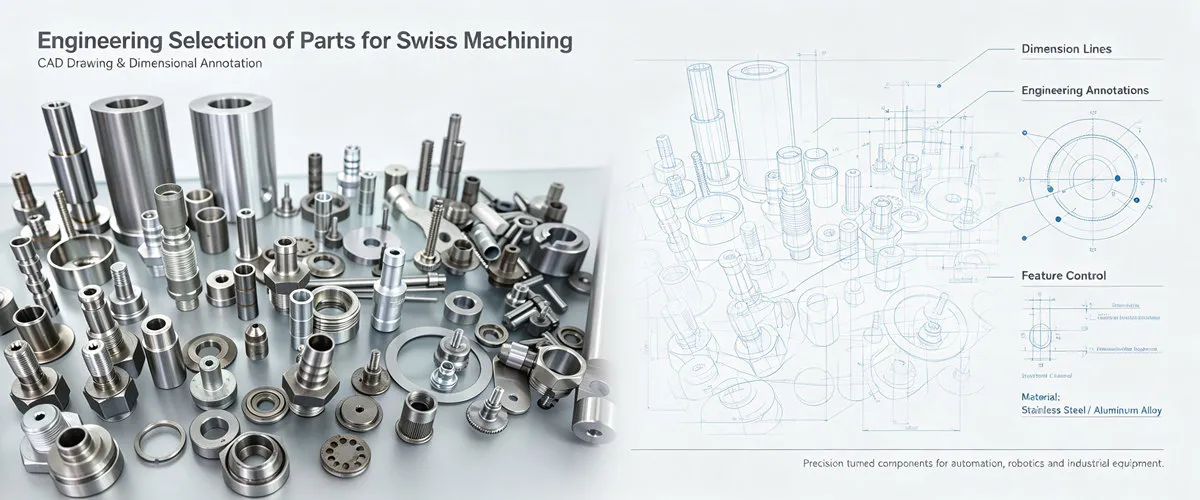
Swiss machining is not always required for every precision part. This process is best suited to be used in the case of products having small diameters, thin and long profiles, complex features, and tight tolerances which must maintain very good stability in the process of machining.
Understanding which parts are suitable for Swiss machining helps engineers select the right manufacturing process before production begins. Components that typically qualify for Swiss machined parts include precision pins, shafts, fittings, bushings, connectors, etc, and tiny components for use in medicine, electronics, automobile and industry.
This guide explains the characteristics that make parts suitable for Swiss machining, the common part types made by Swiss machining, and the instances in which another machining technique is the best.
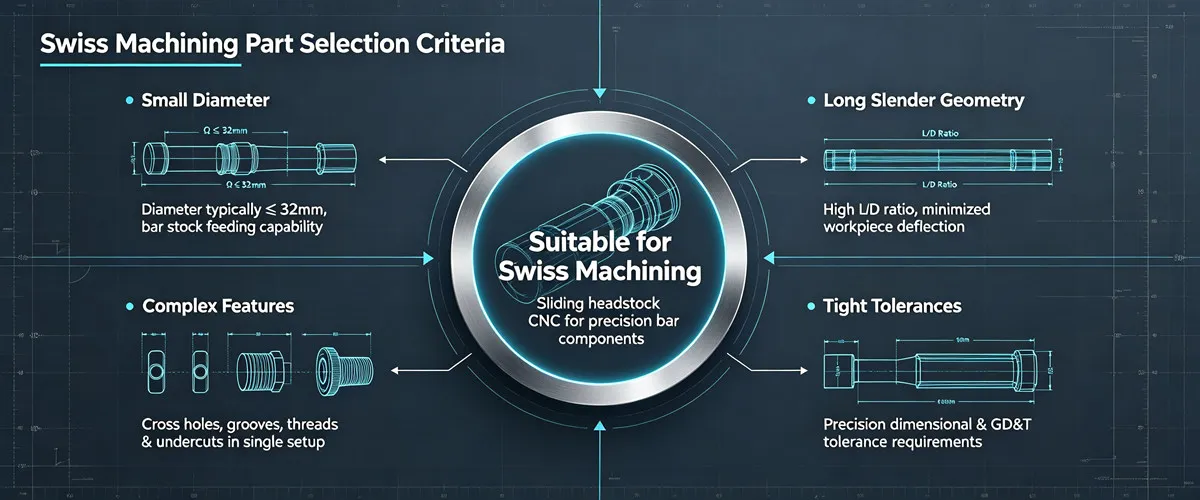
When a component's shape, size specifications, and production requirements allow it to take advantage of Swiss technology's ability to stabilize the component near the cutting point, it can be considered a viable candidate for Swiss machining. The focus is on whether or not a part can take advantage of the functionalities of Swiss machining based on its size, shape, density of features, and tolerance relationships.
Small parts for Swiss machining are often characterized by relatively small diameters. In this way, traditional turning processes may be more complicated due to issues with deflection control and maintaining consistent dimensions. Additionally, the support provided in the Swiss machining method proves to be advantageous for long and thin components as well.
Components that include a variety of machining elements throughout their length are highly compatible with Swiss machining. Whether it be grooves, threads or drilled features, it is possible to produce many diameters, thereby saving time by avoiding separate operations.
Swiss machining can be of advantage when a part needs to maintain certain relationships between important characteristics. Operations that require precise diameters, positional bores, threaded areas, or accurately controlled points of location may be able to use stable clamping device as well as repeating method of production.
The importance of combining these features is greater than importance of any specific measurement. Although a simple small-diameter part could not use Swiss process, the long part containing several precise elements could.
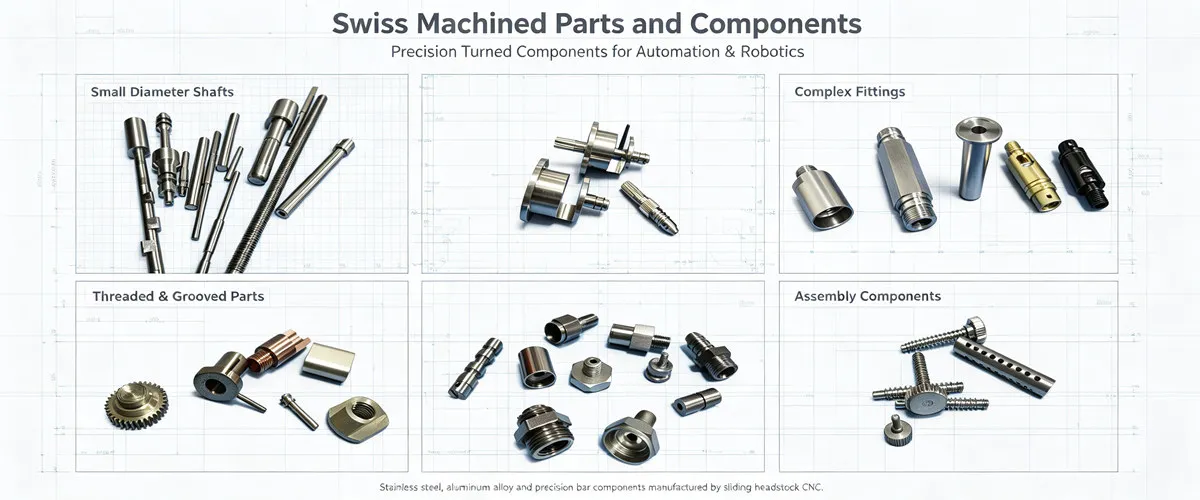
Swiss machined parts are popularly used in applications where parts necessitate small diameters, exact feature relationships, and constant production uniformity. Apart from being defined only by size, these parts are mostly distinguished by their shape, operational requirements, and the necessity for stable machining performance. A lot of companies make use of Swiss machining in production of precision shafts, pins, connectors, bushings, threaded elements, and other cylindrical items with many attributes.
The following part categories represent some of the most common parts for Swiss machining:
Some of the most common applications of the Swiss machining process include Swiss machined shafts and precision pins. In most cases, the fabrication of these items calls for precise control of diameter, concentricity across different sections, and good repeatability for assembly applications.
Typical examples include:
Miniature shafts and drive shafts
Dowel pins and locating pins
Alignment pins
Precision guide components
The Swiss machining process is especially useful when working with parts that have a lengthwise structure which may include features such as step diameters, grooves, threads, and similar features. The ability to hold the material close to the cutting area impacts on achieving dimensional accuracy of slend components.
The use of Swiss machining is prevalent in the manufacturing of small cylinder parts: sleeves, bushings, inserts, etc. These parts are usually characterized by a requirement such as the need of having the outer and inner diameter to be proportional to each other while maintaining a constant wall thickness and keeping high-quality surface finishes.
Common applications include:
Precision bushings
Spacer sleeves
Threaded inserts
Bearing-related components
For these components, maintaining concentricity between internal and external features is often critical to final assembly performance.
Swiss machining is great for manufacturing small connectors and fittings that have many precise features in a small size. They often require turning, drilling, threading, and cross machining in one operation.
Typical examples include:
Electrical connector pins
Sensor connectors
Fluid fittings
Small terminal components
For industries such as electronics, medical devices, and industrial equipment, these parts require consistent dimensions and reliable repeatability across production batches.
Custom screws, studs, threaded inserts, and other small fastening components can benefit from Swiss machining when thread accuracy and feature relationships are important.
Common examples include:
Precision screws
Custom studs
Threaded spacers
Small mechanical fasteners
Swiss machining allows manufacturers to combine turning, threading, drilling, and secondary features efficiently, making it suitable for complex threaded components requiring repeat production quality.
Many fluid control, sensor, and instrumentation parts are good candidates for Swiss machining because they often combine small diameters with precise internal and external features.
Examples include:
Valve stems
Nozzles
Sensor housings
Probe components
Micro fluid-control parts
These components often require tight control of bores, sealing surfaces, threads, and alignment features, making Swiss machining an effective choice for precision manufacturing.
Related resource: Swiss machining products →
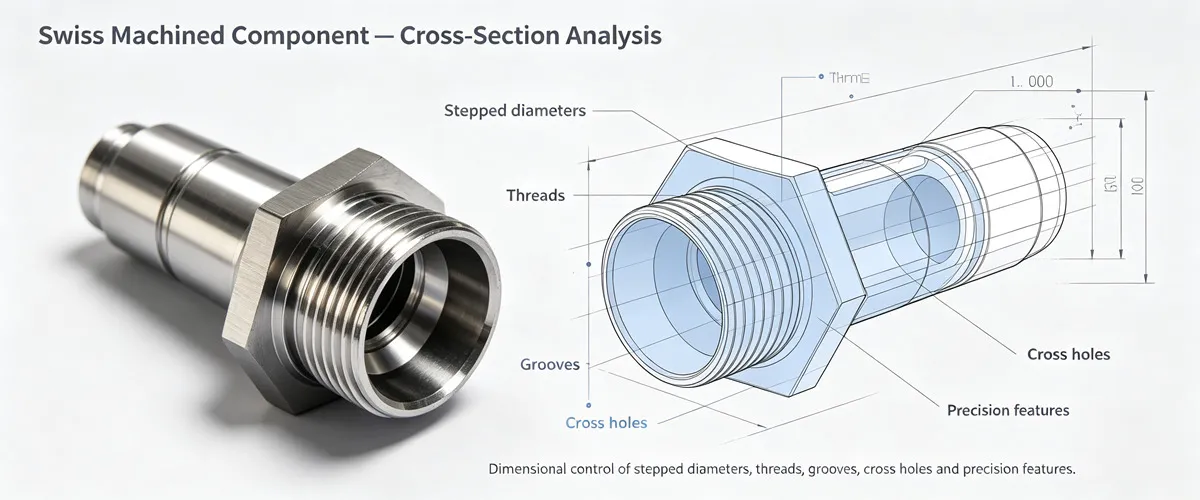
In many cases, whether a part is suitable for Swiss machining depends more on its particular geometry and arrangement of features than on its overall size. Parts that have various turned diameters along with grooves, threads, cross holes, flats, and similar off-axis features can benefit from a modern Swiss machine's ability to carry out several processes at the same time while keeping well-controlled work-holding.
Components that have several diameter changes, accurate grooves, recesses or threaded areas fit perfectly for Swiss machining. These features can be positioned on the length of a part and maintain the relationship between key diameters.
Typical examples include:
Stepped shafts
Threaded pins and studs
Precision sleeves
Grooved bushings
Components with sealing or retaining grooves
The combination of turning and threading operations can be particularly useful when several features must remain accurately related along the same axis.
Swiss machining technique can process parts with turning and some other functions as cross holes, flats, slots, and simple milling operations. The addition of live tooling makes it possible to combine these operations into one cycle instead of requiring moving the part from one equipment to another for every secondary operation.
This option can be useful in situations when the correct position or alignment of a cross feature in relation to the turned diameter is important from functional point of view. The reduction of additional workholding processes can contribute to better control of differences of related features.
Swiss machining long slender parts is one of the clearest applications for the process. The guide bushing keeps the bar stock form being machined close to the cutting area, thus limiting the unsupported segment during the machining process.
This makes Swiss machining particularly useful for:
Long precision shafts
Small-diameter pins
Probes and stems
Slender connector components
Other high length-to-diameter ratio parts
However, length alone should not determine the process. Diameter, material, tolerance requirements, feature complexity, production quantity, and the specific machine configuration should all be considered before selecting Swiss machining.
Swiss machining has a lot of capabilities, but it may not be the best choice for every turned component. There are various aspects to consider while choosing a particular process, including part geometry, diameter, length-to-diameter ratio, feature complexity, production volume and level of machining needs. For short, rigid, large diameter and very simple parts, using conventional CNC turning could be a more suitable process.
Short and stiff components generally benefit less from the guide-bushing support that characterizes Swiss machining. With increasing diameter of the part, it becomes increasingly practical to use conventional turning centers, which are designed for larger workpieces.
Examples include:
Large-diameter shafts
Flanges and hubs
Large fittings
Short, rigid bushings
Heavy cylindrical components
The exact diameter boundary depends on the machine, tooling, and part requirements, so a fixed diameter should not be treated as a universal cutoff.
A basic part with a couple of diameters, typical thread and few subsequent operations probably won’t be worth using Swiss methods. If the part is short and stiff, it may be successfully machined on conventional CNC turning center. For instance, an uncomplicated spacer or simple turned pin may not require the extra functionalities of a Swiss machine.
In general parts that consist of large pockets, flat wide surfaces, deep features milled on the part, or other prismatic shapes are better made using a CNC machining center than a Swiss-type lathe. Though Swiss machining is capable of performing milling operations utilizing the live tooling method, it is most effective when most of the operation consists of the turning .
Quantity produced also has a bearing on selection of process. Swiss machining requires specialized programming, tooling, guide-bushing setup, and process setup. In the case of running a very small prototype or singled piece, these setup requirements may be more than the benefits of machining. Conventional turning machine may be more preferable to produce short simple parts of small amount.
Important note: Swiss machining must be selected if specific benefits of the method are applicable to the part, and not just because the part is small and requires accuracy.
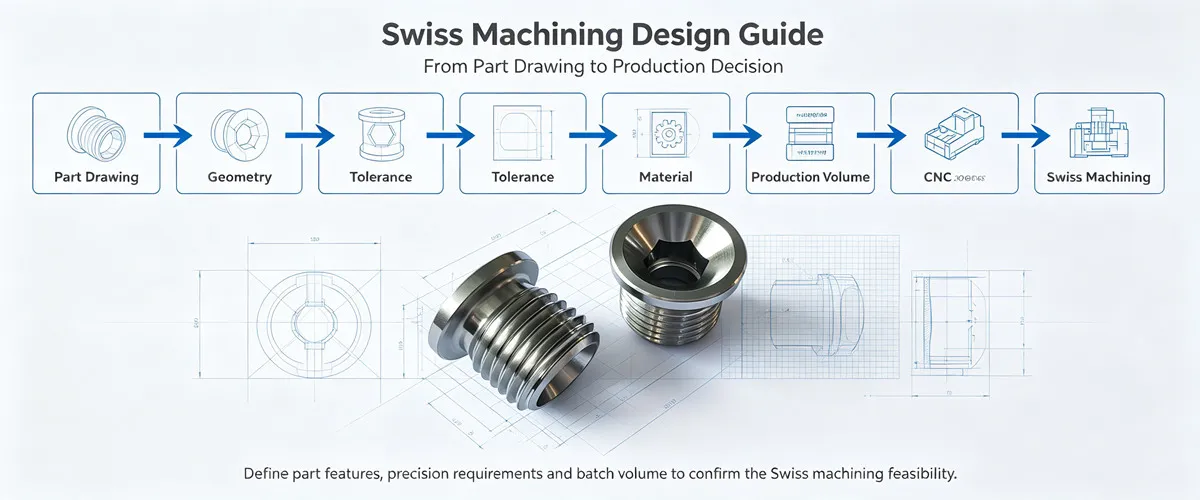
Engineers need to assess more aspects besides the mere size of the component while choosing Swiss machining. Ultimately, it boils down to determining how part geometry, important characteristics, material specifications and anticipated production levels relate to one another.
Consider the part's diameter, total length, and ratio of length to diameter. Parts that have small diameters and slender dimensions are good candidates for Swiss machining because this process offers a stable support during the cutting process.
Consider whether the part requires multiple diameters, grooves, threads, cross holes, or closely controlled feature relationships. Components with complex geometries and tight tolerance requirements can often benefit from Swiss machining capabilities.
The selection of the material and production volume entails the choice of their suitability for the machining process. The main materials that can be machined by Swiss CNC processes include stainless steel, brass, aluminum, titanium, and other kinds of engineering materials. Additionally, repeated quantities of production can leverage the benefits of the use of Swiss machining.
Reviewing the features of a part drawing, functional characteristics, and production criteria will help decide whether Swiss machining is the right option.
Falcon provides custom Swiss machined parts for precision components requiring small diameters, complex features, and consistent production quality. Send your drawings or CAD files to discuss your part requirements, machining options, and production needs.
Request a Swiss Machining Quote →
Components most appropriate for Swiss machining have smaller diameters, long thin shapes, several precision features, or closely related critical dimensions. Common types of parts include shafts, pins, connectors, bushings, fittings, and other precision cylindrical forms.
The Swiss-style machining process is capable of working with many varieties of materials, which may range from alloys of copper and titanium to stainless steel. The optimal material for machining parts is determined by the mechanical properties, environmental factors, and intended use of the components.
Size of the case does not determine process suitability alone. Though many small parts would fit the process, sometimes simpler, shorter parts without many features can be made more easily using other CNC processes.
Several characteristics, such as diameters of various sizes, slots, screws, holes crossing each other, an accuracy of holes, and the relation of features, help determine if Swiss machining can be effectively utilized in the creation of a product.
The most effective approach is to evaluate the part’s drawing, geometry, tolerances, materials, and quantity of production. The machining engineer may look into the requirements and suggest whether Swiss machining or a different manufacturing method would suit best.