English
  日本語
日本語  한국어
한국어  français
  Deutsch
  Español
  русский
  العربية
Apr
Learn More
16

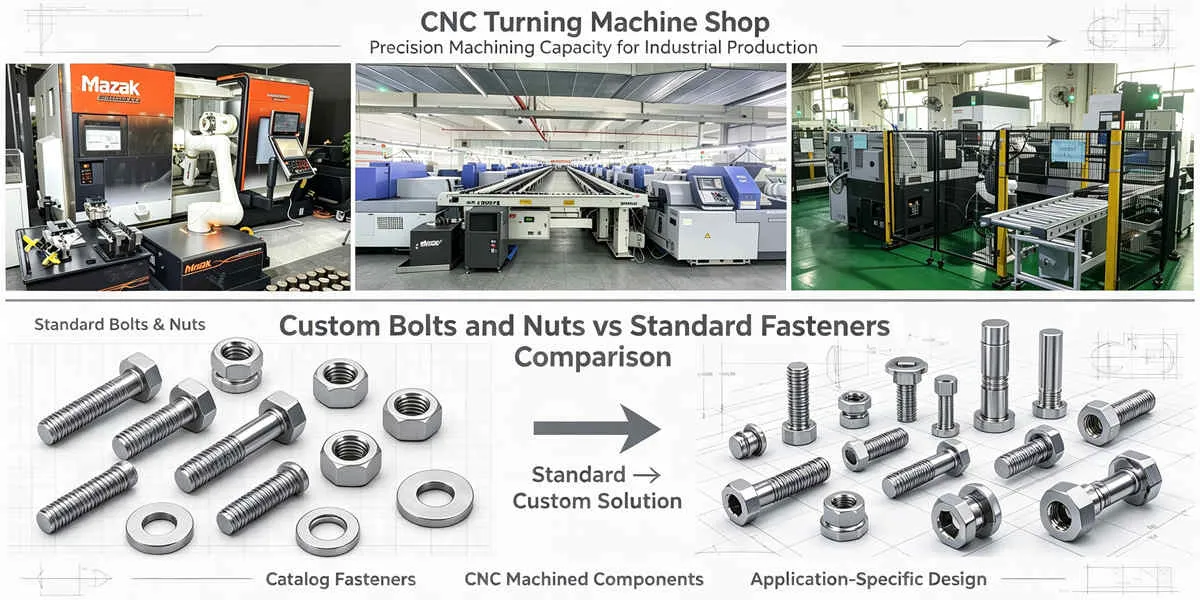
Selecting between off-the-shelf fasteners and bespoke bolts and nuts is not merely deciding which product to buy based on price. Off-the-shelf fasteners are the best choice in those cases where catalog measurements, thread specifications, materials, and functionality of the fastener match the requirements of the process being carried out. In the cases where the standard fastener cannot satisfy certain requirements for size, functionality, assembly, or materials, a custom fastener is preferable.
The main task engineers and procurement teams face is to determine whether the cost of customization is justified by the functional or manufacturing benefits obtained. This guide deals with the comparison of custom bolts with standard fasteners and indicates under which circumstances a made-to-print fastener is preferable from the engineering point of view.
Standard fasteners are made according to predetermined specifications and industry standards, providing easy availability and cost-effectiveness for common assemblies. Custom bolts and nuts refer to parts manufactured in order to comply with the special requirements that cannot be fulfilled using standard parts, such as doing the part in an unusual diameter, length, thread pattern, type of head, or material.
It is not a matter of choosing the “standard” part or the “better” one. The standard fastener works most of the time if its characteristics conform to the assembly requirements. The custom fastener is required when making compromises or using extra parts becomes necessary in order to avoid difficulties with assembly.
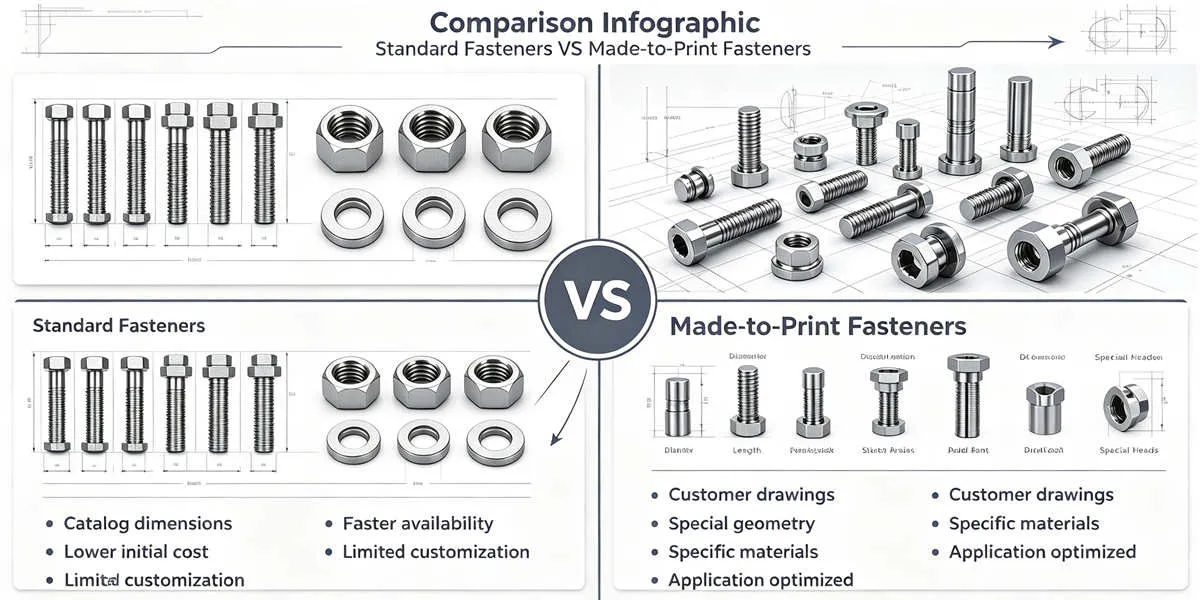
| Factor | Standard Fasteners | Custom / Made-to-Print Fasteners |
| Dimensions | Standardized | Customer-defined |
| Thread | Standard configurations | Can be application-specific |
| Geometry | Catalog designs | Custom geometry |
| Availability | Generally higher | Requires production |
| Initial cost | Usually lower | Usually higher |
| Design flexibility | Limited | High |
| Best suited for | General fastening | Specialized assemblies |
For manufacturers, custom fasteners can also integrate multiple functions into one component, helping simplify an assembly or accommodate space and performance constraints.
Standard fasteners are still the best compromise in several engineering applications. Engineers will need to see if any catalog fastener can fulfill the necessary mechanical performance, assembly and environmental requirements before going for custom bolts and nuts.
For applications with common dimensions, standard thread specifications, and conventional installation methods, standard fasteners offer several advantages:
| Consideration | Why Standard Fasteners Are Suitable |
| Availability | Common sizes and specifications are readily available |
| Cost | No custom tooling, programming, or engineering setup is required |
| Replacement | Easy sourcing and interchangeability during maintenance |
| Qualification | Existing industry standards and certifications are often available |
| Lead time | Stock products typically provide faster delivery |
Standard fasteners are normally the preferred options for general mechanical assemblies, maintenance of equipment, and those situations where design freedom is not a major problem. Nevertheless, using standard fasteners based on the initial cost may be problematic in applications that require specific performance features. Problems like limited installation areas, unusual mating situations, corrosion demands, weight limits, and even integrated functionalities may require a customized solution.
The goal is not to replace standard fasteners with special fasteners. The task here is to find out whether the existing normal options satisfy the existing engineering requirements. When the normal component works, it is usually the best option, whereas in case it leads to some design compromises, a made-to-print fastener may be more cost-effective in the long term.
Whether to opt for custom bolts and nuts or standard fasteners depends on whether it is possible to use an existing catalog component for accomplishing the application’s functional requirements. The inquiry is not simply if custom fasteners are superior but rather when to apply custom fasteners for resolving a specific engineering issue.
In many cases, engineers select custom vs standard bolts based on several key factors:
| Requirement | Why Custom Fasteners May Be Needed |
| Non-standard dimensions | Standard sizes cannot meet length, diameter, or clearance requirements |
| Special thread requirements | Unique thread size, pitch, engagement length, or fit is required |
| Limited installation space | Compact or specialized geometry is needed |
| Material requirements | Standard fasteners cannot provide required corrosion, temperature, or strength performance |
| Functional integration | The fastener needs additional locating, positioning, or assembly features |
Regular fastener catalogs are made for frequent usages. However, some affixes need customized bolt and nut sizes, comprising irregular diameters, lengths, patterns of head, or special configurations.
Activities involving adverse circumstances, precision assemblages, or unique apparatus may need done-for-you bolts and nuts with definite materials, finishes, or mechanical characteristics.
In a number of situations, the fastener is not merely used for the purpose of joining details; it also has some additional functionality, for instance, alignment, positioning, spacing, or decreasing assembly complexity.
Engineers who have to make a choice between custom bolts and standard bolts should take a holistic view of the application requirements, including aspects such as design limitations, production volume, assembly method, and lifetime performance. Custom fasteners present a better solution than standard fasteners when standard fasteners fail to work.
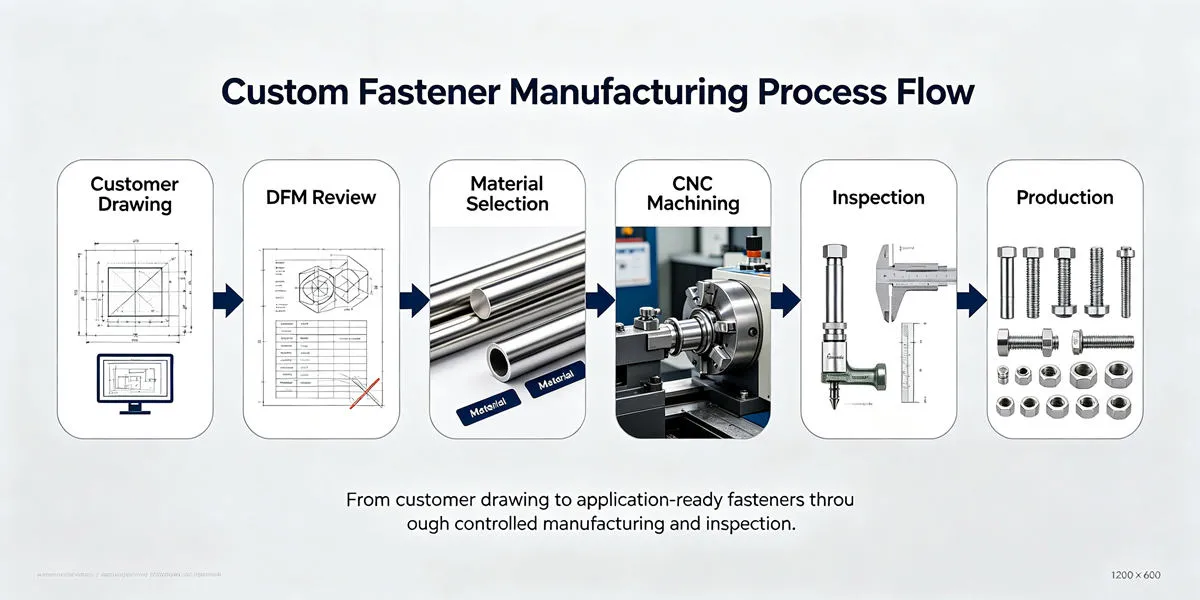
In contrast to conventional fasteners, which are selected from existing catalogs, made-to-print fasteners are produced according to customer-dictated designs such as drawings, CAD models, or engineering specifications. This means that the manufacturing process enables the making of nuts and bolts that have different dimensions, thread requirements, materials, surface finishing, and other properties.
The production process for custom parts made to print typically includes several key stages:
| Stage | Engineering Considerations |
| Drawing Review | Verify dimensions, tolerances, threads, materials, and finishing requirements |
| DFM Analysis | Evaluate manufacturability, tooling requirements, and production feasibility |
| Process Planning | Select suitable machining methods based on geometry and production volume |
| Prototype / First Article | Validate critical dimensions and functional requirements |
| Production Manufacturing | Maintain consistency through controlled processes and inspection |
1. Engineering Drawing Review
The drawing is the foundation of a successful custom fastener project. Manufacturers review critical information including:
Bolt and nut dimensions
Thread specifications
Material requirements
Surface finishes
Critical tolerances
Inspection requirements
A complete drawing helps reduce communication issues and ensures that the final component matches the intended application.
2. Manufacturing Process Selection
The method used for custom bolt manufacturing depends on the geometry, material, tolerance, and quantity of the product. The application of CNC turning, Swiss machining, milling, and additional processes can be used to produce advanced fastener designs. For production operations relating to repeatability and consistent quality, CNC machining allows control over the dimensions of custom bolts and nuts.
For components requiring tight dimensional control and repeatable production, manufacturers typically rely on CNC machining services to produce custom fasteners from customer drawings while maintaining consistency across production runs
3. From Prototype to Production
Made-to-order bolts and nuts can be produced for prototypes, low-volume runs and long production programs. A dependable manufacturing partner must be capable of providing the entire service from the beginning with the drafting phase all the way to the delivery of the final product.
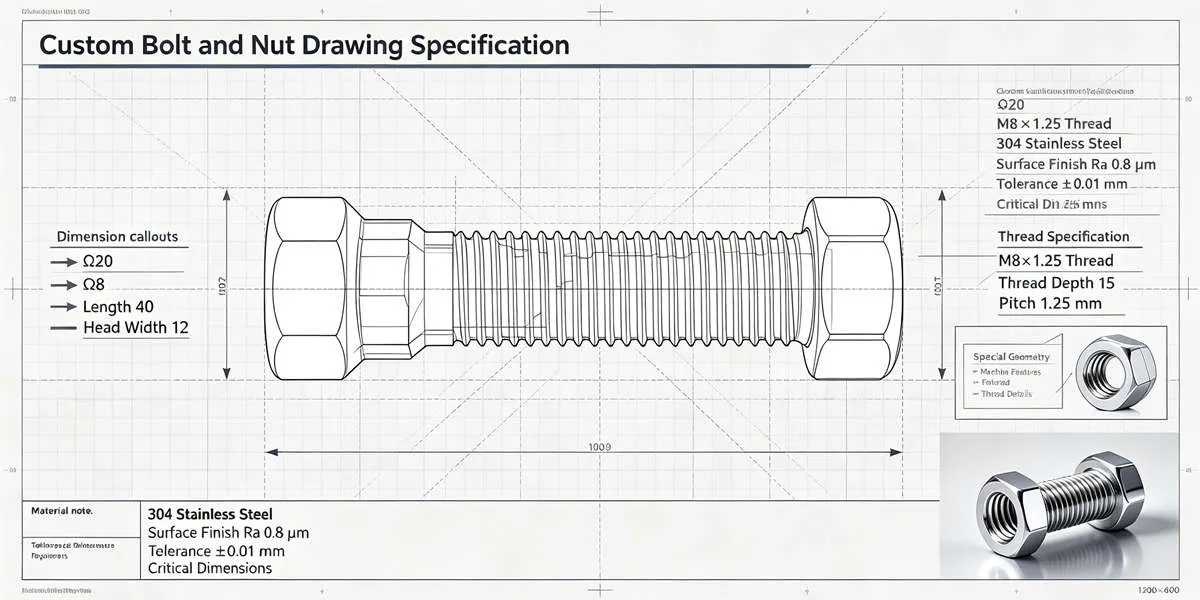
Arranging a successful custom made fastener project involves designing the fasteners clearly. Unlike regular parts taken from catalogs, custom nuts and bolts are designed according to particular engineering norms, which means that every detail of the design can affect its performance, manufacture and price.
When preparing specifications for custom bolts and nuts, engineers should consider the following factors:
| Design Requirement | Key Considerations |
| Dimensions | Diameter, length, head style, shoulder features, and overall geometry |
| Thread Specifications | Thread size, pitch, engagement length, and thread location |
| Material Selection | Strength, corrosion resistance, temperature capability, and application environment |
| Surface Finish | Coatings, plating, passivation, or other finishing requirements |
| Tolerances | Critical dimensions and functional requirements |
| Quantity Requirements | Prototype quantities, production volume, and future demand |
The design of threads is very important since it has a crucial influence on how well the assembly works and how compatible it is with other components. The right specification of the thread will guarantee correct installation and consistent performance.
Also, selection of materials should take into account the environment in which it works but not only the price of the material in question. Depending on the specifications such as corrosion resistance, weight lowering, electrical properties, etc., one can choose different materials such as stainless steel, brass, aluminum, titanium or alloyed steels.
For manufacturers involved in custom bolt manufacturing, reviewing these requirements early helps identify potential machining challenges, select appropriate processes, and provide a more accurate production plan.
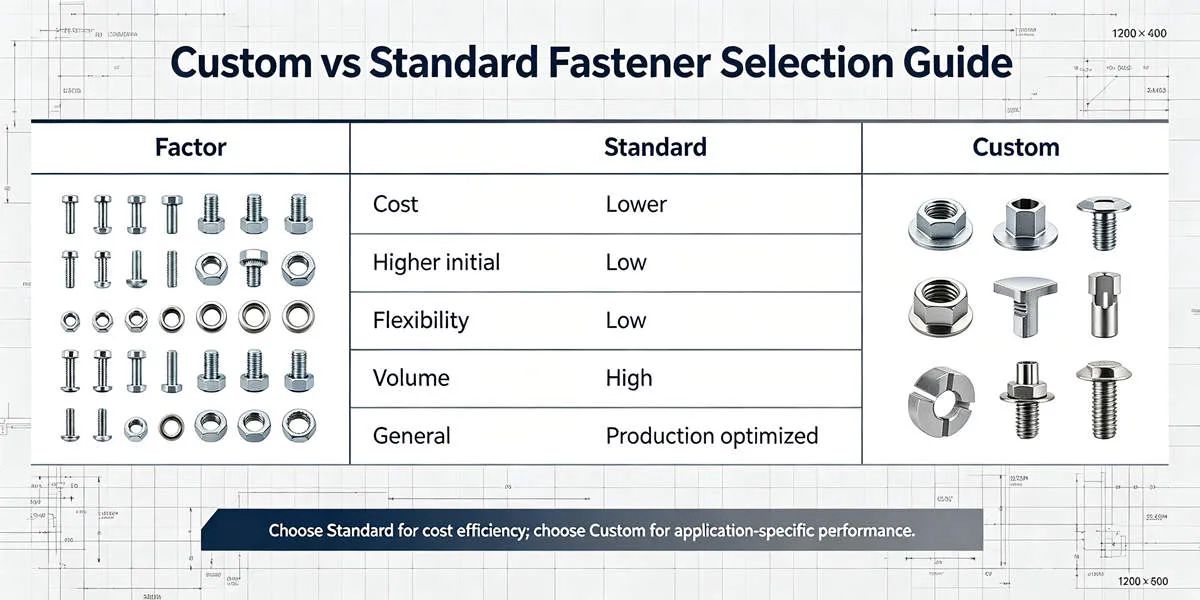
Cost is one of the most important factors when comparing custom fasteners vs standard fasteners, but it is sometimes not lowest unit price that equals lowest overall cost. The most appropriate option varies according to the number of goods required, specification, assembly capability, and future requirements for manufacturing.
As a rule, standard fasteners are cheaper because they are produced in series and do not require any engineering or technological preparation. Accordingly, standard fasteners are a perfect solution if catalog options meet the application requirements in full.
However, the comparison of custom fastener cost vs standard fastener cost must be based on the full set of project specifications.
| Design Requirement | Key Considerations |
| Dimensions | Diameter, length, head style, shoulder features, and overall geometry |
| Thread Specifications | Thread size, pitch, engagement length, and thread location |
| Material Selection | Strength, corrosion resistance, temperature capability, and application environment |
| Surface Finish | Coatings, plating, passivation, or other finishing requirements |
| Tolerances | Critical dimensions and functional requirements |
| Quantity Requirements | Prototype quantities, production volume, and future demand |
In the case of made-to-order fasteners, the cost of initial investment may consist of process planning, drawing review, and obtaining materials. In fact, these costs can easily be considered worth it if the custom design improves performance characteristics of the product.
The amount of production is another factor in play. For prototypes or low volumes, standard fasteners might be more cost-effective if available. In recurring production projects, high volume Swiss CNC machining capabilities can offer high product quality and cost efficiency in production of custom fasteners.
In comparing custom to standard fasteners, engineers should consider the overall value of the product during its entire lifecycle instead of only taking into account the initial price.
When picking out a fastening solution, designers must balance requirements for product design, production, and the overall project value. When comparing custom fasteners vs. standard fasteners, engineers should analyze whether an existing component from the catalog would work for the application or if a custom-made product would offer additional benefits.
The following checklist can help determine the appropriate option:
| Evaluation Factor | Standard Fasteners | Made-to-Print Fasteners |
| Available dimensions | Suitable when catalog sizes meet requirements | Required for non-standard dimensions |
| Thread requirements | Standard thread specifications are acceptable | Special thread size, pitch, or engagement needed |
| Material requirements | Common materials are sufficient | Special materials required for environment or performance |
| Assembly requirements | Conventional installation methods | Limited space or integrated functions required |
| Production needs | Short-term or general applications | Prototype, repeat production, or specialized programs |
Custom fasteners are typically selected for industrial uses when the fastening parts are required to fulfill functions that go beyond those of basic fastening. This could include machinery parts, automation equipment, electronic assemblies, and other specialized industrial processes where precision, selection of material, or installation efficiency is involved.
Selection of materials is another key aspect of the design process. The choice of materials for custom fasteners will depend on their intended use, such as corrosive environment, temperature, required weight, and mechanical load.
The best approach is to first identify the real requirements for the use of the fastening system, then establish whether a standard fastener will suffice or whether better performance and greater return on investment can be realized with custom bolts and nuts.
When talking about custom fasteners, it is not only about replacing conventional fasteners but also about providing solutions to specialized challenges that cannot be solved with the help of the contents from a catalog.
According to engineers, the main custom fastener benefits, which include an improved design freedom, enhanced assembly performance and superior control over materials, sizes and conditions of production.
Custom bolts and nuts can provide additional value when they help to:
Eliminate design compromises caused by standard sizes
Reduce the number of components in an assembly
Improve installation efficiency
Support specialized operating environments
Provide consistent supply for long-term production
The decision of why choose custom bolts over standard bolts should depend on a thorough understanding of all the requirements of the application including the performance needs of application, production volume, assembly requirements and lifecycle expenses.
When standard fasteners fulfill requirements, they will be the most effective solution. But when the project requires unique shape, certain materials or specialized properties, custom-designed fasteners offer more value in the long run.
At Falcon, we support custom fastener projects from drawing review and manufacturing planning through precision CNC production and inspection. Send your drawing or CAD model to discuss your custom bolt and nut requirements.