English
  日本語
日本語  한국어
한국어  français
  Deutsch
  Español
  русский
  العربية

Aug
Learn More
08

The modern automobile is a network of data, with over 100 sensors in the average vehicle, monitoring everything from exhaust temperature and tire pressure to camshaft position and fuel rail dynamics. The reliability of these systems is non-negotiable, and it hinges on the mechanical integrity and dimensional perfection of their smallest metal parts. This is where Swiss-type CNC machining, or Swiss screw machining, transitions from a manufacturing choice to a critical engineering necessity.
At Falcon CNC Swiss, our engineers don't just run machines; we solve intricate problems for Tier 1 and Tier 2 suppliers. The shift towards electric vehicles (EVs) and advanced driver-assistance systems (ADAS) has exponentially increased the demand for precision sensor components that are smaller, more complex, and produced in higher volumes than ever before. This guide delves into why Swiss machining for automotive sensors is the dominant manufacturing process, exploring the technical challenges, optimal material selections, and real-world applications that define this high-stakes field.
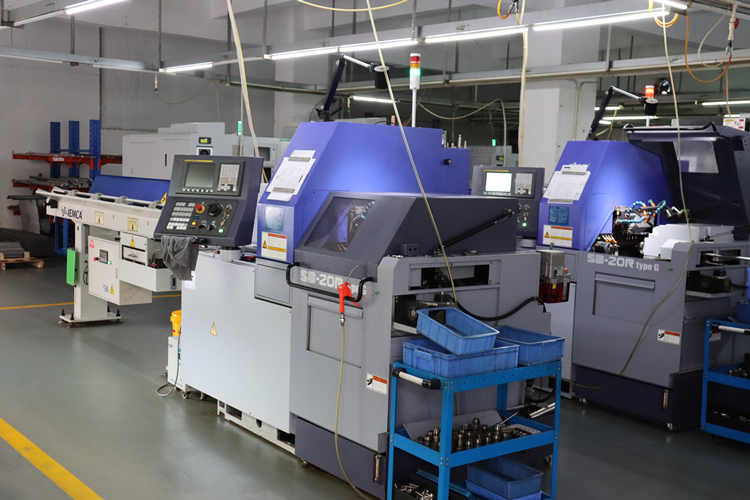
Conventional CNC lathes and milling machines excel at many tasks, but they fall short for the long, slender, and intricately featured parts common in sensor assemblies. Here’s a breakdown of the unique advantages offered by our Swiss machining services for this industry:
Automotive sensors are shrinking. A position sensor pin or a fuel injector sensor probe may have diameters under 2mm with tolerances in the single-digit micron range (±0.005mm or 5µm). The guide bushing in a Swiss-type lathe supports the bar stock millimeters from the cutting tool, virtually eliminating tool pressure-induced deflection. This is paramount for producing high-precision sensor housings and tiny conductive pins that must fit perfectly into molded connectors and assemblies.
Sensor performance can be affected by surface irregularities. A poor finish on a mass airflow sensor probe can disrupt laminar flow, while burrs on an oxygen sensor housing thread can cause sealing failures. Swiss machines, with their live-tooling capabilities and simultaneous operations, can machine complex off-axis features—cross-holes, flats, slots, and threads—in a single setup. This produces the flawless finishes and intricate geometries required for automotive pressure sensor housings and rotary encoder shafts without secondary operations that introduce error.
Automotive is a volume game. A single sensor model may require millions of screw machined sensor components annually. Swiss screw machines are designed for relentless, unattended production. Coupled with automated bar feeders and in-process gaging, they deliver the statistical process control (SPC) needed to meet automotive PPAP (Production Part Approval Process) requirements. This makes them ideal for producing high-volume automotive sensor pins and connector bodies with zero defect goals.
Sensors live in engine bays, transmissions, and wheel wells—environments of extreme heat, vibration, corrosion, and media exposure. Swiss machining seamlessly handles the full spectrum of necessary materials, from corrosion-resistant stainless steels for exhaust gas temperature sensor fittings to high-conductivity brass for electronic sensor connector pins, and even exotic alloys for next-generation applications.
Let’s examine specific applications where our CNC Swiss machining for sensors delivers critical value.
These are the protective shells and structural interfaces for sensing elements.
Materials: Typically 303/304/316 Stainless Steel, Aluminum 6061, Brass C360.
Features: Precision internal bores for sensor element seating, external O-ring grooves, mounting threads (e.g., NPT, M12x1.5), anti-rotation flats, and laser-etched markings.
Example: An ABS wheel speed sensor housing requires a precise bore for the magnetic pickup, a robust mounting thread, and a sealed cable exit path—all machined concentrically for reliable signal generation.
These are the active sensing or sensed components.
Materials: Often 17-4 PH Stainless (for strength), Martensitic Stainless (for magnetism), Titanium (for lightweight strength).
Features: Very small diameters, precise lengths, hardened tips, unique head profiles, and sometimes specially tuned magnetic properties.
Example: A camshaft or crankshaft position sensor target pin is a small, hardened pin with a specific profile that must be produced in volumes of millions with zero dimensional variation to ensure accurate engine timing.
The electrical interface of the sensor.
Materials: Free-cutting Brass (C360) for excellent conductivity and machinability, Phosphor Bronze for spring properties.
Features: Complex pin-socket geometries, crimping zones, insulation grips, and plating-ready surfaces (for tin, gold, or nickel).
Example: A TPMS (Tire Pressure Monitoring System) sensor connector pin must provide a gas-tight seal, reliable electrical contact, and withstand constant vibration and thermal cycling.
These interface the sensor with hydraulic or pneumatic lines.
Materials: 316 Stainless, Aluminum, Brass.
Features: Complex internal porting, JIC/SAE/AN flared or O-ring face seal threads, and integrated mounting features.
Example: A common rail fuel pressure sensor adapter must contain ultra-high pressure diesel fuel (over 2,000 bar) and provide a leak-proof connection to both the rail and the sensor, demanding perfect thread form and surface finish.
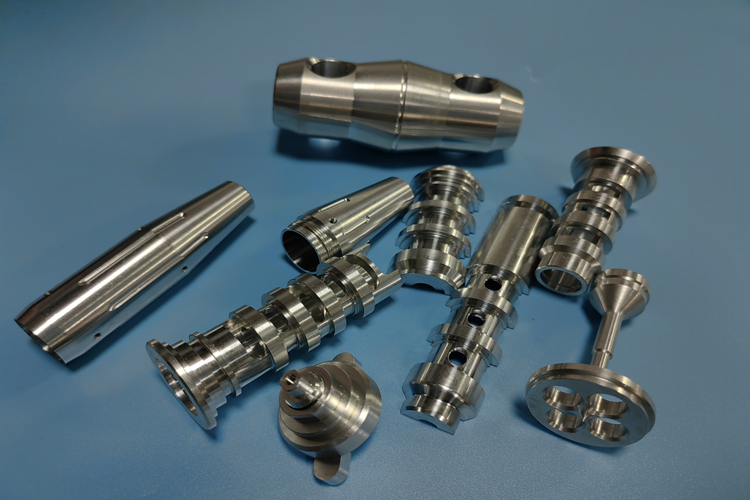
Selecting the optimal material is half the engineering battle. Here’s our analysis of common choices for precision automotive sensor parts:
Material | Key Properties | Typical Sensor Applications | Swiss Machining Consideration |
303 Stainless Steel | Excellent machinability, good corrosion resistance, non-magnetic. | Sensor housings, connector bodies, general fittings. | The default choice for most stainless components. Superior chip breakage allows for high-speed production of complex sensor parts. |
316 Stainless Steel | Superior corrosion & chemical resistance. | Exhaust sensors, urea (DEF) sensors, marine/coastal vehicle sensors. | Slightly tougher to machine than 303. Requires optimized tool paths and coolants to maintain tool life and surface finish on critical sensor fittings. |
17-4 PH Stainless | Can be precipitation hardened to very high strength (H900 condition). | High-strength sensor pins, shaft targets, fasteners in high-vibration zones. | Machined in the annealed (soft) state, then heat-treated. Requires careful planning for post-machining growth/distortion. |
Brass C360 | Best-in-class machinability & electrical conductivity. | Electrical connector pins, terminals, low-pressure fittings. | Enables the fastest cycle times for high-volume electronic sensor components. Often plated for enhanced solderability or corrosion resistance. |
Aluminum 6061-T6 | Lightweight, good strength-to-weight ratio, decent corrosion resistance. | Sensor mounting brackets, housings for non-critical environments, EV battery sensor components. | Prone to galling; requires sharp tools and proper coolant to achieve a clean finish on aluminum sensor housings. |
Plastics (PEEK, Acetal) | Electrical insulation, chemical resistance, lightweight. | Insulative bushings, spacer sleeves, custom grommets within sensor assemblies. | Swiss machining of plastics requires specialized tool geometry to manage heat and clamping force, preventing deformation of small plastic sensor parts. |
Producing millions of perfect parts presents distinct hurdles. Here’s how our Swiss machining expertise addresses them:
Challenge: Holding a ±0.005mm diameter tolerance on a 1.5mm pin across 500,000 parts.
Solution: Utilizing thermally stable Swiss machines, ceramic guide bushings, and in-process laser measurement systems that provide real-time feedback for automatic tool compensation.
Challenge: Removing microscopic burrs from cross-holes and thread crests on a fuel sensor component without altering critical dimensions.
Solution: Implementing synchronous tooling strategies (e.g., “back-turning”) and designing tool paths that minimize burr formation at the source, complemented by targeted, automated deburring processes.
Challenge: Automotive quality standards require full traceability of raw material to finished part.
Solution: Integrating our Swiss machining services with a rigorous material certification and lot-control system. Every bar of metal is logged, and this data flows through to the final shipment documentation.
Challenge: Integrating multiple features (threads, flats, holes) into one tiny part without resorting to expensive, multi-step assembly.
Solution: Leveraging the multi-axis, live-tooling capability of modern Swiss-type lathes to complete parts in one cycle. A single CNC Swiss screw machine part can replace what was once a multi-piece assembly, reducing cost and improving reliability.
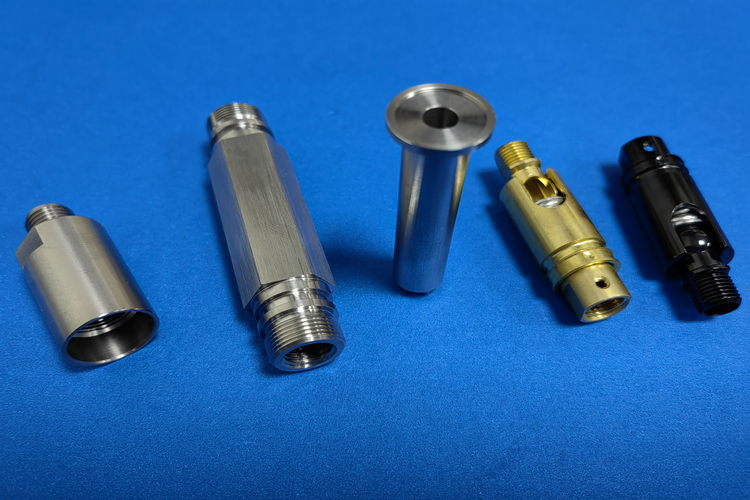
Challenge: A Tier 1 supplier needed a high-precision, aluminum sensor housing for a next-generation TPMS valve stem. The part included a deep, small-diameter bore for the pressure sensor chip, a delicate external thread for the valve cap, an O-ring groove, and a complex anti-theft spline feature. Volumes were in the millions per year, with a strict cost target and zero-leak performance requirement.
Falcon CNC Swiss Solution:
Design for Manufacturability (DFM) Review: Our engineers suggested minor draft angles on the spline and a slight radius adjustment on the O-ring groove to dramatically improve tool life and chip evacuation.
Process Design: We configured an 8-axis Swiss-type lathe with dual spindles and synchronized live tooling. The part was completely finished—including all milling and threading—in a single chucking, eliminating cumulative tolerance error.
Material Selection: We recommended and sourced a specific, free-machining aluminum alloy with tight chemical controls to ensure consistent machinability and anodizing response.
Quality Integration: An in-process vision system was added to inspect the critical bore diameter and the presence of the spline features on every single part, providing 100% inspection for key characteristics.
Result: The customer received a fully finished, anodize-ready TPMS housing at a 22% lower unit cost than their previous multi-process method, with a 50% reduction in scrap rate and a guaranteed leak performance that exceeded specifications.
The evolution of the automobile—toward electrification, autonomy, and hyper-efficiency—is fundamentally an evolution of its sensory nervous system. The physical components that enable this sensing revolution cannot be an afterthought. They require a manufacturing philosophy built on precision, consistency, and deep technical collaboration.
Swiss machining is not merely a process for making automotive sensor parts; it is the enabling technology that allows sensor designers to push the boundaries of what’s possible. When you partner with a specialist like Falcon CNC Swiss, you’re not just outsourcing production. You’re gaining a team of engineers who understand the interplay between material behavior, geometric design, and manufacturing physics.
Ready to discuss how precision Swiss machining can solve your most challenging automotive sensor component requirements? Contact our engineering team today for a confidential design review and quote. Let us show you how our focused expertise in Swiss machining services can bring reliability, scalability, and value to your next sensor project.