English
  日本語
日本語  한국어
한국어  français
  Deutsch
  Español
  русский
  العربية
Mar
Learn More
19

The process of designing precision components requires more than just specifying tolerances and dimensions in drawings. A good design foresees how feature requirements, material choice, geometry of the part, as well as production capabilities, will work together for efficient and stable production of the given component.
This Swiss machining DFM guide details important aspects that engineers must take into account prior to approving parts for manufacturing. These aspects include tolerance selection, features of small diameter, wall thickness, and surface finish, and the use of correct Swiss machining design guidelines brings good manufacturability, lower cost of machining, and stable quality of the final product.
If engineers implement DFM principles into the product development process in a timely manner, they will be able to manufacture details of high precision, which can be produced by means of Swiss CNC machining without facing known challenges.
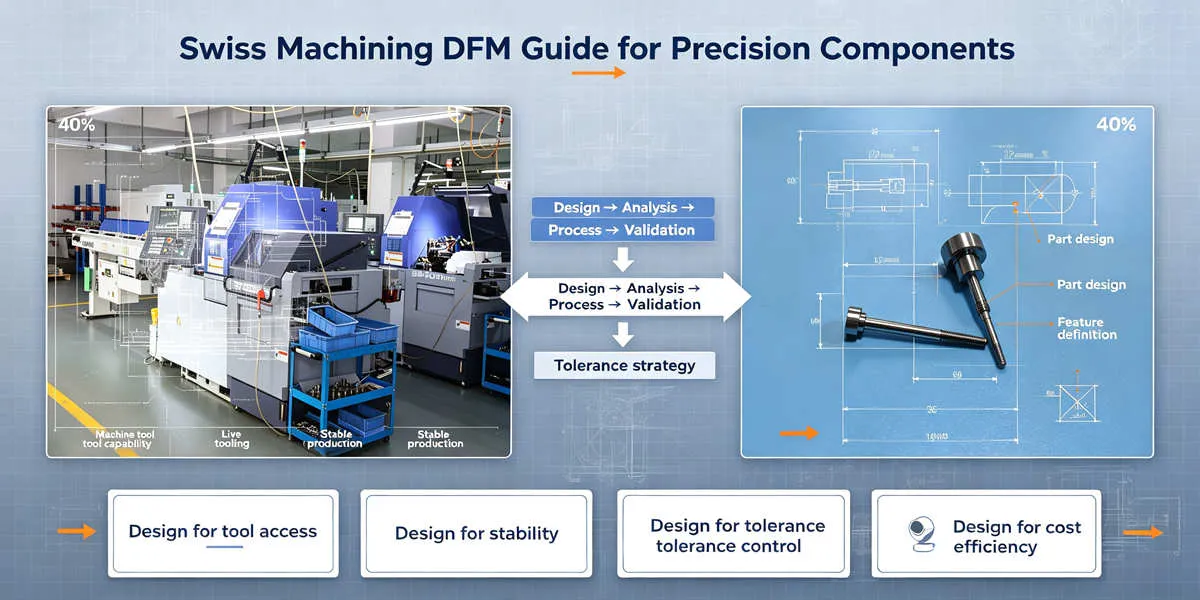
Design for Manufacturability (DFM) refers to the method of improving the design of a part to make it easier to manufacture. In Swiss machining, DFM means identifying the design requirements of the part in accordance with the possibilities and limitations of Swiss CNC machines, tools, materials, and methods of production.
Unlike regular CNC machining, Swiss machining is frequently applied to small, complicated, and precise parts that require a high precision. This requires effective Swiss machining DFM, including part geometry, tolerances, accessibility of features, behavior of material and sequence of processing.
DFM-oriented design assists engineers in foreseeing possible manufacturing problems at an early stage. This includes instances such as overly tight tolerances, complex features that may be difficult to machine, too much tool wear, or fragile thin-walled components. Through effective addressing of these points in the design phase, manufacturing can be simplified and the processing results of a product can become more consistent and successful.
In terms of high-precision components, DFM is not about hindering any creative endeavors in design. Rather, it represents an approach to creating engineering designs that provide required performance characteristics, yet are made with Swiss CNC technology in mind.
From the early stages of the design process, the application of design for manufacture principles allows engineers to generate highly accurate components that are simple to manufacture. In the case of Swiss machining, proper manufacturing techniques are necessary because this form of machining is usually chosen for tiny but complicated parts where stability directly influences quality and production efficiency.
By effective Swiss machining best practices, manufacturers can enhance their tool selection, sequencing, and cutting parameters before the actual production process takes place. In fact, well-designed products are important as they allow minimizing the number of unnecessary operations and limiting tool wear.
DFM also plays an important role in controlling Swiss machining cost factors. Such aspects like strict tolerances, hard to work with geometries, unnecessary surface finishes, and complicated secondary processes affect the length of machining operations as well as the costs of production.
When engineers analyze a design from a manufacturing point of view, they can attain the needed balance between functionality and manufacturing capabilities. As a result, precision becomes guaranteed; production cycles are cut; and Swiss CNC manufacturing becomes affordable.
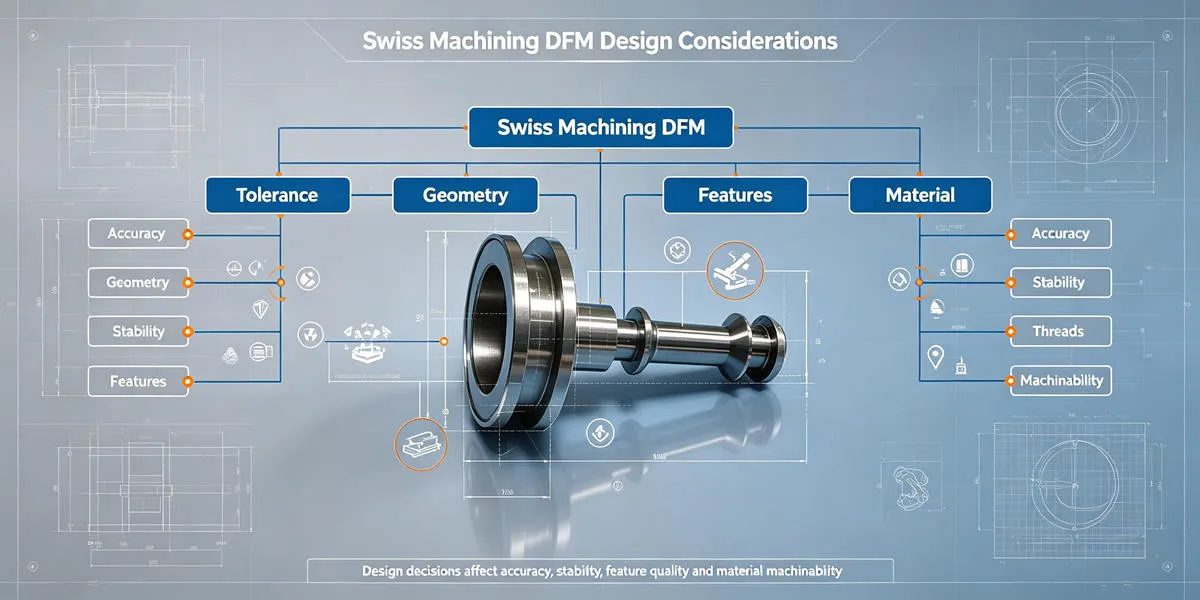
Effective Swiss machining design guidelines start with knowledge of how the part design requirements will function in the machining process. Although Swiss CNC machines can fabricate complex and precise components, they will operate at their best if the design has already incorporated considerations regarding manufacturing.
When developing precision components for Swiss machining, engineers should evaluate several key design factors:
| Design Factor | DFM Consideration |
| Tolerance Requirements | Apply tight tolerances only to critical functional areas to avoid unnecessary machining difficulty and cost. |
| Part Geometry | Create features that allow efficient tool access and stable cutting conditions. |
| Feature Size | Consider available tooling capabilities when designing holes, grooves, slots, and other small features. |
| Material Selection | Choose materials that balance performance requirements with machinability. |
| Surface Finish | Specify finishes based on functional needs rather than applying unnecessary requirements. |
Implementing the Swiss machining design rules aids in avoiding various problems of production, including excess wear of tools, component deformation, failure to maintain stable machining conditions, and longer time to produce parts.
In the case of small and complex details, a small mistake in design may lead to very serious issues in production. For instance, reducing unnecessary and too tight tolerances and making the features easier to machine could enhance reliability of the process.
As such, a useful tight Swiss machining part design guide should aim at balancing the required level of precision with the limitations imposed by real-world manufacturing capacity. Taking these factors into account from the beginning will help design more satisfactory components and achieve high consistency and efficiency in Swiss CNC machining.
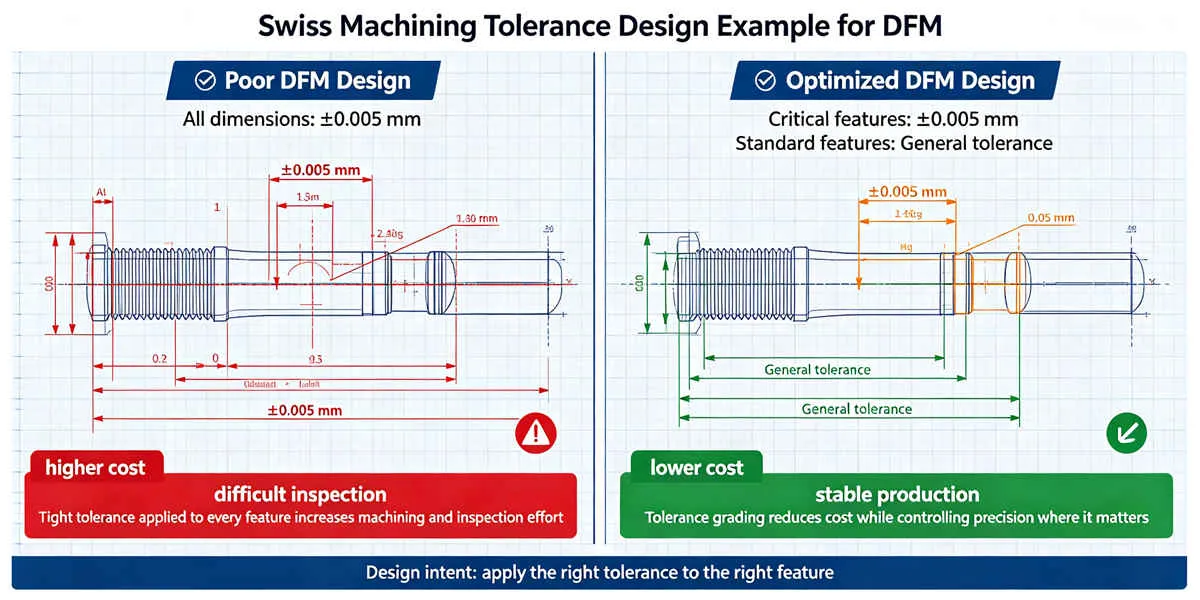
The choice of tolerance is among the key factors to be considered for Swiss machining design rules. Even though Swiss CNC machining technology is capable of producing very precise pieces of work, stating the tightest tolerance on each and every dimension may not be the best approach in design.
The definition of tolerances should depend on the functional needs of each feature. For example, some critical places like mating surfaces, sealing points, bearing surfaces and aligning features require tighter tolerances, while some other non-critical sizes can rely on a standard machining tolerance.
Excessively tight tolerances are troublesome from a manufacturing standpoint in that they necessitate more process control, slower machining, special inspection techniques, or extra finishing operations. All of these can lead to greater expense and time required to manufacture the component while providing no improvement in the actual functioning of the item.
One practical method of managing Swiss machining tolerances is to distinguish between functional dimensions and reference ones and to make properly known critical features on engineering drawings. As a result, the manufacturers can optimize machining processes while retaining the required accuracy.
The fact that engineers incorporate tolerance specifications in the design phase enables them to achieve an optimal ratio of the performance of the part and the efficiency of its production.
The geometry of a part greatly influences the efficiency, stability, and manufacturability of Swiss CNC machining operations. When designing a part, sufficient consideration must be given to the features that make Swiss machines suitable while eliminating unnecessary troubles from machining.
In a practical Swiss machining part design guide, engineers should deliberate over the factors like aspect ratio, reachability of tools, and stability of cutting tools right from the design. Utilizing Swiss machining techniques proves to be most optimal for slender and long parts while being of small diameter because of the supportive role of the guide bushing during machining. However, if ratios are very high or features left unsupported, the risk of vibrations and deflections increases significantly.
When creating designs, it is important to take into account the need for certain operations. This means that designers should minimize complexity of a design by eliminating features that require difficult access angles, require multiple tools, or complicate additional operations. Internal corners, grooves, and complicated profiles can be studied based on the equipment and production potential that may be utilized.
By adhering to the Swiss machining design rules, engineers are able to design parts that are easier to machine, while making sure that required precision is reached. By designing parts for manufacturing process, the production company's performance is enhanced.
Many small features are found in Swiss machined parts; however, it is important that each feature is designed in consideration of manufacture. Following appropriate rules for Swiss machining ensures that engineers do not create complexities that are unnecessary, but still make sure that the part works and is made successfully.
When designing holes, threads, and other precision features, consider the following DFM factors:
1. Design Holes Based on Tooling Capability
Select hole sizes that match standard drilling and tooling options whenever possible.
Avoid extremely small or deep holes that require specialized tools or slower machining conditions.
Consider the depth-to-diameter ratio to reduce tool deflection and improve hole accuracy.
2. Optimize Thread Requirements
Use standard thread sizes whenever possible to improve tooling availability and process stability.
Avoid unnecessarily fine threads or excessive thread depth unless required by the application.
Consider thread location and accessibility to ensure reliable machining and inspection.
3. Consider Feature Size Limitations
Evaluate small grooves, slots, undercuts, and narrow profiles based on available tooling.
Avoid features that require multiple setups or complex tool paths without functional benefits.
Maintain sufficient space between features to allow proper tool access and stable cutting conditions.
When engineers adhere to realistic Swiss machining hole size guidelines, thread design guidelines, and factors related to feature size, they can make precise parts that are simpler to manufacture, have more predictable quality, and be produced at a lower cost.
Switzerland is known for made parts that have thin walls and slender shapes, especially with small parts. However, low wall thickness means that component rigidity is lower and vibrations are higher and that one has to experience some challenges while machining or inspecting the parts.
When designing components for Swiss machining, engineers should consider the following DFM factors:
1. Maintain Sufficient Wall Thickness
Avoid excessively thin walls that may deform under cutting forces or clamping pressure.
Ensure enough material support around holes, grooves, and internal features.
Balance weight reduction requirements with structural stability.
2. Consider Part Rigidity and Deflection
Long, small-diameter parts require careful consideration of length-to-diameter ratios.
Minimize unsupported sections that may cause vibration or tool deflection.
Use stable geometries that allow consistent cutting conditions.
3. Optimize Thin Features for Manufacturing
Avoid fragile edges or narrow sections that are difficult to machine reliably.
Consider material characteristics, as softer materials may deform more easily during machining.
Review critical thin-wall features with the manufacturer before production.
Following proper Swiss machining minimum wall thickness considerations helps improve process stability, reduce manufacturing risks, and ensure consistent quality for Swiss machining small diameter parts.
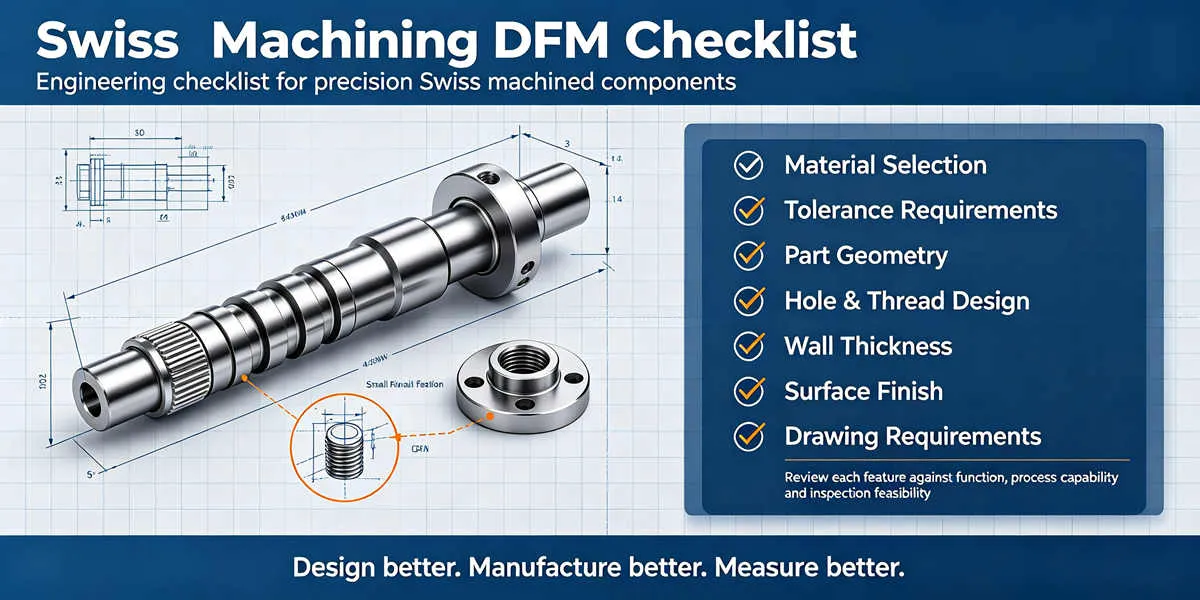
Prior to launching a precision part into production, it is important for engineers to consider important design factors that indicate that the component is suitable for Swiss CNC production. Using a Swiss machining DFM checklist allows for the identification of potential problems before they arise, resulting in a reduction of any changes in the design, costs, and production uncertainties.
When preparing drawings or CAD models for Swiss machined components, consider the following design review points:
| Design Review Item | DFM Consideration |
| Material Selection | Confirm that the selected material provides the required performance while maintaining good machinability and process stability. |
| Tolerance Requirements | Specify tight tolerances only for functional features that require precise control. |
| Part Geometry | Ensure the design supports stable machining, proper tool access, and efficient material removal. |
| Hole and Thread Features | Review hole sizes, depths, and thread specifications based on realistic tooling capabilities. |
| Wall Thickness | Maintain sufficient material thickness to prevent deformation and vibration during machining. |
| Surface Finish | Define surface requirements based on part function and avoid unnecessary finishing operations. |
| Drawing Details | Provide complete dimensions, tolerances, material specifications, and critical feature requirements. |
Adhering to the Swiss machining design review checklist helps engineering and manufacturing teams understand how to bring about improvements in manufacturability before production starts. Successful cooperation between the design team and the machining partner will create a final product that meets all performance specifications.
For engineers who are developing highly sophisticated precision pieces, it is important to be aware of how design affects manufacturability. A good DFM plan ensures that the Swiss machined product will be manufactured efficiently and with high quality.
The choice of material has a great impact on machining stability, tool operation, surface quality, and the overall productivity itself. In designing precision components for Swiss machining, it is important to consider not only the functional characteristics of the part but also the behavior of the material during the manufacturing processes.
Key material selection considerations include:
1. Balance Performance and Machinability
Select materials that meet mechanical, thermal, or corrosion-resistance requirements while maintaining reasonable machinability.
Avoid choosing difficult-to-machine materials unless their performance advantages are necessary for the application.
2. Consider Material Behavior During Machining
Evaluate factors such as material hardness, work hardening tendency, chip formation, and thermal characteristics.
Some materials may require specialized tooling or optimized cutting parameters.
3. Match Material Choice to Production Requirements
For high-volume Swiss machining, materials with consistent properties and reliable machinability can improve process stability.
Material availability and supply consistency should also be considered during design planning.
Choosing the right material is an important part of Swiss machining material selection, helping engineers achieve the required component performance while maintaining efficient and reliable manufacturing.
The surface finish requirements should be established according to the true functional requirements of the part, not be set as a general quality requirement. In Swiss machining, unnecessary surface finish requirements may lengthen machining time, require inspection, and increase secondary processing costs.
When specifying surface requirements, engineers should consider:
1. Define Functional Surface Requirements
Identify surfaces that require specific roughness values due to sealing, sliding, electrical contact, or assembly requirements.
Avoid applying tight surface finish specifications to non-critical areas.
2. Consider the Manufacturing Process
Evaluate whether the required finish can be achieved directly through Swiss machining or requires additional operations.
Consider how material type, tooling, and cutting conditions influence achievable surface quality.
3. Minimize Unnecessary Secondary Operations
Additional processes such as polishing, grinding, or coating should only be specified when they provide functional benefits.
Clear drawings and finish requirements help manufacturers select the most efficient production approach.
By applying practical Swiss machining surface finish requirements, engineers can maintain component performance while improving manufacturability and controlling production complexity.
Best DFM practices contribute not just to manufacturability enhancement, but also help keep all production costs under control. Some design approaches involving Swiss machining can affect cycle time, tools utilized for production, inspection of parts produced and overall production efficiency.
Common design factors that may increase Swiss machining cost factors include:
1. Excessive Tight Tolerances
Applying tight tolerances to non-critical dimensions increases process control requirements.
Additional inspections and slower machining conditions may be required.
2. Complex or Difficult-to-Machine Features
Small grooves, deep holes, unusual threads, or difficult-access features may require specialized tooling.
Complex geometries can increase programming time and machining operations.
3. Unnecessary Secondary Operations
Additional grinding, polishing, coating, or finishing processes can increase production time.
Functional requirements should be clearly defined to avoid unnecessary processing.
4. Challenging Material Selection
Difficult-to-machine materials may require specialized tools, lower cutting speeds, or additional process optimization.
To reduce Swiss machining costs, engineers need to find design simplifications, utilize reasonable tolerances, and take manufacturing requirements into account as early as possible during the product development process.
An experienced Swiss machining services provider can be helpful during the design review process since this is the most critical stage to identify your chances of improving part manufacturability without impacting performance.
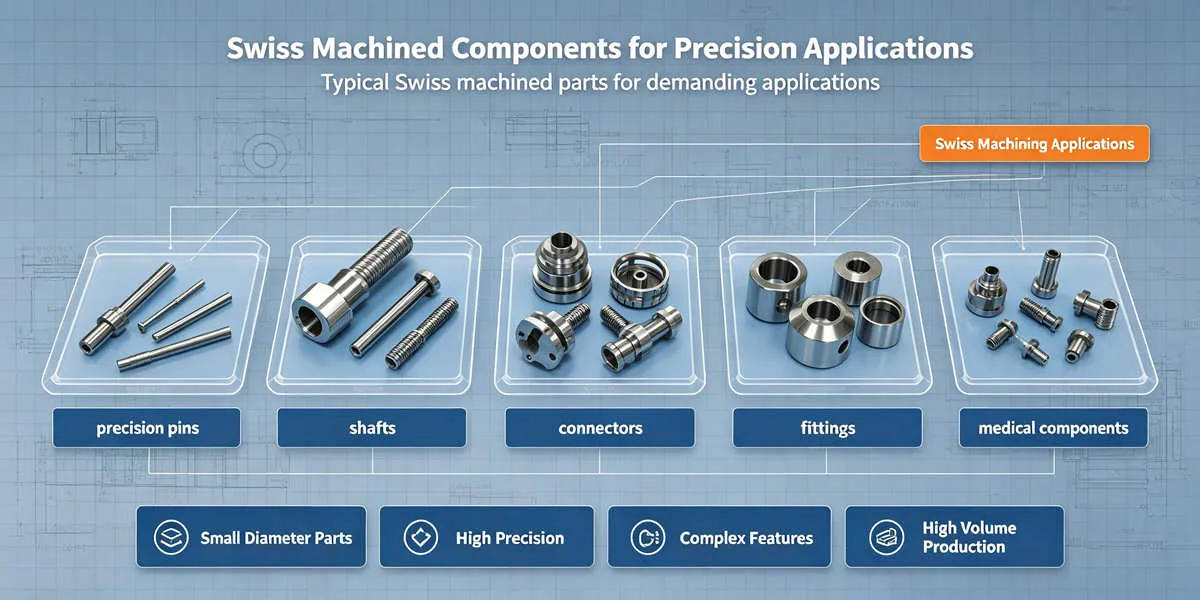
The application of Swiss machining is only applicable for certain CNC machined parts if there is a need for them. This method works best when part characteristics call for a combination of size, precision, complicated features, and consistent processing capabilities.
Engineers should consider Swiss machining when a component has the following characteristics:
1. Small Diameter and High-Precision Requirements
Ideal for slender, miniature, and precision components that require excellent dimensional control.
Commonly used for shafts, pins, connectors, fittings, and other small critical parts.
2. Complex Turning and Milling Features
Suitable for components requiring multiple operations such as turning, drilling, threading, and live-tool milling in a single setup.
Helps reduce handling and improve process consistency.
3. Medium to High Production Volumes
Swiss machining is particularly effective when repeatability and production efficiency are important.
Stable processes help maintain consistent quality across larger production quantities.
4. Tight Quality and Reliability Requirements
Suitable for industries requiring reliable precision, including medical, electronics, automotive, and aerospace applications.
Grasping when to use Swiss machining helps the engineer choose the most appropriate manufacturing process at the design stage. When dealing with complex Swiss machined parts, effective DFM planning is necessary to make full use of Swiss machining and optimize production costs at the same time.
Swiss machining's design for manufacturability (DFM) is optimizing a component's design to enhance manufacturability as well as production efficiency and cost control. It examines considerations relating to component geometry, tolerances, materials, features required for manufacturing, and machining capabilities prior to manufacturing.
Engineer should make sure to consider practical tolerances, stable part geometry, accessible features, and proper materials as well as realistic requirements for surface finish while designing components for Swiss machining. Keeping design specs simple while avoiding excessive complexity leads to more reliable production and fewer issues in manufacturing.
Swiss machining tolerance specifications should depend on the functional characteristics of each element. Key parameters of the product, including mating surfaces, alignment features, and sealing points, may need tighter tolerances than the elements whose dimensions are determined by the standard tolerances.
DFM lowers Swiss machining expenses by detecting possible production problems prior to starting up the process. Fine-tuning tolerances, eliminating complicated features, picking the right materials, and decreasing unnecessary secondary operations allow for minimizing the machining cycle time, requirements for tooling, and for inspection costs.
Swiss machining is frequently used to produce small and intricate components such as pins, shafts, connectors, fittings, medical components, and electronic parts that require high precision. When properly planned using DFM, the process of producing these Swiss machined components becomes reliable and effective.