English
  日本語
日本語  한국어
한국어  français
  Deutsch
  Español
  русский
  العربية

May
Learn More
10

Client: Global Spinal Implant Manufacturer (Spinal Fixation Division)
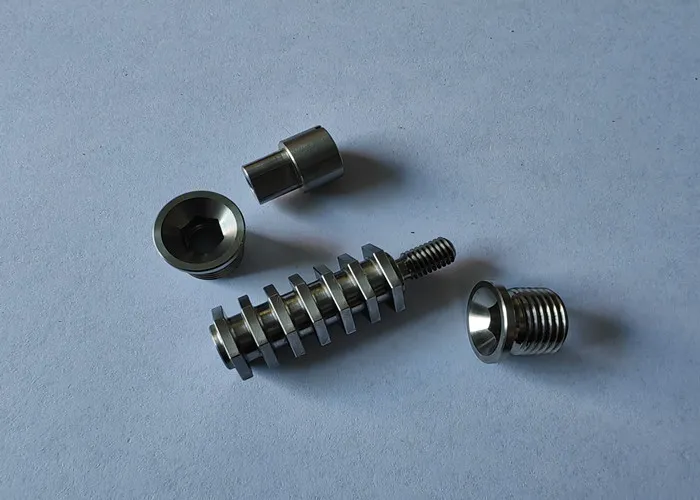
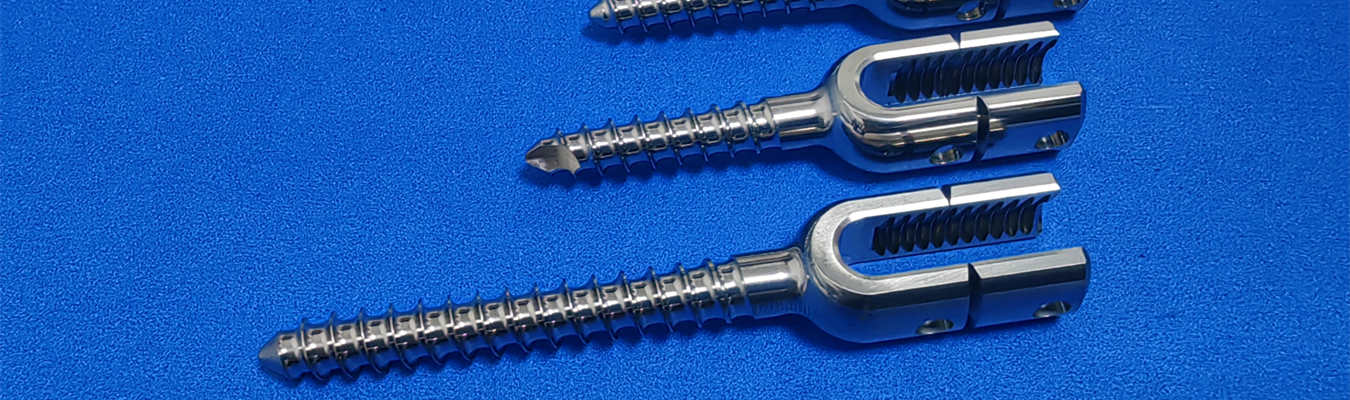
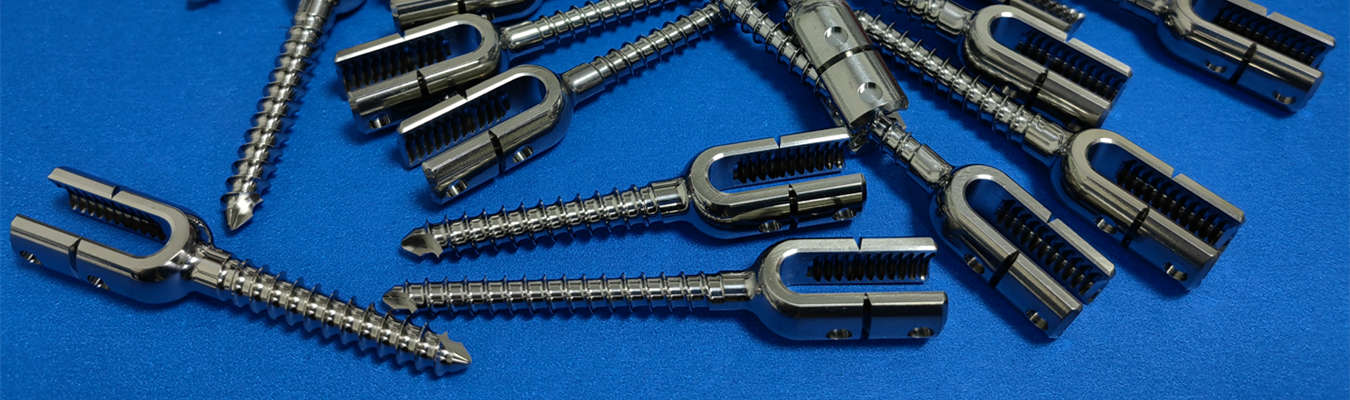
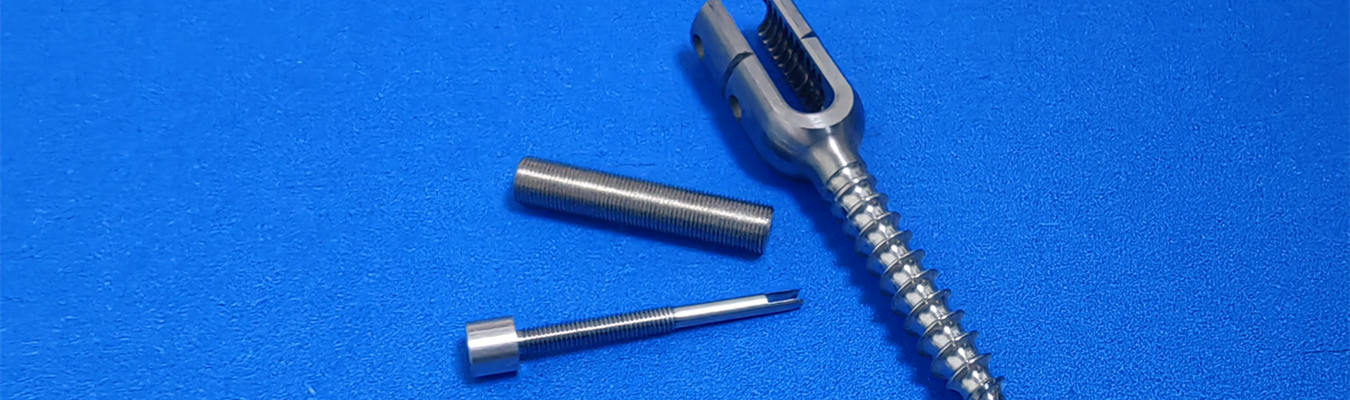
Component: Titanium Bone Screws - Self-tapping, with U-slot for pedicle screw connection
Challenge: Manufacture titanium screws that have a tolerance of ±0.005mm on the U-slot interface, Ra ≤ 0.4μm polished surface, no burrs on the self-tapping threads, pass ASTM F136 and provide full lot traceability based on ISO 13485.
Solution: 5-axis CNC Swiss machining, Medical polishing and passivation, 100% verification of critical dimensions with lot traceability.
Result: 99.8% first pass yield, CpK of ≥1.67 on all critical features, no field complaints, and provided support for the successful 510(k) clearance of the customers new spinal fixation system.
A leading bone screws manufacturer was seeking an ultra-precise partner to manufacture their next-generation pedicle screw connector component used in complex spinal fusion surgeries. This titanium spinal implant piece features a self-tapping (tap) thread for vertebral (spinal) anchoring and a U-shaped rod slot where the rod and the threaded portion will connect. The spinal fixation hardware must have the ability to endure cyclic loads in excess of 1 million cycles before experiencing loosening or fatigue failure.
Prior to engaging the services of a screw machining supplier for their titanium bone implants, the customer had issues with inconsistent U-slot geometry (variation of up to +/− 0.02 mm) and residues remaining after cleaning. These issues would result in increased costs to the customer by having to rework the surgical screws manufactured from previously supplied connectors. The customer required a supplier to manufacture orthopaedic implants connectors with high tolerances, a medical-grade surface finish and full traceability of all stages of the manufacturing process; from sourcing raw materials through to finished titanium surgical implant products.
Beginning with an error in the first sentence (the ISO 13485 certification on medical devices is not located in the ISO 13485 standard), we provided a response based upon the requirements of the ISO 13485 to manufacture and provide Machined Medical Device components through Distributor. The Project transitioned from Prototypes to Low Volume to Large Volume Production (10x the size).
| Parameter | Value | Remarks |
|---|---|---|
| Product Category | Titanium Medical Screws | Spinal fixation implant component |
| Part Name | Spinal Fixation Implant Component | Pedicle screw with U‑slot rod interface |
| Material | Ti‑6Al‑4V ELI Titanium | ASTM F136, biocompatible |
| Manufacturing Technology | CNC Swiss Machining | Multi‑axis, live tooling |
| Precision Level | High Precision Medical Machining | ±0.005 mm on critical features |
| Tolerance | ±0.005 mm | U‑slot width, rod channel diameter |
| Surface Treatment | Medical Polishing and Passivation | Ra ≤ 0.4 μm, removes surface contaminants |
| Implant Standard | ASTM F136 | ELI grade for surgical implants |
| Medical Certification Support | ISO 13485 | Full quality management system |
| Critical Feature | U‑Slot Rod Interface | ±0.005 mm, 0.8 μm surface finish |
| Thread Type | Self‑Tapping Bone Thread | Dual lead, variable pitch for bone purchase |
| Application | Orthopedic Implant Systems | Spinal fusion, deformity correction |
| Industry | Medical Devices | Class II/III implantable devices |
| Production Capability | Low to High Volume | 1,000 – 50,000+ pcs/year scalable |
| Inspection Method | 100% Critical Dimension Verification | Vision + CMM + optical comparator |
| Traceability | Full Lot Traceability | Raw material to finished screw |
Upload your drawings and receive a competitive quote within 24 hours.
Request a Quote → Get expert guidance on machining processes, materials, and surface finishes.
When developing a new posterior spinal fixation system, the customer faced four critical challenges with their existing screw bone supply chain:
Variation in U-Slot Dimensions: Prior vendors could not maintain a dimension of ±0.01mm, much less ±0.005mm. The U-Slot that captures the spinal rod varied widths which caused rod slip, or excessive torque were the rod was locked in place.
Self-Tapping Thread Burrs: Conventional CNC turning of bone titanium self-tapping thread flanks generated micro-burrs, which could abrade bone tissue or loose the bone screw.
Surface Contamination: Residual cutting fluid and oxides on the surface after basic cleaning exposed provision of inflammation in vivo, which violates the ASTM F-136 surface requirement for the titanium rod.
No Traceability: The FDA required customer traceability to the material from which the bone screw is made through to the finished titanium screw in bone; their last vendor could only provide the batch level traceability.
The customer asked for proof of bone screw material, mechanical characteristics and compatibility with human tissue before performing their procurement process. They were looking for a collaborator familiar with materials science and regulatory requirements; ultimately, they wanted to find a trusted manufacturer of surgical bone screws to support a 510(k) submission while maintaining consistently-priced contracts for five years. Learn more about our custom bolt and nuts manufacturing.
Titanium (Ti-6Al-4V ELI) bar stock (ASTM F136) - 10 years of mill certificates on materials by lot
CNC Swiss machining (Citizen)
Guide bushing support to hold long slender screw blanks
Main spindle - rough and finished turning of outside diameters and thread whirling of dual-lead variable pitch thread (bone threads) self-tapping threads.
Live tooling - milling of U-slot on rod interface with custom made PCD end mills to ± 0.005 mm.
Backworking - deburring and chamfering can be carried out using a sub spindle for threading.
Medical polishing - centrifugal barrel finishing with ceramic media to remove micro-burrs and provide a surface finish with Ra ≤ 0.8 µm.
Passivation - nitric acid passivation of the surface of the part will remove free iron and contaminates per ASTM F86.
Final cleaning - parts will be cleaned in an ultrasonic cleaning system using a medical grade detergent and DI water and dried in a Class 7 cleanroom.
100% Inspection - inspection will be done using a vision system to check for U-slot width, thread presence and length. Use of CMM will verify complete geometry for samples, and use of an optical comparator will verify thread profile.
Packaging for lot traceability - each screw will be individually laser marked with a lot code. Each package will be labelled with the material certification, date of passivation, and expiration date.
Learn more about our advanced CNC Swiss machining service.
| Challenge | Root Cause | Solution Implemented |
|---|---|---|
| U-slot width out of tolerance | Tool deflection at entry/exit of slot | Custom PCD slotting tool + helical ramping; reduced feed at corners |
| Thread burrs (self-tapping tip) | Work hardening of Ti-6Al-4V during thread whirling | Optimized thread whirling with sharp inserts + post‑polishing with ceramic media |
| Surface roughness >0.4 μm | Built‑up edge on conventional carbide tools | Switched to polycrystalline diamond (PCD) finishing tools + high‑pressure coolant |
| Lot traceability gaps | Manual record keeping | Implemented barcode scanning at each station; full ERP lot tracking |
| Cost control for low volume | High setup time for orthopedic runs | Modular tooling families – changeover < 30 minutes; lower bone screw price |
ISO 13485 Quality System requires 100% critical dimension verification (titanium surgical screws).
Spinal fixation hardware lots are controlled with
During production process: CNC probes verify U-SLOT depth and thread start position every fifth part.
At the end of production (100%): Automated vision (keyence LM) measures a U-SLOT WID (-0.005 mm), LENG, HEAD DIA. AND THRD CREST condition. Any dims exceeding 80% of tolerance results in rejection.
Periodically (1st and last piece + every 50 pcs): CMM (Zeiss CMM) for full GD&T including slot position, perpendicularity, and thd pitch diameter.
Abrasion verification: profilemetre (mitutoyo) R ≤ 4 μm on contacting from shaft rods.
Thread gage: Go/No Go For Bone SCREWS (custom gages made per our customer prints).
Microscopic inspection: 10% sample selected @ 50X magnification for remaining burr or scratch from manufacture.
Material Traceability: PMI XRF (X-RAY fluorescence) first piece from each lot to verity that the material is Ti 6Al-4V ELI.
Inspection results linked to lot number and uploaded to customer portal to assist in regulatory submission to manufacture bone screws; additionally answer audit question providing unbiased evidence identifying all components used in a bone screw an objective manner.
| Metric | Target | Achieved |
|---|---|---|
| First‑pass yield | ≥95% | 99.8% (over 25,000 parts delivered) |
| U‑slot width CpK | ≥1.33 | 1.67 |
| Surface roughness (Ra) | ≤0.4 μm | 0.28 – 0.35 μm |
| Lot traceability completeness | 100% | 100% (full from mill to shipping) |
| Customer reject rate (12 months) | ≤100 ppm | 0 ppm |
| Lead time (prototype to PPAP) | 16 weeks | 11 weeks |
| Cost per screw (compared to previous supplier) | – | -22% at same volume |
Our customer has received FDA-510(k) clearance four (4) months ahead of schedule due to the prime quality data package we supplied them for their spinal fixation system. They now have awarded us the production for three (3) more pedicle screw connector components and orthopedic implant connectors.
This manufacturing platform applies broadly to titanium surgical implant parts and medical device machined components:
Spinal fixation hardware: pedicle screws, hooks, rods, cross connectors
Titanium bone screws for trauma (locking plates, intramedullary nails)
Screws for bones in joint reconstruction (hip, knee, shoulder)
Titanium screw for bone – dental implants and craniomaxillofacial fixation
Surgical bone screws for foot and ankle, hand and wrist procedures
Titanium spinal implant components for minimally invasive surgery (MIS)
Orthopedic implant connectors for external fixation frames
Bone titanium fasteners for robotic surgical instruments
Our processes are equally suitable for screws for bones used in veterinary orthopedics and custom patient‑matched implants.
Check more detail about our surgical and diagnostic manufacturing service.
As a specialist in medical device machined components, we offer end‑to‑end solutions for titanium medical screws and other implantable hardware:
CNC Swiss machining of Ti, 316L stainless, PEEK, and other implantable materials
Titanium spinal implant components – custom geometries, U‑slots, cannulated screws
Pedicle screw connector components – tulip heads, set screws, reduction screws
Spinal fixation hardware – rods, plates, hooks, crosslinks
Orthopedic implant connectors – modular junctions, taper connections
Titanium surgical implant parts – bone plates, interference screws, suture anchors
Bone screws manufacturers support – private label, contract manufacturing
Post‑processing: medical polishing, passivation, anodizing, cleaning (Class 7 cleanroom)
Quality and regulatory: ISO 13485, FDA registered, full lot traceability, 100% inspection
Cost management: scalable volumes to optimize bone screw price and titanium bone screw price without compromising quality
No matter if you require a few hundred prototypes or companies to keep product costs low, in our case hundreds of thousands of surgical screws, we offer an end-to-end solution and gentle help. Our engineering team can answer the question of what bone screws are made of so that the overall surgical screws cost can be brought down through the optimization of design-for-manufacturing (DFM). Explore our precision titanium machining capabilities.
Ready to source reliable titanium surgical screws or other spinal fixation hardware for your orthopedic implant system?
Send your CAD model (STEP) and 2D drawing with critical tolerances – we will respond within 24 hours with:
DFM analysis for U‑slot, thread, and thin‑wall sections
Prototype pricing and lead time (50‑500 pcs in 2‑3 weeks)
Volume pricing for low‑to‑high volumes (1,000 – 100,000 pcs/year)
Sample first‑article inspection report (free)
Quality and regulatory package (ISO 13485, ASTM F136 traceability)