English
  日本語
日本語  한국어
한국어  français
  Deutsch
  Español
  русский
  العربية

Aug
Learn More
11

CNC Swiss machining is a unique type of precision machining often used to manufacture small complex, precise components. Unlike conventional CNC machining, Swiss machining allows for parts to be produced with tighter tolerances and improved surface finishes. This makes Swiss machining a good option in industries where precision and reliability are critical.
What Makes CNC Swiss Machining Different?
The primary difference with CNC Swiss machining is the way the material is supported during the machining process. The bar stock is held and rotated in a guide bushing that supports the material close to the cut when conducting CNC Swiss machining. This minimizes deflection and vibration which enables machining of long, slender, and intricate parts with unmatched accuracy.

The CNC Swiss Machining Process
Process Step #1 - Loading Bar Stock - The CNC Swiss machining process begins by loading a long bar of raw material into the CNC Swiss-type lathe.
Process Step #2 - Guide Bush Support - The bar stock is clamped in a guide bushing much like a barfeeder - in proximity to where the cutting tool will expand cutting shape/chip.
Process Step #3 - The bar rotates and moves linearly (axially) through the guide bush bushing as the tools perform different types of operations (turning, milling, drilling, threading, etc).
Process Step #4 - Multiple Tools Working Simultaneously- Swiss machines typically utilize multiple cutting inserts (tooling) that may also work interchangeably or Simultaneously to completely complex features in one set up.
Process Step #5 - Part Separation - After machining is completed, the finished part is separated from the original bar stock.
This allows for high volume production runs of part with highly consistent quality, while minimizing secondary operations to finish piece.

Common Parts Manufactured with CNC Swiss Machining
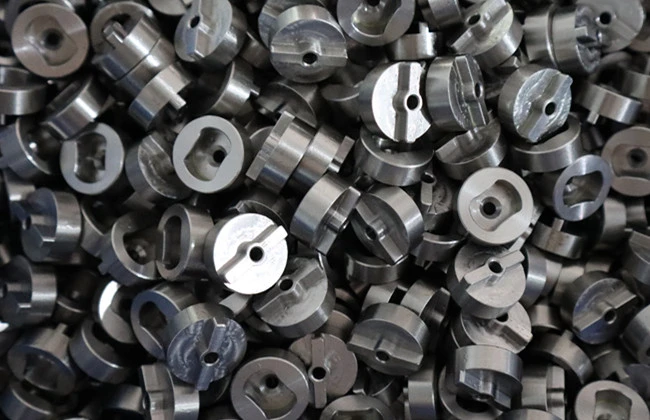
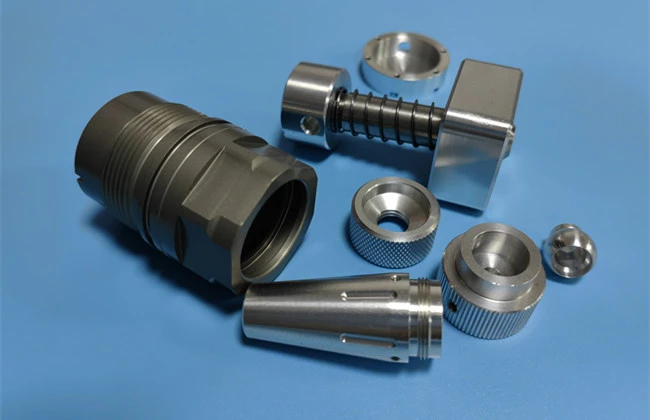
Swiss machining is commonly utilized to manufacture precision parts such as:
Shafts, pins
Screws, bolts, nuts
Connectors & fittings
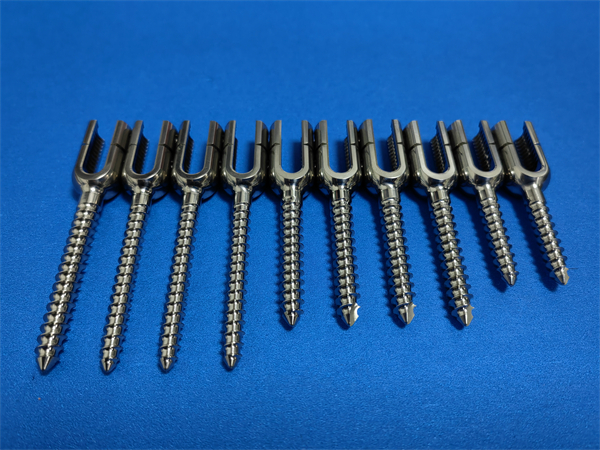
Medical devices
Aerospace fasteners
Electronic components
These parts must show excellent dimensional accuracy, smooth finishes, and tight tolerances, and many of these parts are dimensionally constrained to very small tolerances and must comply with strict ASTM standards. CNC Swiss machining is one method to assure and produce these extremely precise parts.
CNC Swiss Machined Parts Applications
The agility and precision of CNC Swiss machining make it suitable for the following industries:
Medical Devices: Fabricating small, complex surgical instruments and implants, all with biocompatible materials.
Aerospace: Machining lightweight, vibration-resistant components for flight systems.
Electronics: Producing miniaturized connectors and fasteners used in the latest high-tech devices.
Automotive: Delivering precision, machined components for engine and transmission systems.
Industrial Equipment: Fabricating fasteners and shafts that are durable and can withstand high-load applications.
Why Choose Falcon CNC Swiss?
Falcon CNC Swiss specializes in providing precision CNC Swiss machining services and delivering parts that meet the strictest quality standards. Our state-of-the-art Swiss type CNC machines, combined with a team of experienced technicians, allow us to provide quality parts at competitive prices while allowing for rapid turnaround times and enhanced part accuracy.
We also provide complementary services such as precision CNC machining and Swiss machined components to accommodate all of your manufacturing needs.