English
  日本語
日本語  한국어
한국어  français
  Deutsch
  Español
  русский
  العربية
Sep
Learn More
03

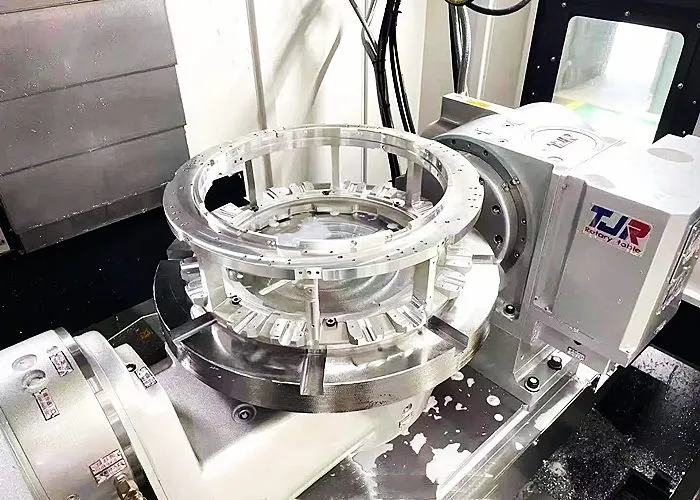
The impeller is the most important part of any turbomachinery system from a fluid dynamic perspective. This deceptively complex component transfers the energy from a motor to a fluid and generates the critical flow, pressure, and vacuum needed in applications ranging from jet engines to medical ventilators. The entire system performance relies upon the associated geometric accuracy, surface finish, and structural performance of the impeller. This challenge is what makes impeller machining one of the most challenging areas of manufacturing, and therefore why the 5-axis machining has become the go to technology.
Moving away from conventional methods or even traditional 3-axis machining is no longer optional to produce high performing impellers. The purpose of this blog is to explain the engineering challenges, business benefits, and market demanded need to take advantage of 5-axis CNC technology for high precision impeller machined parts.
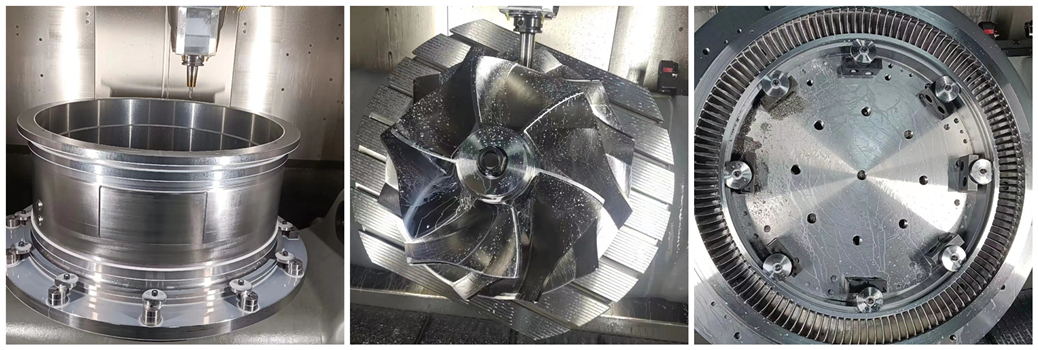
From an engineering perspective, an impeller is an engineers nightmare as it presents inaccessibility and complexity. More particularly, an impeller design is entangled with:
Complex Free-Form Faces: Typically designed with complex, compound curvatures (airfoil) for enhancing fluid flow and minimizing energy loss.
Undercut and Inaccessible Areas: The channels between the blades are long and skinny and often have edge undercuts, all of which are inaccessible from normal tooling on a 3-axis machine.
Thin-Wall: In a lot of cases, blades are leaving it very thin to decrease weight and inertia. This creates vibration and deflection challenges through the machining of the blades.
Extreme Tolerances and Surface Finish: Relatively small deviations of designed geometry or surface finish can start cavitation and turbulence, which diminishes performance and can cause failure.
Conventional machining techniques need many setups and fixtures to capture all angles needed. Each setup introduces potential error leading to misalignment and ultimately stack-up tolerances which can ruin the efficiency or in some cases make them inoperable.
Lastly, a working summary of each of the benefits of 5-axis simultaneous machining provides a solution to these issues. A 5-axis CNC machine machining can move a part in 3 linear axes (X, Y, Z) and in 2 rotational axes (A and B) simultaneously. At that point, CNC machining of complex impellers becomes a completely different experience.
The most significant advantage for precision impeller manufacturing is the ability to process the entire part in one clamping. The machine can uniquely locate the impeller blank at the best angle to maintain perpendicularity from cutting tool to complex blade surface. Utilizing a single setup eliminates the propagating setups and achieves perfect alignment of the hub, blades, and shroud if present - and this is the key to precision impeller machining.
The use of rotational axes allows the machine to tilt the part so you can bring in a shorter cutting tool to get down in the narrow, deep passage(s) between the blades. The use of a shorter tool results in dramatically improved stiffness and therefore eliminates vibration (chatter). This is very important for:
Machining the thin walled impeller blades without bending them and maintaining dimensional fit.
Producing higher quality surface finish on the blades profiles which is important for hydrodynamic and aerodynamic efficiency.
Complex 5-axis contouring allows the tool to have constant chip load and best cutting conditions thus prolonging tool life with consistent results for the entire run.
Whether it’s a turbomachinery impeller for a rocket engine made out of a heat resistant superalloy like Inconel, a compressor wheel for an automotive turbocharger made out of high strength aluminum, or a medical device impeller made out of biocompatible titanium, 5-axis CNC can do it all. The same machine that does the roughing operations with violent cutting of materials can also perform the fine and delicate finishing passes, allowing incredible flexibility for customized impeller fabrication.
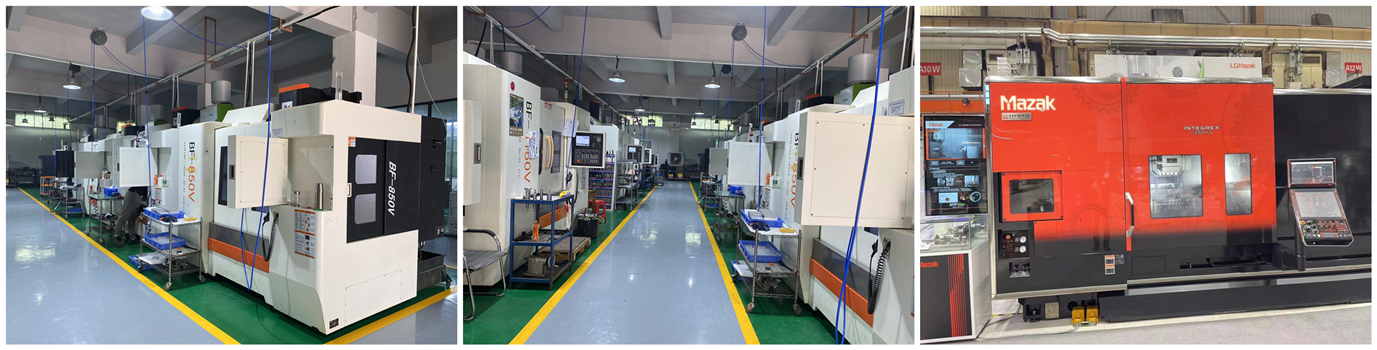
Investing in 5-axis impeller machining is not just an engineering choice, it can become a business decision.
Reduced Total Cost of Ownership (TCO): A 5-axis machine has a higher acquisition price, but it can reduce labor costs (less setups), scrap costs (better accuracy), and secondary processing (often “done-in-one” methods). These factors greatly reduce the part cost in very high volume precision manufacturing.
Reduced Time-to-Market: 5-axis machining can reduce production lead times, thanks to single-setup capability. This undercover benefit can actually allow companies to develop and sample designs quicker, and ultimately bring products to market faster—more importantly in the automotive and aerospace markets.
Enabling New Designs: 5-axis machining opens new possibilities for engineers to design impellers with complex, high-efficiency geometries that were once thought impossible or could only be made with high costs. This results in product innovation for a competitive advantage.
Supply Chain Simplification and Certainty: By using a manufacturer that specializes in CNC impellers, you benefit from having a dependable source of critical parts. This reduces complexity in your supply chain and decreases your risks. Not to mention, the high quality and on-time delivery of parts.
There are several high-risk industries that use manufactured high-performance machined impellers for high performance applications.
Aerospace & Defense: This industry uses turbomachinery components as components for jet engines, auxiliary power units (APUs), environmental control systems etc. Aerospace impellers have to operate in high stress and temperature environments, thus requiring perfect manufacturing tolerances from exotic materials.
Automotive & Motorsports: Impellers are used for turbocharger compressor wheels that enhance engine performance and also as coolant pumps in electric vehicles. These impellers have to perform under high speed and thus require high-speed impeller machining to maintain balance and longevity.
Medical & Life Sciences: Impellers are used for ventilators, dialysis machines, and blood pumps. These medical devices require precisely machined impellers from biocompatible materials, require very good surface finishes to minimize the growth of bacteria, and best of all—require functions that happen every time without fail.
systems in oil & gas, chemical process and HVAC applications are made strong, made efficiently, made to last, and made to create a more secure path for impeller manufacturing.
Not every machine shop is outfitted to effectively execute plans to machine an impeller. A few points to consider in selecting your manufacturer.
Advanced 5-axis Machining Capability: Proven track record producing complex free-form shapes.
Engineering Experience: Engineers with fluid dynamics knowledge is critical to provide design for manufacturability (DFM) input and guidance to enable your impeller design to be performance and manufacturability optimized.
Formal Quality Control: Without in-process inspection and full-featured measurement equipment (CMMs), it will be challenging to verify that every critical dimnesion on your precision machined blades and rotors is actually precise.
The development of 5-axis CNC technology enabled the evolution of impellers from simple paddle wheel types to highly sophisticated airfoil components. The transition of 5-axis impeller machining from an area of expertise to the norm for producing the high-value, reliable components expected from today’s technology is quite unique. This is the only process able to turn lofty engineering design aspirations into commercial manufacturing reality.
Are you designing the latest and greatest turbine technology? Call Falcon CNC Swiss to see how our 5-axis precision machining process can animate existing and future impeller and rotor products with precision and speed. Get your quote today and see the benefit expertise makes.