English
  日本語
日本語  한국어
한국어  français
  Deutsch
  Español
  русский
  العربية


Oct
Learn More
02

Aluminum CNC machining is one of the most widely used manufacturing processes for producing lightweight, durable, and high-precision components across industries such as aerospace, automotive, electronics, medical equipment, and industrial automation. Due to its excellent machinability, corrosion resistance, strength-to-weight ratio, and versatility, aluminum has become a preferred material for precision CNC machining applications.
From prototypes to high-volume production, manufacturers use CNC milling, CNC turning, and advanced machining technologies to produce custom aluminum parts with tight tolerances and complex geometries. Different aluminum alloys, including 6061, 7075, 2024, and 5052, provide different combinations of strength, machinability, corrosion resistance, and performance requirements for various applications.
Choosing the right aluminum alloy, machining process, tolerance level, and surface finish is essential for achieving reliable performance and cost-effective production. A professional aluminum CNC machining service should provide complete manufacturing capabilities, including material selection, CNC programming, precision machining, surface treatment, and quality inspection.
At Falcon CNC Swiss, we specialize in manufacturing CNC aluminum parts for industrial applications using advanced CNC milling, CNC turning, and Swiss machining technologies. With precision manufacturing capabilities and experience working with multiple aluminum alloys, we support customers from prototype development to full-scale production.
This comprehensive aluminum CNC machining guide explains the complete manufacturing process, common aluminum alloys, machining capabilities, tolerances, surface finishes, design considerations, applications, and key factors to consider when selecting an aluminum machining partner.
Aluminum CNC machining is a precision manufacturing process that uses computer-controlled machines to remove material from aluminum blocks, bars, or other raw stock to create accurate and complex components. By following digital CAD/CAM designs, CNC machines can produce CNC aluminum parts with consistent dimensions, tight tolerances, and excellent surface quality for a wide range of industrial applications.
Unlike traditional manual machining methods, CNC machining aluminum uses programmed tool movements to control cutting operations automatically. This allows manufacturers to achieve higher repeatability, improved efficiency, and better dimensional accuracy, especially for components with complex geometries or strict engineering requirements.
The aluminum CNC machining process typically begins with a 3D CAD model or technical drawing provided by the customer. Engineers then select the appropriate aluminum alloy, machining strategy, cutting tools, and production parameters based on the part design and performance requirements. The CNC machine removes unwanted material through controlled cutting operations until the final component reaches the required shape and specifications.
Common aluminum machining processes include:
CNC milling: A machining process that uses rotating cutting tools to remove material and create complex shapes, pockets, slots, holes, and precision surfaces. Aluminum milling is widely used for housings, brackets, structural components, and industrial parts.
CNC turning: A process where the aluminum workpiece rotates while cutting tools remove material to produce cylindrical components such as shafts, bushings, pins, and fittings. Aluminum turning is suitable for producing accurate round parts with efficient production cycles.
5-axis CNC machining: Advanced machining technology that allows cutting tools to move along multiple axes simultaneously, enabling the production of complex aluminum components with fewer setups and improved accuracy.
Swiss CNC machining: A specialized precision machining process designed for small, complex, and high-volume components. It is commonly used for producing aluminum precision parts with tight tolerances, including connectors, medical components, and miniature mechanical parts.
The advantages of aluminum CNC machining come from both the properties of aluminum and the flexibility of CNC manufacturing. Aluminum offers excellent machinability, allowing faster cutting speeds and efficient production compared with many harder metals. At the same time, CNC technology provides manufacturers with the ability to maintain consistent quality across prototypes, small batches, and large-scale production.
For companies requiring lightweight, strong, and precisely manufactured components, professional aluminum CNC machining services provide a reliable solution from material selection and prototype development to final production and inspection. Falcon CNC Swiss combines advanced CNC milling, turning, and Swiss machining capabilities to manufacture precision aluminum components for demanding industries worldwide.
Aluminum has become one of the most widely used materials in CNC manufacturing because it offers an excellent combination of lightweight design, strength, corrosion resistance, and machining efficiency. These advantages make aluminum an ideal choice for producing precision aluminum parts used in aerospace, automotive, electronics, medical equipment, robotics, and industrial applications.
One of the main reasons aluminum is preferred for aluminum CNC machining is its excellent machinability. Compared with harder metals such as stainless steel and titanium, aluminum alloy material requires lower cutting forces and allows faster machining speeds. This helps manufacturers achieve shorter production cycles, improved tool life, and cost-effective production while maintaining high dimensional accuracy.
Aluminum provides a strong balance between weight reduction and mechanical performance. Its lightweight characteristics make it especially valuable for industries where reducing component weight can improve efficiency and performance.
Common applications include:
Aerospace structural components
Automotive lightweight parts
Electronic housings
Precision mechanical parts
Aluminum naturally forms a protective oxide layer that provides good corrosion resistance. In addition, CNC machined aluminum components can be enhanced through surface treatments such as anodizing, hard anodizing, bead blasting, and powder coating.
These finishing options improve:
Surface appearance
Wear resistance
Corrosion protection
Product durability
Aluminum also provides excellent thermal conductivity, making it suitable for heat dissipation applications such as heat sinks, electronic enclosures, and power equipment components.
Another advantage is the wide selection of aluminum alloys available for CNC machining. Different alloys provide different combinations of strength, machinability, and corrosion resistance, allowing engineers to select the most suitable material for each application.
For example, 6061 aluminum is commonly used for general precision components due to its balanced properties, while 7075 aluminum is selected for high-strength applications such as aerospace parts.
By combining advanced CNC processes with the right aluminum alloy selection, manufacturers can produce reliable CNC aluminum parts with tight tolerances, complex designs, and consistent quality.
Choosing the right aluminum alloy is an important step in aluminum CNC machining because different alloys provide different levels of strength, machinability, corrosion resistance, and mechanical performance. Although aluminum is generally considered an easy-to-machine material, selecting the appropriate alloy can significantly affect machining efficiency, surface quality, component durability, and final application performance.
For CNC manufacturing, engineers usually select aluminum alloys based on factors such as part strength requirements, operating environment, dimensional accuracy, surface finish, and production volume. The most commonly used aluminum alloys for CNC machining include 6061, 7075, 2024, and 5052.
| Aluminum Alloy | Main Characteristics | Common CNC Applications |
| 6061 Aluminum | Excellent machinability, balanced strength, good corrosion resistance | Brackets, housings, structural parts, precision components |
| 7075 Aluminum | High strength, excellent fatigue resistance, lightweight performance | Aerospace parts, high-performance components |
| 2024 Aluminum | High strength and good fatigue resistance | Aircraft components, mechanical structures |
| 5052 Aluminum | Excellent corrosion resistance and good formability | Enclosures, covers, sheet metal components |
6061 aluminum is one of the most widely used materials in CNC machining because it provides a good balance between strength, machinability, corrosion resistance, and cost. It is commonly selected for general-purpose precision components where reliable performance and efficient manufacturing are required.
The excellent machinability of 6061 aluminum makes it suitable for CNC milling, CNC turning, and Swiss machining applications. It can also achieve high-quality surface finishes through processes such as anodizing and bead blasting.
Typical applications include:
Industrial brackets
Machine components
Electronic housings
Automotive parts
Precision aluminum components
For general CNC applications, 6061 aluminum machining is often the preferred choice due to its versatility and cost-effectiveness.
7075 aluminum is a high-strength alloy commonly used when mechanical performance is more important than machining cost. It provides significantly higher strength than 6061 aluminum and is widely used in aerospace and high-performance applications.
Although 7075 aluminum is slightly more challenging to machine compared with 6061, advanced CNC equipment and optimized cutting parameters allow manufacturers to produce accurate and complex components.
Common applications include:
Aerospace structural parts
High-performance mechanical components
Robotics components
Precision equipment parts
For applications requiring maximum strength-to-weight performance, 7075 aluminum machining is an excellent solution.
2024 aluminum is known for its high strength and excellent fatigue resistance. It is frequently used in aerospace and transportation applications where components must withstand repeated loading conditions.
Compared with 6061 aluminum, 2024 provides higher strength but lower corrosion resistance, so additional surface protection may be required depending on the application environment.
Typical applications include:
Aircraft components
Structural parts
High-load mechanical components
5052 aluminum is valued for its excellent corrosion resistance and good formability. Although it has lower strength compared with 6061 and 7075, it performs well in applications requiring durability and environmental resistance.
Common applications include:
Electronic enclosures
Covers and panels
Marine components
Industrial equipment parts
The best aluminum alloy depends on the specific requirements of the component. Engineers should consider:
Strength requirements: Choose 7075 or 2024 for high-strength applications.
Machinability: Choose 6061 for efficient CNC production and complex parts.
Corrosion resistance: Choose 5052 or apply surface treatment when environmental protection is required.
Surface finish requirements: Consider alloys that support anodizing or other finishing processes.
By understanding the differences between aluminum alloy grades, manufacturers can select the most suitable material to achieve the required balance of performance, cost, and manufacturability.
Falcon CNC Swiss works with multiple aluminum grades to manufacture custom aluminum CNC parts for industries requiring lightweight, precise, and reliable components, from prototype development to production manufacturing.
The aluminum CNC machining process involves using computer-controlled equipment to remove material from aluminum stock and create precision components based on CAD drawings or 3D models. Depending on the part geometry, tolerance requirements, production volume, and application needs, manufacturers select different machining methods to achieve the desired results.
Modern CNC manufacturing combines advanced programming, precision tooling, and automated inspection technologies to produce precision aluminum components with consistent quality. Common processes used for aluminum precision CNC machining include CNC milling, CNC turning, 5-axis machining, and Swiss machining.
Aluminum CNC milling is one of the most common machining methods used to manufacture complex aluminum components. During the milling process, rotating cutting tools remove material from a stationary workpiece to create features such as pockets, slots, holes, contours, and complex surfaces.
CNC milling is suitable for producing:
Aluminum housings
Brackets
Covers
Structural components
Heat sink parts
Precision mechanical parts
Depending on part complexity, manufacturers may use 3-axis, 4-axis, or advanced multi-axis milling machines. Multi-axis machining reduces the number of setups required and improves accuracy when producing components with complex geometries.
For aluminum parts requiring lightweight structures, tight tolerances, and detailed features, CNC milling provides an efficient and reliable manufacturing solution.
Aluminum CNC turning is a machining process where the aluminum workpiece rotates while cutting tools remove material to create cylindrical features. This process is especially suitable for producing round components with accurate diameters and smooth surface finishes.
Typical aluminum turning applications include:
Shafts
Pins
Bushings
Connectors
Fittings
Precision cylindrical components
CNC turning provides excellent dimensional consistency and is commonly used for both prototype production and high-volume manufacturing. When combined with live tooling capabilities, CNC turning machines can also perform secondary milling operations, allowing manufacturers to produce more complex parts in fewer setups.
5-axis aluminum machining provides advanced manufacturing capability for complex parts that require multiple angles, curved surfaces, or precise geometric features.
Unlike traditional machining methods that require multiple repositioning steps, 5-axis machines can move the cutting tool and workpiece along multiple axes simultaneously. This improves:
Dimensional accuracy
Surface quality
Machining efficiency
Complex feature capability
Typical applications include:
Aerospace aluminum components
High-performance mechanical parts
Complex industrial components
Prototype parts with advanced geometries
5-axis CNC machining is especially valuable when part accuracy and surface quality are critical.
Swiss machining aluminum parts is a specialized precision machining process designed for producing small, complex, and high-precision components. Unlike conventional CNC turning, Swiss machines support the workpiece close to the cutting area, improving stability when machining long, thin, or miniature components.
Swiss CNC machining is commonly used for:
Small diameter aluminum shafts
Precision connectors
Medical components
Electronic components
Complex miniature parts
The advantages of Swiss machining include:
Excellent dimensional accuracy
Reduced vibration during cutting
Ability to machine complex geometries
Efficient production of high-volume precision parts
For industries requiring tight tolerances and repeatable quality, Swiss machining provides an effective solution for manufacturing advanced aluminum components.
The ideal machining method depends on factors such as part design, material grade, tolerance requirements, surface finish, and production quantity.
Machining Process Best For
| Machining Process | Best For |
| CNC Milling | Complex shapes, pockets, housings, structural parts |
| CNC Turning | Round parts, shafts, bushings, cylindrical components |
| 5-Axis Machining | Complex geometries and multi-angle features |
| Swiss Machining | Small precision parts and high-volume production |
By combining different CNC technologies, manufacturers can produce reliable CNC aluminum parts ranging from prototypes to mass production components.
Falcon CNC Swiss provides comprehensive aluminum CNC machining services, including CNC milling, CNC turning, Swiss machining, and precision manufacturing solutions for customers requiring accurate, lightweight, and durable aluminum components.
Tolerance is a critical factor in aluminum CNC machining, especially for components used in industries that require high accuracy and consistent performance. CNC machining tolerance defines the acceptable variation between the designed dimensions and the final manufactured part. Selecting the right tolerance level helps ensure proper assembly, functionality, and cost-effective production.
Modern CNC equipment allows manufacturers to produce precision aluminum parts with very tight dimensional control. However, the achievable tolerance depends on several factors, including part geometry, aluminum alloy selection, machining process, tooling condition, machine capability, and inspection methods.
For standard aluminum CNC machining applications, typical tolerances may range from:
| Machining Level | Typical Tolerance |
| Standard CNC machining | ±0.05 mm |
| Precision CNC machining | ±0.02 mm |
| High precision machining | ±0.01 mm or tighter |
Several factors influence the final accuracy of aluminum components:
Part Design and Geometry
Complex designs with thin walls, deep cavities, or irregular structures may require additional machining strategies to maintain dimensional stability. Proper design considerations, including suitable wall thickness and corner radius, can improve machining accuracy.
Aluminum Alloy Selection
Different aluminum alloys have different mechanical properties. For example, 6061 aluminum provides excellent machinability and stability, while high-strength alloys such as 7075 aluminum may require optimized machining parameters to achieve consistent results.
Machining Process
The selected machining method also affects achievable tolerance.
CNC milling is suitable for complex shapes and precision surfaces.
CNC turning provides excellent accuracy for cylindrical components.
Swiss machining is ideal for small, high-precision aluminum parts with tight dimensional requirements.
Inspection and Quality Control
Accurate measurement is essential for maintaining consistent aluminum machining tolerance. Professional manufacturers use advanced inspection equipment such as:
Coordinate Measuring Machines (CMM)
Optical measurement systems
Digital micrometers
Calipers and gauges
These inspection methods ensure that manufactured components meet customer drawings and engineering specifications.
Producing high-accuracy aluminum components requires a combination of advanced CNC equipment, experienced programming, optimized cutting parameters, and strict quality control procedures.
Falcon CNC Swiss specializes in manufacturing precision aluminum components with tight tolerances for demanding industrial applications. Through advanced CNC milling, turning, Swiss machining capabilities, and professional inspection processes, we help customers produce reliable aluminum parts from prototypes to production quantities.
Surface finishing is an important step in aluminum CNC machining because it improves the appearance, durability, corrosion resistance, and functional performance of manufactured components. Although aluminum naturally forms a protective oxide layer, additional surface treatments can enhance its mechanical properties and provide better protection for demanding applications.
The right aluminum surface finishdepends on the application requirements, including environmental exposure, wear resistance, appearance expectations, and dimensional considerations. Common finishing methods for CNC aluminum parts include anodizing, bead blasting, polishing, and powder coating.
Anodizing is one of the most common finishing processes for CNC machined aluminum components. It creates a controlled oxide layer on the aluminum surface, improving corrosion resistance and surface hardness while allowing different color options.
Advantages of anodized aluminum parts include:
Improved corrosion resistance
Increased surface durability
Better appearance
Wide range of color options
Minimal impact on part dimensions
Anodizing is commonly used for:
Electronic housings
Consumer products
Aerospace components
Industrial equipment parts
Hard anodizing creates a thicker and harder oxide coating compared with standard anodizing. It is typically selected for components requiring improved wear resistance and long-term durability.
Common applications include:
Mechanical components
Precision fixtures
Industrial equipment parts
High-wear aluminum components
Bead blasting is a surface treatment process that creates a uniform matte texture by applying abrasive media to the aluminum surface. It is often used when a clean, consistent appearance is required.
Benefits include:
Improved surface appearance
Removal of machining marks
Uniform texture
Brushing can also create a directional finish for applications where appearance is important.
Polishing improves surface smoothness and creates a bright, reflective appearance. It is commonly used for aluminum components where aesthetics are important.
Typical applications include:
Consumer electronics
Decorative components
High-end equipment parts
The appropriate finishing method depends on the final application requirements.
| Surface Finish | Main Benefits | Typical Applications |
| Anodizing | Corrosion protection, color options | Electronics, industrial parts |
| Hard anodizing | Wear resistance, durability | Mechanical components |
| Bead blasting | Uniform matte appearance | Housings and enclosures |
| Polishing | Smooth cosmetic finish | Decorative components |
| Powder coating | Additional protection | Industrial equipment |
Selecting the correct CNC aluminum finishing process helps manufacturers achieve the required balance between appearance, performance, and cost.
Falcon CNC Swiss provides complete aluminum manufacturing solutions, including precision machining and surface treatment support, helping customers produce reliable precision aluminum components for various industries.
Although aluminum is considered one of the most machinable metals, producing high-quality CNC aluminum components still requires careful process control. Factors such as material selection, cutting parameters, tooling, part design, and machining strategy can significantly affect the final quality of the component.
Understanding common aluminum machining challenges allows manufacturers to optimize production processes, improve dimensional accuracy, and achieve consistent results for demanding applications.
One common challenge when CNC machining aluminum is material adhesion on cutting tools. Because aluminum is a relatively soft metal, it can stick to cutting edges under improper cutting conditions, affecting surface quality and tool performance.
Common solutions include:
Selecting suitable carbide cutting tools
Optimizing cutting speeds and feeds
Using proper lubrication and coolant
Maintaining sharp cutting edges
These measures help improve tool life and maintain stable machining performance.
Aluminum’s ductility can sometimes lead to burr formation, especially when machining thin edges, small holes, or complex geometries. Excessive burrs can affect assembly accuracy and require additional finishing operations.
To reduce aluminum burr problems, manufacturers typically optimize:
Cutting tool geometry
Cutting direction
Machining parameters
Deburring processes
Proper process planning helps achieve cleaner edges and better surface quality.
Thin-wall aluminum components are commonly used in aerospace, electronics, and lightweight structural applications. However, their reduced rigidity can make them more vulnerable to vibration and deformation during machining.
Solutions include:
Optimized fixture design
Reduced cutting forces
Multiple machining passes
Proper tool selection
For complex lightweight components, experienced engineers must carefully balance material removal efficiency with dimensional stability.
Achieving consistent aluminum machining quality requires controlling multiple factors throughout production. Temperature changes, machine calibration, tooling condition, and material stability can all influence final dimensions.
Professional CNC manufacturers use:
Advanced CNC equipment
Process monitoring
In-process inspection
Coordinate Measuring Machines (CMM)
to ensure components meet customer specifications.
Successful aluminum machining requires more than advanced equipment. It requires engineering experience, optimized manufacturing processes, and strict quality control procedures.
Falcon CNC Swiss combines precision CNC milling, turning, Swiss machining, and inspection capabilities to overcome common machining challenges and deliver reliable precision aluminum components for industries requiring accuracy, consistency, and repeatable production quality.
Proper part design plays an important role in achieving high-quality results in aluminum CNC machining. A well-designed component not only improves machining accuracy but also reduces production time, minimizes manufacturing difficulties, and helps control overall costs.
Following CNC machining design guidelines during the early design stage allows engineers and manufacturers to identify potential machining challenges before production begins. Important factors include wall thickness, corner radius, hole design, tolerances, and material selection.
Thin walls are common in lightweight aluminum components, but extremely thin features can increase the risk of vibration and deformation during machining.
For better machining stability:
Avoid unnecessarily thin walls
Use consistent wall thickness when possible
Consider machining forces during design
Proper wall thickness helps improve dimensional accuracy and reduces the need for additional finishing operations.
CNC cutting tools are typically round, meaning internal corners will naturally have a radius after machining. Designing sharp internal corners can increase machining difficulty and require smaller tools or additional operations.
Recommended practices include:
Use larger internal corner radii where possible
Match corner radius with available tooling
Avoid unnecessary sharp internal features
This improves machining efficiency and tool life.
Hole features are common in aluminum CNC parts, but their design can affect machining performance.
Engineers should consider:
Appropriate hole depth-to-diameter ratios
Standard drill sizes when possible
Suitable thread specifications
Accessibility for cutting tools
Optimized hole design improves accuracy and reduces manufacturing complexity.
Although CNC machines can achieve very tight tolerances, specifying extremely strict requirements for every feature may increase machining time and cost.
A better approach is to:
Apply tight tolerances only where required
Use standard tolerances for non-critical dimensions
Clearly identify critical functional areas
This helps balance performance requirements with manufacturing efficiency.
Effective aluminum part design requires cooperation between designers and manufacturers. By considering machining capabilities during the design stage, engineers can create components that are easier to produce while maintaining performance requirements.
Falcon CNC Swiss works closely with customers to optimize designs for manufacturability and produce reliable custom aluminum CNC parts through advanced CNC machining processes.
Due to its lightweight structure, excellent machinability, corrosion resistance, and versatility, aluminum is widely used across many industries requiring accurate and reliable components. From aerospace structures to electronic housings and industrial equipment, CNC aluminum parts provide an effective combination of performance, durability, and manufacturing efficiency.
The flexibility of aluminum CNC machining allows manufacturers to produce components ranging from simple brackets and housings to complex precision parts with tight tolerances and advanced geometries.
The aerospace industry uses aluminum extensively because reducing weight while maintaining strength is critical for aircraft performance. CNC machined aluminum parts are commonly used for structural and mechanical applications where high accuracy and reliability are required.
Typical aerospace applications include:
Structural brackets
Mounting components
Aircraft fittings
Lightweight mechanical parts
High-strength aluminum alloys such as 7075 and 2024 are often selected for aerospace applications due to their excellent strength-to-weight ratio and fatigue resistance.
The automotive industry increasingly uses aluminum to reduce vehicle weight and improve fuel efficiency. CNC machining enables manufacturers to produce accurate aluminum auto components for traditional vehicles, electric vehicles, and performance applications.
Common automotive applications include:
Engine components
Transmission parts
Suspension components
Lightweight brackets
Custom prototype parts
Automotive aluminum components require excellent dimensional accuracy and consistent quality, especially for parts used in demanding mechanical systems.
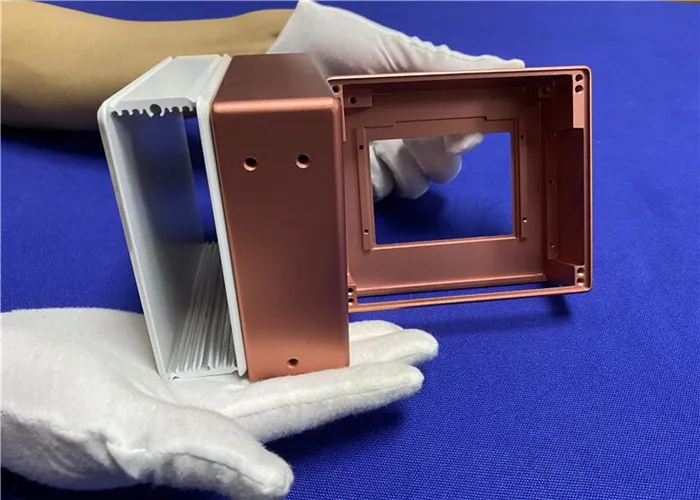
Aluminum is widely used in electronics because it provides lightweight protection, good thermal conductivity, and an attractive appearance. CNC machining allows manufacturers to create custom enclosures with precise openings, mounting features, and complex designs.
Applications include:
Control boxes
Instrument enclosures
Communication equipment components
Surface treatments such as anodizing and bead blasting can further improve appearance and durability.
Because aluminum has excellent thermal conductivity, it is commonly used for heat dissipation applications. CNC machining provides flexibility when producing complex cooling structures that require precise dimensions.
Typical applications include:
LED cooling components
Power electronics cooling parts
Thermal management components
For advanced thermal applications, manufacturers can combine CNC machining with other processes to achieve optimized cooling performance.
Industrial automation and robotics systems require lightweight yet durable components with accurate positioning and reliable operation.
Common applications include:
Robot brackets
Motion system components
Machine frames
Custom mechanical parts
Aluminum CNC machining allows manufacturers to produce complex industrial components with reduced weight and high structural performance.
The wide range of aluminum grades, machining processes, and finishing options makes aluminum suitable for diverse engineering applications. Selecting the correct alloy, manufacturing method, and quality requirements ensures that each component meets its intended performance goals.
Falcon CNC Swiss provides aluminum precision parts for industries including automotive, electronics, robotics, industrial automation, and other advanced manufacturing sectors. With CNC milling, turning, Swiss machining, and quality inspection capabilities, Falcon supports customers from prototype development to production manufacturing. Explore more of our precision CNC machined parts →
The cost of aluminum CNC machining depends on multiple factors, including material selection, part complexity, machining time, surface finishing requirements, tolerance specifications, and production volume. Understanding these factors helps engineers optimize part designs and select the most cost-effective manufacturing solution.
Unlike simple material pricing, the total cost of CNC aluminum parts is mainly determined by the manufacturing process required to produce the component according to engineering requirements.
Different aluminum alloys have different material costs and machining characteristics. Common alloys such as 6061 aluminum are often selected for general-purpose components because of their excellent machinability and cost efficiency.
High-performance alloys such as 7075 aluminum may have higher material costs but are preferred for applications requiring increased strength and performance.
The complexity of a component directly affects machining costs. Parts with:
Complex geometries
Multiple setups
Deep cavities
Tight tolerances
Advanced surface requirements
usually require more programming, machining time, and inspection processes.
Optimizing part design through DFM principles can help reduce unnecessary manufacturing costs while maintaining required performance.
Tighter tolerances typically require more precise machining processes and additional inspection procedures. For example, standard aluminum components may require basic measurement, while high-precision parts may require advanced inspection equipment such as CMM systems.
Additional finishing processes can affect the final price of aluminum components. Common options include:
Anodizing
Hard anodizing
Bead blasting
Powder coating
Polishing
The selected finish depends on requirements such as appearance, corrosion resistance, and durability.
Production quantity also influences the overall aluminum CNC machining price. Prototype and low-volume parts usually have higher unit costs because programming and setup expenses are distributed over fewer pieces. Larger production runs can achieve better cost efficiency through optimized processes and automation.
By balancing material selection, design requirements, machining processes, and production volume, companies can achieve the best value for their aluminum machining projects.
Falcon CNC Swiss provides flexible aluminum machining services ranging from prototypes to production quantities, helping customers manufacture reliable aluminum components with competitive costs and consistent quality.
Selecting the right material is an important decision in CNC manufacturing because material properties directly affect part performance, machining difficulty, production cost, and application suitability. While aluminum is one of the most commonly used CNC materials, other metals such as stainless steel and titanium may provide advantages for specific engineering requirements.
Understanding the differences between materials helps engineers choose the most suitable option for their precision CNC components.
| Material | Advantages | Limitations | Common Applications |
| Aluminum | Lightweight, excellent machinability, corrosion resistance, cost-effective | Lower strength than some metals | Aerospace, electronics, automotive, industrial parts |
| Stainless Steel | High strength, excellent corrosion resistance, durability | More difficult to machine, higher cost | Medical, food equipment, industrial components |
| Titanium | Extremely high strength-to-weight ratio, excellent corrosion resistance | Higher material and machining cost | Aerospace, medical, high-performance applications |
Compared with stainless steel, aluminum is easier to machine and generally allows faster cutting speeds, shorter production cycles, and lower machining costs. Its lightweight characteristics make it suitable for applications where reducing weight is important.
However, stainless steel provides higher strength, wear resistance, and temperature resistance. It is often selected for harsh environments where durability is more important than weight reduction.
Aluminum is usually preferred for:
Lightweight structures
Electronic housings
Heat dissipation components
High-volume production parts
Stainless steel is commonly selected for:
Medical components
Chemical equipment
Heavy-duty industrial parts
Titanium provides exceptional strength and corrosion resistance while maintaining a high strength-to-weight ratio. However, titanium is more challenging to machine due to its lower thermal conductivity and higher material hardness.
Compared with titanium, aluminum offers:
Easier machining
Lower production costs
Faster manufacturing cycles
Better suitability for large-volume production
Titanium is typically selected for applications where extreme performance requirements justify the higher manufacturing cost.
The best material depends on the specific requirements of the application, including strength, weight, corrosion resistance, operating environment, and budget.
For many industrial applications, aluminum CNC machining provides the ideal balance of performance, manufacturability, and cost efficiency. When higher strength or specialized performance is required, stainless steel or titanium may provide better solutions.
Falcon CNC Swiss works with various engineering materials, including aluminum, stainless steel, brass, copper, and titanium, helping customers select the right material and machining process for their precision components.
Producing custom aluminum CNC parts requires a complete process from engineering review to final inspection. A professional aluminum CNC machining service helps customers achieve accurate, reliable, and cost-effective components.
The typical manufacturing process includes:
1. Design Review
Engineers review CAD drawings, tolerances, materials, and production requirements to optimize manufacturability.
2. Material Selection
Common aluminum alloys include 6061, 7075, 2024, and 5052, selected based on strength, corrosion resistance, and application needs.
3. CNC Machining
Advanced CNC milling, CNC turning, 5-axis machining, and Swiss machining are used to produce precision aluminum components.
4. Finishing and Inspection
Surface treatments such as anodizing and bead blasting improve appearance and durability. Final inspection ensures parts meet customer specifications.
Falcon CNC Swiss supports customers from prototype development to production manufacturing, delivering high-quality CNC aluminum components for industrial applications.
Falcon CNC Swiss provides professional aluminum CNC machining services for prototypes and production parts. With advanced CNC milling, CNC turning, Swiss machining, and quality inspection capabilities, we manufacture precision aluminum components for automotive, electronics, robotics, and industrial applications.
Request a quote today for your custom aluminum CNC parts.