English
  日本語
日本語  한국어
한국어  français
  Deutsch
  Español
  русский
  العربية

May
Learn More
10

Aluminum high volume production involves a proper balance between efficiency of production, producing the quality parts, and ensuring the convenience of repeated processes in the long run. The difference between making prototypes and aluminum parts in large numbers is that the latter type of production pays much attention to achieving repeatability in the processes, optimizing the production methodology, and ensuring that the process of making parts costs less and gives similar results in each of the cases.
There are multiple factors that are taken into account while determining which High volume CNC aluminum production methods should be used in a particular case of production. These factors include the shape of the part, type of aluminum alloy, the required device parameters (such as allowed deviations), and a number of parts that will be produced in the course of the year.
Many companies begin with prototypes before moving from prototype to mass production aluminum parts. A properly planned transition is important in allowing companies to recognize the design shortcomings, optimize the machining processes as well as minimize the risks of production before making the transition to mass production.
This guide will discuss the different types of aluminum manufacturing methods, design factors to consider, cost consideration, quality control requirements, and practical tips on how to achieve reliable high-volume production of aluminum components.
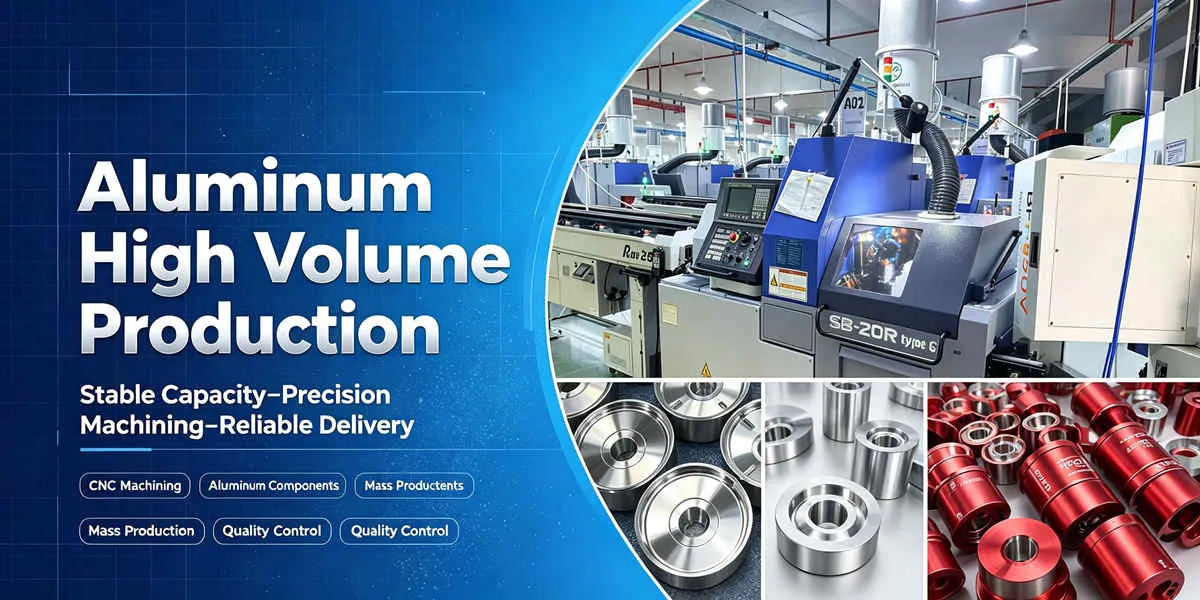
Aluminum high volume production means producing large amounts of aluminum goods while maintaining consistent quality, accuracy, and efficiency. This method of producing aluminum products differs from prototyping or low-volume manufacturing because high-volume production involves improving production processes that enable exact repeating manufacturing, constant cycle times, and predictable process costs.
High volume aluminum production services includes careful planning of the production process, which includes selecting the right materials, optimizing processes, developing a tooling strategy, designing work-holding devices, and acquiring the right inspection and quality control processes.
When companies need high-volume aluminum manufacturing and production, they typically look for a manufacturer who is capable of high-volume operations, can carry out repeat work, and can make changes if necessary. The goal of high-volume aluminum production is not just to produce as many products as possible, but also to assure high reliability.
Large scale aluminum production is useful for businesses that need anything from thousands of parts in an automotive industry to precision components for electronics, robotics, and other industrial equipment. An ideal high volume aluminum parts manufacturer must showcase both production and engineering capabilities in order to properly complete the production cycle from validation stage to continuous supply stage.
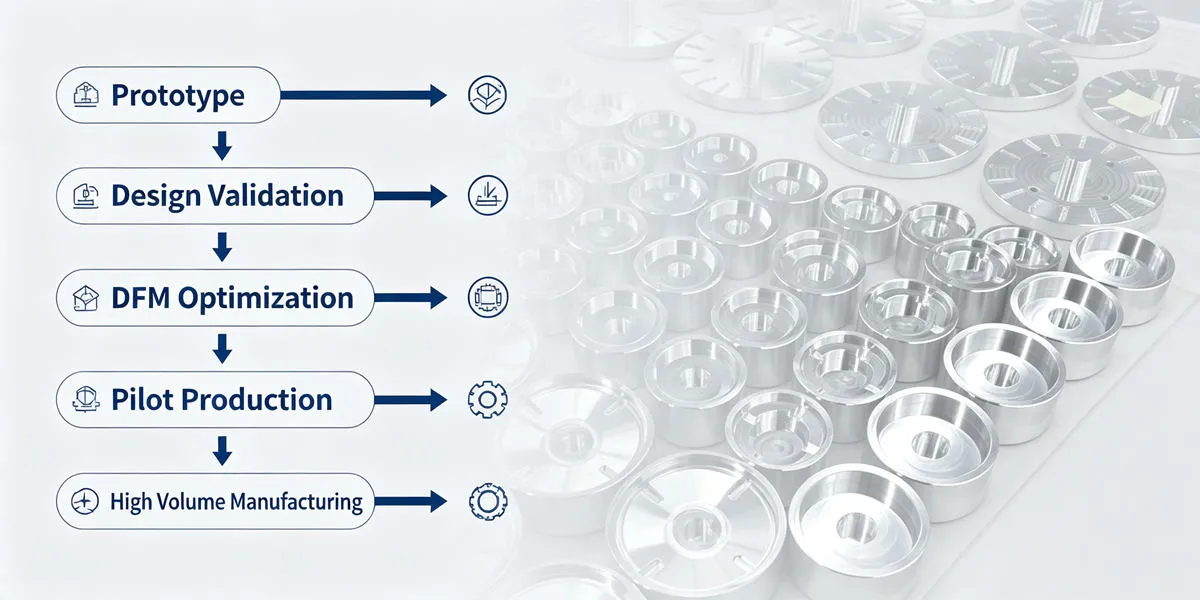
Many manufacturers initiate the product development stage with prototypes that allow validating design, functionality and assembly requirements before increasing the production volume. As the process of transition from prototype production to mass manufacturing of the aluminum parts implies certain evaluation of manufacturability, process stability, cost efficiency and requirements for quality of production. In order for the transition to be effective, the process usually involves the evaluation of prototypes to define possible improvements during scaling production.
The transition process implies evaluation of more than just increasing order quantities. Engineers need to evaluate material availability, manufacturing processes, production capacity, inspection process and supply chain requirements. The development of the aluminum CNC prototype manufacturing process provides useful information for enhancing part design and readiness for repeat production.
The shift from low-volume aluminum production to high-volume levels should be made based on factors like demand, design maturity, yearly output needs, and cost targets in manufacturing. An early decision may lead to pointless changes to manufacturing while delaying planning may increase expenses and reduce scalability.
A proper timeline for scaling aluminum production would have the steps including prototype validation, optimizing design, pilot production, process approval, and mass manufacturing. This approach eliminates the risks associated with production and guarantees that creation of aluminum details would become steady at higher volumes.
Choosing the best method for high volume aluminum production depends on the design of the part, the volume of production, the specifications of the piece, the characteristics of the material used, and the cost objectives. One kind of manufacturing process cannot be used for all aluminum components.
| Manufacturing Method | Advantages | Suitable Applications |
| CNC Machining | High precision, flexible design changes, tight tolerances | Precision aluminum components, prototypes transitioning to production, complex parts |
| Die Casting | Fast cycle times, suitable for large quantities, lower unit cost at scale | High-volume complex aluminum parts |
| Extrusion | Efficient for constant cross-section profiles | Frames, housings, heat sink profiles |
In comparing CNC machining with aluminum die casting, it can be said that CNC machining offers superior flexibility in terms of geometry complexity and accuracy while being suitable for low production runs that do not require bespoke tooling. In contrast, die casting becomes worthwhile when producing large quantities of parts justifying the cost of molds and fast cycle times.
In comparing die casting with extrusion for high volume applications, it is important to take into consideration part geometry as the main determining factor. Extrusion is highly effective for production of long shapes with simple cross-sections, whereas die casting works best for manufacturing parts with complex three-dimensional geometry integrated with functional features.
Consideration has to be paid to annual volume, complexity in design, tolerance specifications, surface finish, cost of tooling, and product life cycle in the choice of the ideal aluminum mass production method. Falcon CNC Swiss puts precision CNC machining as a viable option for aluminum dollars due to the importance of accurate production processes.
The initiation of a profitable large-scale aluminum project begins with a suitable design. A good aluminum manufacturing design guide needs to take into account aspects such as part configuration, accessibility to machining processes, consumption of materials, tolerance requirements, and repeatability of production before the actual manufacturing process starts. A proper design means that one can shorten processing time, improve consistency in production as well as manage costs in the long run.
A practical DFM checklist for aluminum parts should include
| Design Consideration | Production Impact |
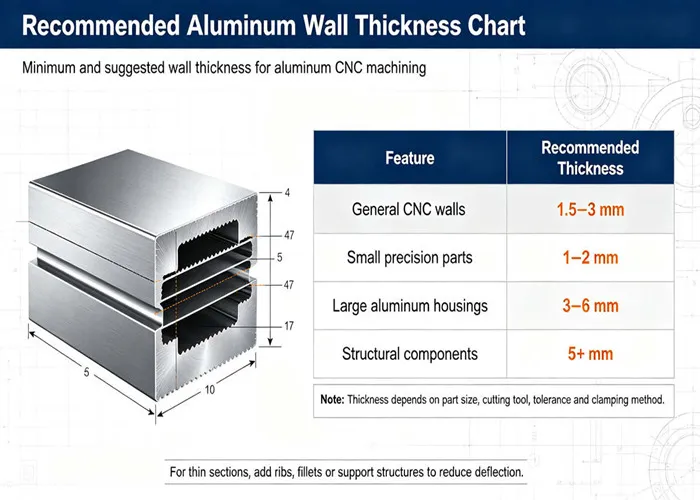
| Wall Thickness | Avoid unnecessary thin sections that may affect stability during machining |
| Tool Accessibility | Ensure features can be produced efficiently with standard tooling |
| Tolerances | Apply tight tolerances only where function requires them |
| Part Geometry | Reduce unnecessary complexity and additional machining operations |
| Material Usage | Optimize designs to reduce waste and improve cost efficiency |
For high-volume production, aluminum production design considerations go beyond individual part features. The engineers must ensure that the assembly, inspection techniques, repeatability of production, and changes in design in the future are considered as well. A good design helps the producers create working processes before starting to make an actual product.
Some issues faced when increasing production are over-tolerance, complex features, wrong choice of metals, and inappropriate design. Avoiding these common mistakes scaling aluminum production helps reduce delays and prevents costly redesigns during production.
Working with a company that has experience in machining aluminum, like Aluminum Precision Machining, can help identify the manufacturing issues that are due to improper design.
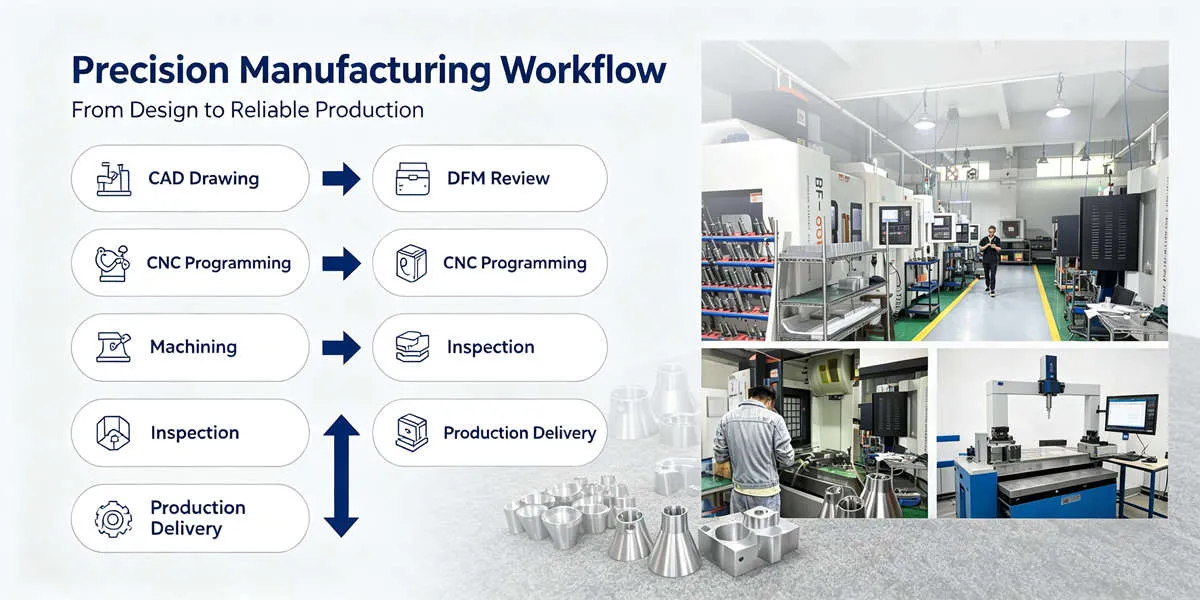
High volume machining methods involving CNC aluminum fabrication entails a regulated machining process that can provide quality that can be achieved consistently across large production lot sizes. Production manufacturing is not like prototype machining; its emphasis is more on the stability of the process, cycle time optimization, performance of the tooling, and reliability of the inspection methods. Precision CNC machining is the commonly used method for making aluminum components that are required to be accurate, have complex features as well as their processes become repetitive.
A typical high volume aluminum machining process includes several key stages
| Production Stage | Main Focus |
| Engineering Review | Confirm drawings, tolerances, materials, and manufacturing requirements |
| Process Planning | Optimize machining sequence, tooling, and workholding methods |
| CNC Machining | Produce aluminum components with stable and repeatable parameters |
| Inspection | Verify critical dimensions and production consistency |
| Continuous Improvement | Adjust processes to improve efficiency and quality |
For reliable aluminum production run services, manufacturers must ensure that they maintain stable machining environment for the entire production process. Important processes, such as; controlling tool wear, calibrating machines and evaluating the stability of fixtures must be taken into account during manufacturing of aluminum components.
The production process of aluminum components in high-volume CNC machining is different from prototype production. Because of that, it is extremely important to consider the following factors: appropriate documentation, first piece inspection, and constant quality monitoring.
Moreover, stability of aluminum production is vital for industries that rely on interchangeable parts. Constant high volume CNC production process contributes to reducing variances in production worked time and fulfilling all necessary production requirements.
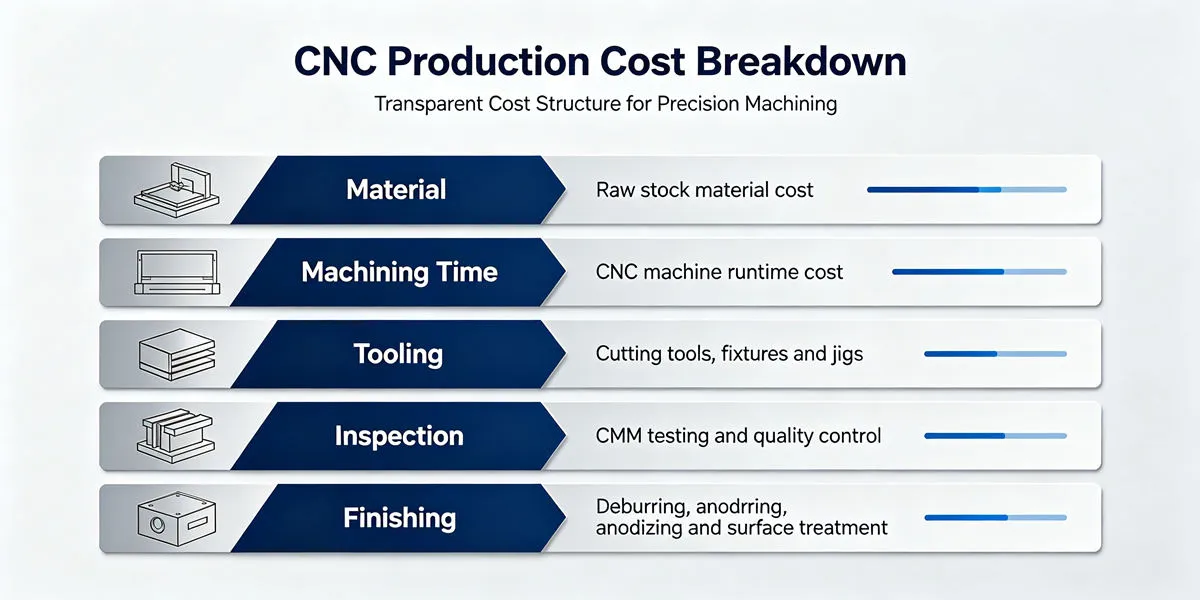
Many companies ask how much does high volume aluminum production cost, yet profit is not determined by the price of the material only. Volume, complexity of parts, required operations, finishing, inspection, and process optimization are only a few examples of aspects that affect the total cost.
Main elements that influence cost are
| Cost Factor | Impact on Production Cost |
| Material Selection | Aluminum alloy type, availability, and material utilization affect overall cost |
| Part Design Complexity | Complex geometries may require more machining time and additional operations |
| Production Volume | Larger quantities can reduce the average setup and programming cost per part |
| Machining Efficiency | Optimized tooling, fixtures, and cycle time improve cost efficiency |
| Quality Requirements | Inspection standards and documentation requirements affect production expenses |
To achieve economy in production, minimizing the unit cost of aluminum usually requires process efficacy, effective production planning, and optimal manufacturing. However, the process itself should not impact the production of a dimensionally accurate, high-performance product that is also reliable over time.
Aluminum machining cost breakdown analysis proves effective at conveying the information required by engineers to identify weak spots in the production. Popular aluminum part cost reduction tips include eliminating unnecessary features, optimizing tolerances, improving material usage, minimizing operations, and implementing design for manufacturability practices.
For high-volume projects, tooling costs for high volume aluminum production should be included in the analysis. Despite the need to pay for the tooling, the increase in production run size will make cost-effective mass production possible thanks to spreading the investment over a larger number of products.
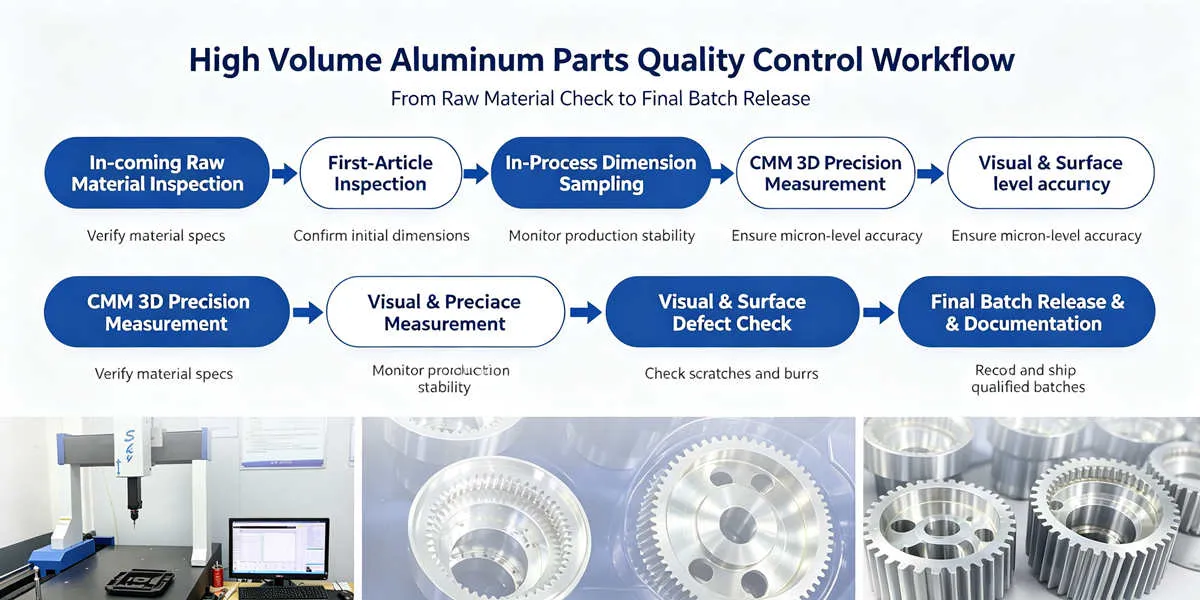
Quality control of high volume aluminum parts is crucial to ensure that the end product functions properly in every phase of its operation. With increased production volumes, manufacturers are expected to test every part to ensure that it complies with the specifications, tolerances, and functionality standards established for the product.
Quality inspection systems in aluminum production usually comprise
| Inspection Stage | Purpose |
| First Article Inspection | Confirm the initial production part meets drawing requirements |
| In-Process Inspection | Monitor critical dimensions during production |
| Final Inspection | Verify completed parts before shipment |
| Documentation Control | Maintain traceability and production records |
| Quality Requirements | Inspection standards and documentation requirements affect production expenses |
For high volume machining quality control, manufacturers pay more attention to the stability of the processes than to the quality of the finished components. Monitoring of tool wear, calibrating the machines, controlling the fixtures and using standardized procedures all help in minimizing the level of variety in the most prolonged series of production runs.
In order to ensure consistency of production of aluminum parts, it is necessary to implement continuous monitoring of the production process. Production data can allow identifying problem areas in advance, which will also lead to efficiency increase of the machining.
Consistency in the quality control process is also crucial in industries such as automotive, electronics, robotics and industrial equipment, as the components to be manufactured must fit the larger assemblies regularly.
Aluminum die casting for high volume production is commonly used for manufacturing large quantities of aluminum components with consistent shapes and efficient cycle times. It is especially suitable for parts where high production volume can justify the initial tooling investment.
The principle of aluminum die casting is based on the injection of molten aluminum into a reusable mold for the purpose of producing components that are almost ready-to-use. This technology is advantageous where units sold are many because it minimizes the need for machining and lowers general costs.
The main disadvantages of die casting are linked to the cost of tooling, design flexibility, and tolerances. When it comes to high precision elements, whereby complicated features and precise tolerances are expected, CNC machining is recommended.
When comparing CNC machining vs die casting aluminum, engineers should take into account production volumes, complexity of parts, dimensions to be achieved and overall aim of the project.
How to scale aluminum production from prototype is a careful balancing act which aims for consistent design validation, manufacturing processes and quality standards as production gets larger. And scaling from small scale production of prototype components to large scale mass production does not just mean increasing numbers, as process optimization is key on this journey.
A successful moving from prototype to mass production aluminum means that design review, DFM improvements, process validation, tool or jig optimization and quality assurance have to be followed in order to identify possible problems in advance of the actual production.
A typical scaling aluminum production timeline may include
| Stage | Main Objective |
| Prototype | Validate design and functionality |
| Process Review | Improve manufacturability and production efficiency |
| Pilot Production | Confirm process stability and quality |
| Full Production | Maintain repeatable output and delivery |
For manufacturers in need of dependable aluminum production run services, the selection of a manufacturer with engineering backing and manufacturing capabilities will ease the transition. A systematic process reduces the likelihood of production issues and helps ensure the required supply over the long term.
Choosing an experienced and capable CNC Contract Manufacturing partner enables manufacturers to effectively handle production planning, control processes, and make improvements to products life cycle.
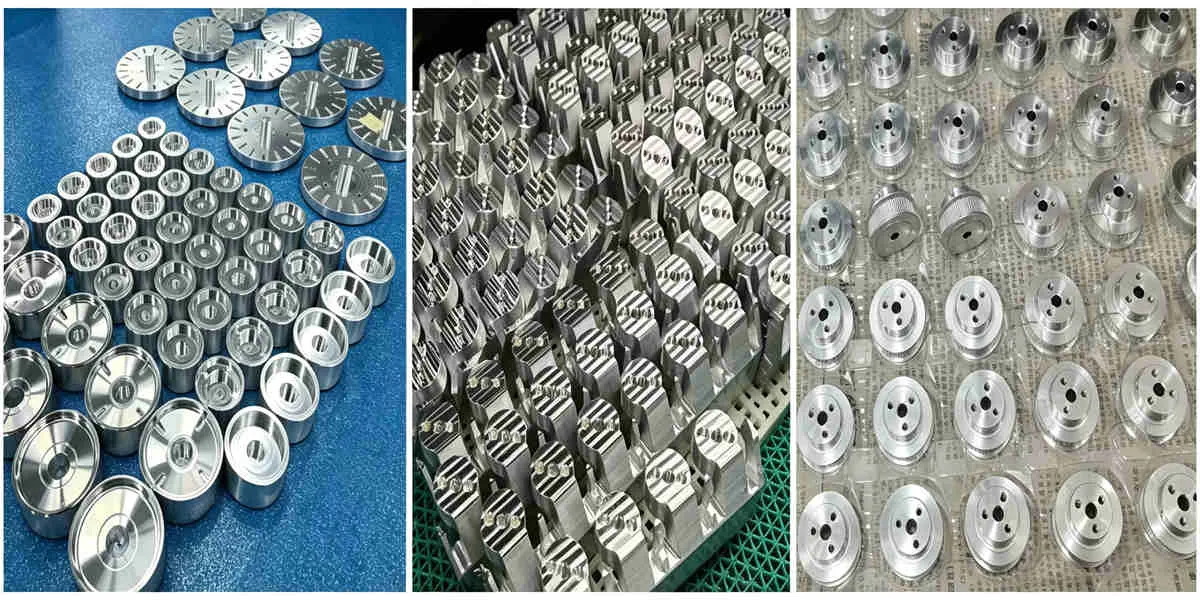
Falcon CNC Swiss supports high volume aluminum production with a focus on precision machining, process stability, and consistent part quality. Our production method is customized towards the manufacture of aluminum components to achieve dependable repeat production, precise dimensions, and controlled process conditions.
As a high volume aluminum parts manufacturer, Falcon provides the necessary engineering and machining facilities to transform prototypes into production orders. Our broad experience in aluminum precise machining helps us produce complex aluminum components with high demanding specifications.
If you have to deal with high volume production of aluminum parts, Falcon has processes like optimization of production processes, quality control, and production support. Using CNC Contract Manufacturing services, we help our customers maintain a reliable supply chain and consistently produce great volumes of batches over long periods of time.
Irrespective of your industry (automobile, robotics, electrical engineering, or manufacturing), Falcon will provide you with high-quality aluminum machining services from the first stages of production planning to regular mass production.
Aluminum high volume production denotes the mass production of aluminum products, ensuring uniform quality, accuracy of measurements, and effective manufacturing. The methodology generally includes advanced principles, stable workflows, and effective quality assurance systems.
The most common production methods include CNC machining, extrusion, and die casting. The optimal method will depend on the degree of complexity of the item to be manufactured, volume required, tolerances and cost targets.
Manufacturers need to get part drawings, 3D CAD files, materials and surface finish descriptions, annual volume, quality requirements, and other specifications to get high volume aluminum parts pricing.
In general, this goal may be reached by redesigning the parts, improving machining process, eliminating unnecessary operations and choosing the best matched production methods available depending upon volume produced per year.