English
  日本語
日本語  한국어
한국어  français
  Deutsch
  Español
  русский
  العربية
Jan
Learn More
23

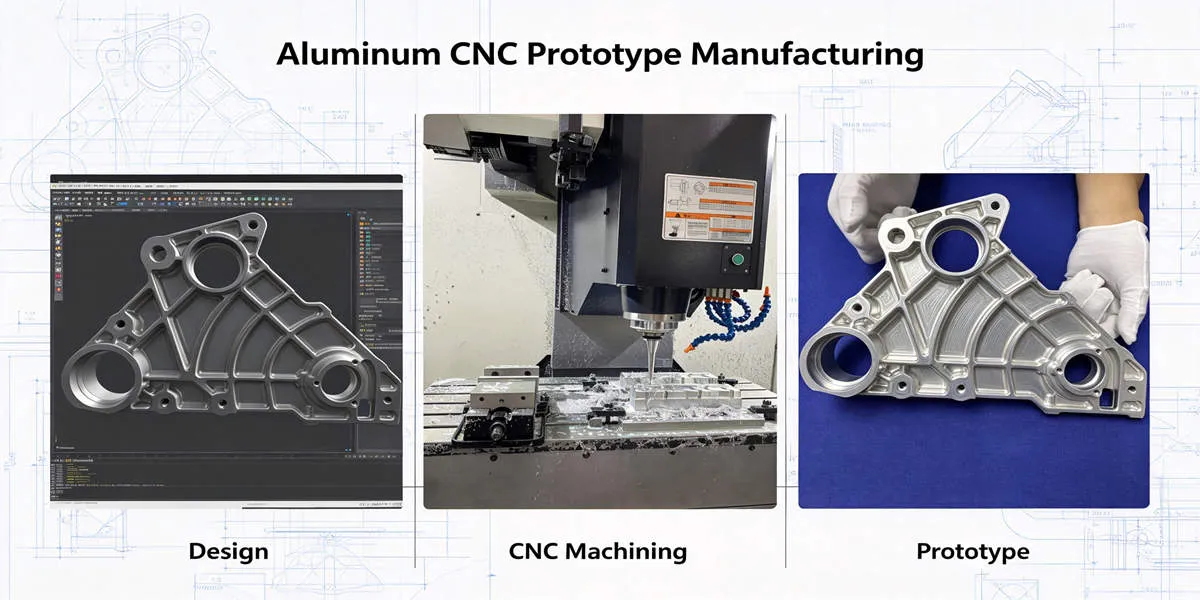
An aluminum CNC prototype can help engineers ascertain the geometry, performance of the material, tolerances, and assembly requirements that a component requires before the manufacturing process can commence. CNC is extremely effective for functional aluminum prototypes since the component may be created from raw materials that can also be utilized in production.
Each step from the CAD design to inspection produces an impact on how well the prototype performs and how easy it would be to manufacture the prototype in large quantities. A well-planned aluminum CNC prototype manufacturing process can also identify design issues early and reduce changes during production.
The guide will look at the key issues engineers should know regarding aluminum CNC prototypes including design requirements, choice of material, CNC methods, price issues, finalization and quality control process.
CNC machining technology is preferred for aluminum prototypes as it allows the creation of functional components from the identical material potentially utilized for mass production. This capability enables engineers to assess size, assembly, performance, and surface properties with the help of a representative prototype instead of relying on non-functional models. Furthermore, CNC machining technology is appropriate for the development of prototypes in low quantities, as well as for making iterations.
For custom aluminum CNC prototypes, the main advantages include:
| Advantage | Engineering Benefit |
| Production-Grade Material | Enables functional testing with aluminum alloys used in real components |
| Dimensional Accuracy | Supports verification of critical dimensions and assembly interfaces |
| Design Flexibility | Allows modifications without dedicated molding or casting tooling |
| Low-Volume Capability | Practical for prototypes and initial production quantities |
| Surface Finish Options | Supports finishing requirements representative of the final part |
Precision aluminum CNC prototypes are very useful when the part being tested is exposed to actual working conditions. Mounting holes, machined threads, pockets, interfaces, and surfaces can be assessed before production.
CNC machining provides a solid and practical connection between prototype development and manufacturing, as modifications made during testing can be translated to the CAD model and later machined into new parts.
In case a project requires aluminum CNC prototyping services, it is vital to choose a manufacturer with required machining and engineering abilities, to ensure that the results achieved during prototyping will correspond to later manufacturing requirements. Explore Precision CNC Machining Service for aluminum prototyping.
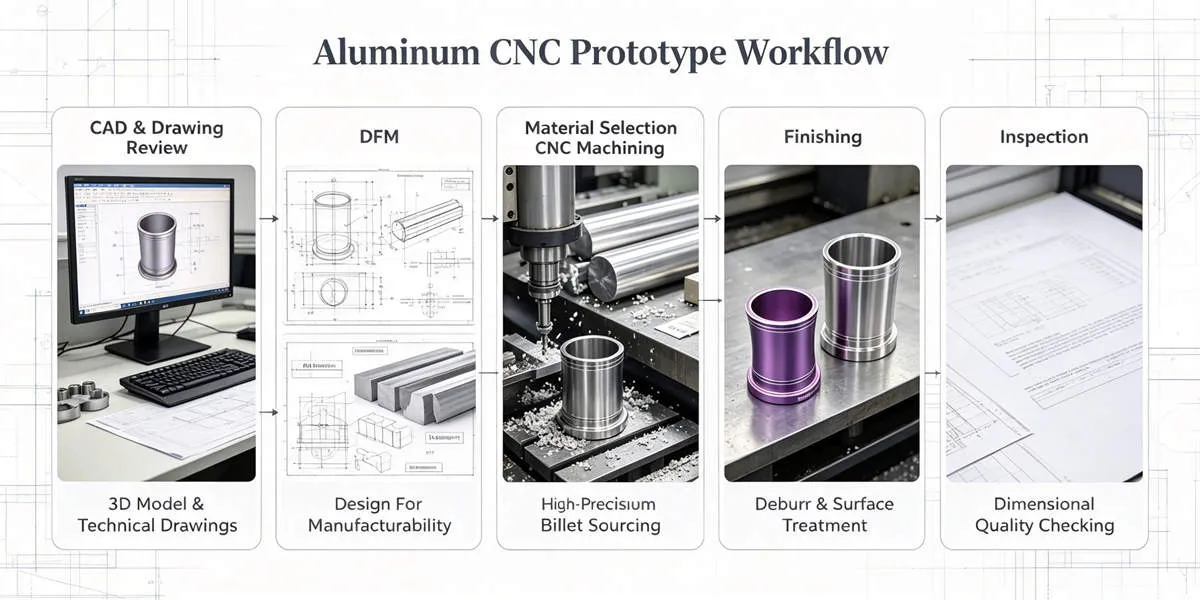
The aluminum CNC prototype machining process start from engineering specifications and CAD modeling, followed by material preparation, machining, finishing, and inspection. Following a systematic process allows the prototype to effectively fulfill its purpose of producing valuable details that can be used during future design iterations.
| Manufacturing Step | Key Considerations |
| 1. CAD & Drawing Review | Confirm geometry, critical dimensions, tolerances, threads, and surface requirements |
| 2. DFM Review | Check tool access, wall thickness, internal corners, and machining feasibility |
| 3. Material Selection | Select the aluminum alloy according to strength, machinability, and application requirements |
| 4. CNC Machining | Mill or turn the aluminum stock according to the approved design |
| 5. Finishing | Apply required deburring, surface treatment, or anodizing |
| 6. Inspection | Verify critical dimensions and functional features against the drawing |
For an aluminum CNC prototype from CAD file, the 3D design forms an essential shape of the piece but the engineering drawing conveys critical tolerances, threads, surface treatment, and other conditions for production. Having both ensures that the manufacturer knows which points require more control and checking.
In the manufacturing process of CNC milling aluminum prototypes, the machining technique is dependent on the geometry of the part being manufactured. Certain parts may have a standard multi-axis machining, while very complicated features will probably need additional setups and a 5-axis technique. It’s very important that during the Design for Manufacturing evaluation one has all the necessary information concerning the access to tools, workholding and removal of material. Learn more about our aluminum prototype part machining capabilities.
Prototype creating is followed by finishing and measuring before testing can take place. In case a flaw in the design is revealed in the course of testing, the CAD model can be modified accordingly and one more prototype can be produced without making any special tooling for production purposes.
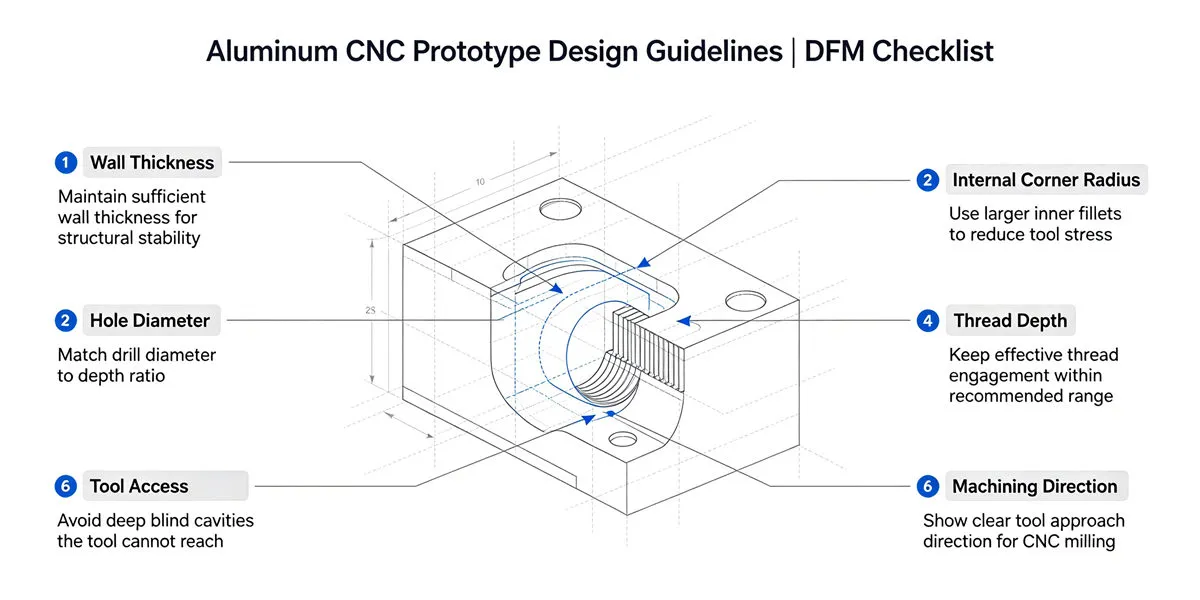
Before commencing with the machining of CNC prototype, the design must take into account the manufacturability of the prototype. Adhering to the practical aluminum CNC prototype guidelines is essential to minimizing machining time, maximizing dimensional stability and simplifying the process of making changes. The most important thing is to have a good balance of the intended function and the elements that can be production optimized.
| Design Factor | Recommended Approach |
| Wall Thickness | Avoid unnecessarily thin or tall walls that may deflect or vibrate during machining |
| Internal Corners | Use practical radii that match standard cutting tools rather than sharp internal corners |
| Holes & Threads | Use standard hole sizes and practical depths where possible |
| Tolerances | Apply tight tolerances only to features that affect fit, function, or performance |
| Tool Access | Keep pockets, holes, and machined surfaces accessible to standard tooling |
| Setups | Arrange features to minimize unnecessary repositioning and additional setups |
When considering how to design an aluminum CNC prototype, you should consider the thickness of the walls alongside factors such as the height, shape, material type, and required tolerances. Allowing excessive panel deflection in thin walls will be causing risk for their distortion during cutting process. On the other hand, the height of the walls needs to be taken into account, as elevated structures are more prone to vibration and the associated dimensional variations.
For aluminum CNC machining prototype tolerances, you should make sure not to apply strict tolerances to every parameter of the design. Each characteristic of crucial aspects, such as connecting surfaces, should be managed with a tight tolerance, while noncritical parameters do not have to have very strict limits of tolerance, which would create a need for high level of machining and inspecting the design more than it needs.
Internal corners should be designed depending on the characteristics and properties of the tools which will be used in this process. Properly designed internal angles will lead to the rigidity of the equipment used and will make the machining process easier. Following these design for CNC machining aluminum prototype principles helps create prototypes that are easier to machine, inspect, modify, and ultimately transition into production.
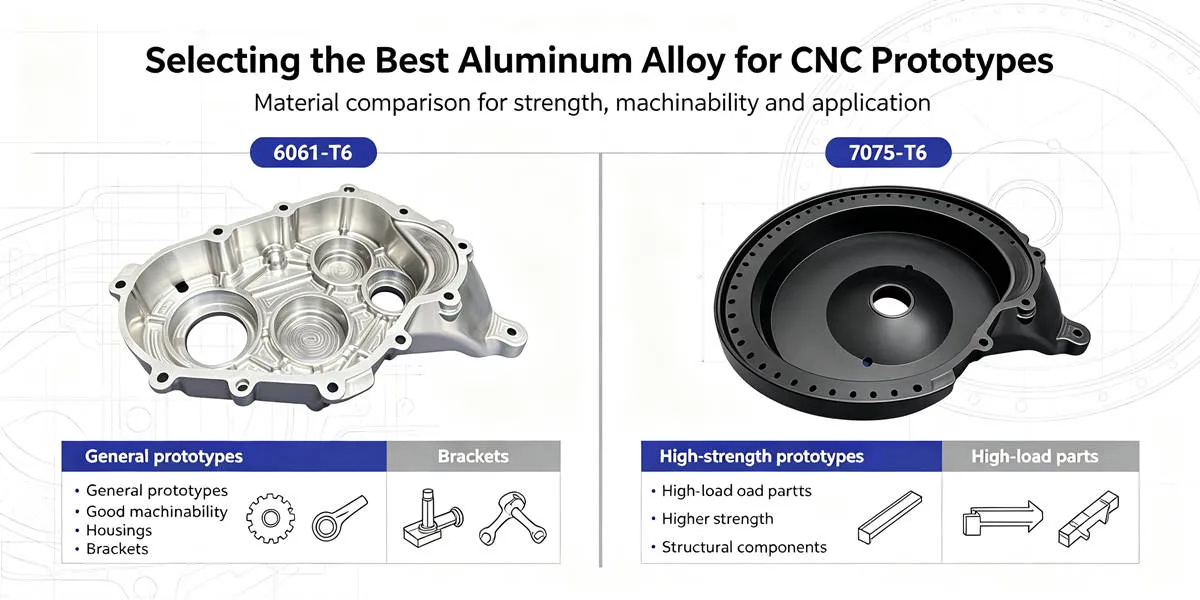
Choosing the best aluminum for CNC prototype development depends on what the prototype needs to prove. Selecting materials should be done by taking into consideration application, mechanical loading, conditions of usage, and finishing processes. 6061-T6 and 7075-T6 are two of the most frequently used kinds of aluminum for CNC prototyping.
| Aluminum Alloy | Key Characteristics | Typical Prototype Use |
| 6061-T6 | Good strength, machinability, corrosion resistance, and availability | Housings, brackets, mounting parts, general functional prototypes |
| 7075-T6 | Higher strength and hardness, with higher material and machining considerations | Structural components, high-load parts, performance prototypes |
| 5052 | Good corrosion resistance and formability | Applications where forming or environmental resistance is important |
6061-T6 is popular as a base material for a simple 6061 aluminum CNC prototype, owing to its great availability, machinability, and finishing possibilities. This alloy is especially well-suited for prototypes are evaluated in terms of fit, form, assembly, or functionality.
7075 aluminum CNC is preferable in situations where prototype requires high load capacity or must undergo structural testing. The main advantage of using 7075 is that it offers many times greater strength than 6061 alloy; however, it may prompt higher material costs and different aspects of corrosion and finishing.
The main question to consider when analyzing requirements for 6061 vs 7075 aluminum prototypes is not what alloy is the better one in general terms, but rather which alloy is more representative in terms of the final operating conditions of the end product. Find more information about aluminum machining.
The method of machining to fabricate an aluminum prototype must be chosen according to its functional and geometric features. CNC milling aluminum prototype parts is suitable for housings, brackets, plates, pockets, holes, and contoured components., CNC turning is the best course of action due to the nature of the components produced.
| Machining Method | Best Suited For | Key Consideration |
| 3-Axis CNC Milling | Plates, brackets, housings, pockets | Efficient for accessible features |
| 5-Axis CNC Milling | Angled surfaces, complex contours, multi-sided parts | Provides greater tool access and can reduce setups |
| CNC Turning | Shafts, pins, bushings, cylindrical parts | Best for rotational geometries |
For 3 axis vs 5 axis aluminum prototype machining, the impact of design geometry must be given priority over the aspect of precision. While 3-axis machining can deliver several prismatic parts, it may be necessary to make use of 5-axis machining due to the requirement of having features located on various surfaces or being machined at certain angles.
When it comes to CNC turning aluminum prototype parts, CNC turning should be the method of choice when the major geometry is rotational in that features such as bores, grooves, and diameters can be created from aluminum stock directly.
For Falcon CNC Swiss, the choice of machining technology should be based on actual drawings, geometry, tolerances, and production specifications. The aim does not lie in deploying the latest technology for each prototype, it lies in opting for an efficient process that would allow the production of prototypes with necessary features.
The aluminum CNC prototype cost does not only depend on the aluminum needed for making it. In terms of a one-off prototype, programming, setup, machining time, tolerance requirements, finishing, and inspection will affect significantly the total prices.
| Cost Factor | Effect on Prototype Cost |
| Material | Alloy, stock size, and material availability affect the initial cost |
| Part Complexity | More features, deeper pockets, and additional setups increase machining time |
| Tolerance | Tight tolerances may require additional machining and inspection |
| Quantity | Setup and programming costs can be distributed across multiple parts |
| Surface Finish | Anodizing, blasting, or other finishing adds secondary processing |
| Inspection | Additional dimensional or quality requirements increase inspection time |
The number of pieces is a critical factor when determining the price of an aluminum CNC prototype. A prototype will experience the highest costs related to programming and setup, while producing different parts in one order will allow to distribute these fixed costs across all units.
Design can also impact the cost of CNC aluminum machining. Design features should be minimized, practical tolerances should be applied and finish should be used only when really necessary for a prototype design.
Having the necessary information such as a CAD model, drawing, material type, quantity, tolerance specifications, required surface finish and delivery options is vital for making a quote for an aluminum CNC prototype.
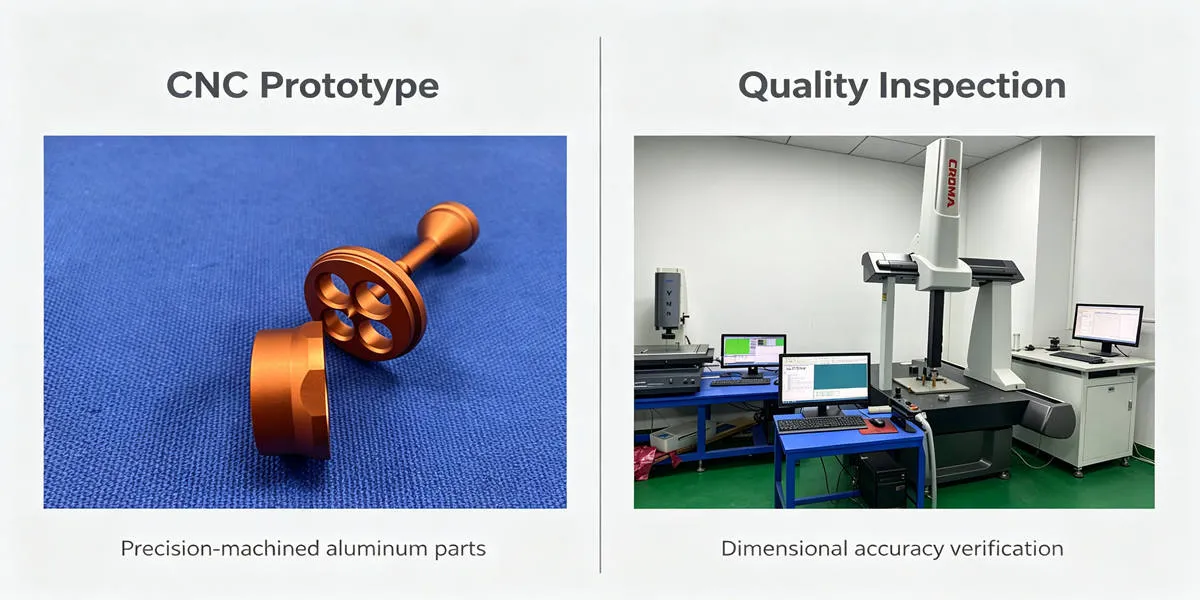
Through the process of final finishing and inspection of aluminum prototypes, a suitable product can then be subjected to functional testing and final evaluation. The type of CNC aluminum prototype finishing should be based on the needs of the prototype.
| Finish / Inspection | Typical Purpose |
| As-Machined | Functional testing while retaining the machined surface |
| Anodizing | Surface protection, corrosion resistance, and appearance |
| Bead Blasting | Uniform matte appearance and removal of visible machining marks |
| Dimensional Inspection | Verification of critical dimensions and tolerances |
| Surface Inspection | Checking roughness, tool marks, scratches, and cosmetic requirements |
The anodized aluminum CNC prototype can provide a better representation of the end-use part especially with regard to the appearance of the surface or its ability to resist corrosion. However, while anodizing could change dimensions, roscnts and fitting surfaces, the design must take into consideration the required finishing process.
When creating a tight tolerance aluminum CNC prototype, the focus of inspection must be on the dimensions important for assembly and functioning rather than imposing unnecessarily strict tolerances on all details. The inspection process would involve either dimensional control, verification of threads, control of surface roughness and/or CMM inspection.
Proper specification of the used raw materials together with surface finish and critical dimensions will ensure the results are as close as possible to the targeted product.
The choice between aluminum CNC prototyping vs 3D printing depends on the nature of the prototype being tested. CNC machining is preferable when prototypes need to demonstrate final aluminum properties, dimensions, interaction with other components, or surface finish. 3D printing is better when the goal is rapid assessment of form, fit or geometry.
| Method | Best Suited For |
| CNC Machining | Functional aluminum prototypes, precision features, assembly testing |
| 3D Printing | Early concept models, complex geometry, rapid form checks |
| Aluminum Casting | Complex near-net shapes and larger production volumes |
| Dimensional Inspection | Verification of critical dimensions and tolerances |
| Surface Inspection | Checking roughness, tool marks, scratches, and cosmetic requirements |
| Inspection | Additional dimensional or quality requirements increase inspection time |
When comparing a CNC aluminium prototype vs plastic prototype, CNC is deemed advantageous when some being used evaluation relates to weight, strength, thermal behavior, or production-grade aluminium performance takes place. A plastic prototype is also considered useful for the initial dimensional and ergonomical verifications in the future.
CNC machining vs aluminium cast prototypes has a practical advantage in that CNC does not imply the construction of dedicated casting tooling, meaning CNC is more sensible for small quantities. When the geometry is very complex, the appeal of casting becomes more desirable.
Hence, the best method for an aluminum prototype is determined by the geometry, quantity, functionality, material validation, and future production process. In case of implementing the CNC process and manufacturing the end component by CNC machining, developing a CNC prototype serves as a great opportunity for detecting issues connected with the fabrication of the final component.
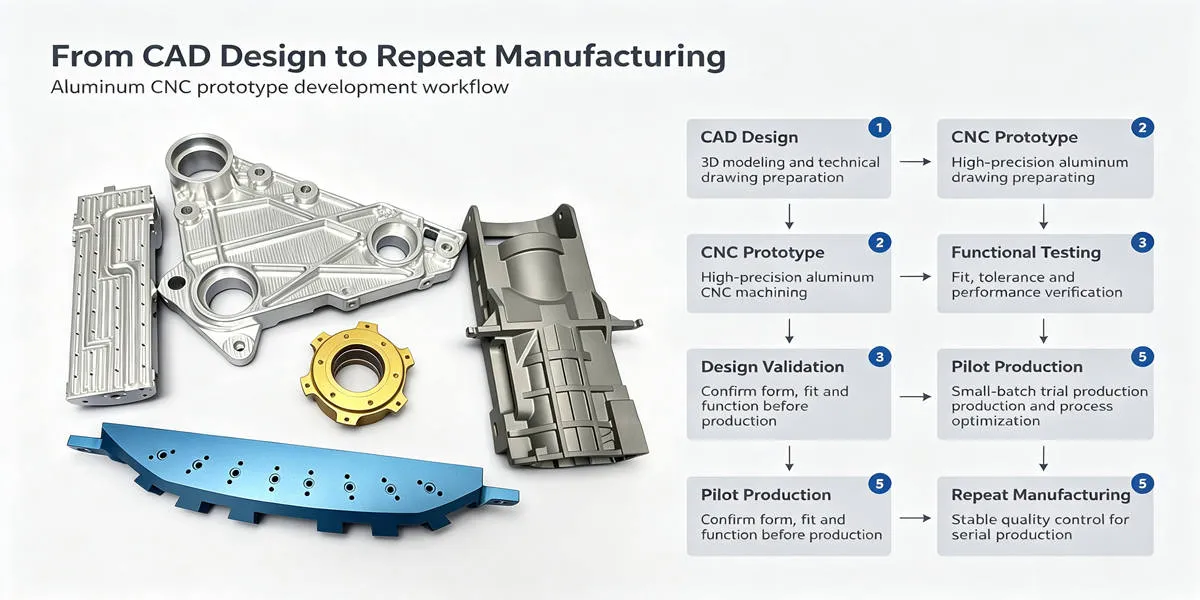
A good prototype should not just prove that a component can be manufactured, it must also produce valuable insights that will aid the transition from prototype to high-volume production. Ensuring that the prototype is based on the same material, machining practices, tolerances and evaluation processes will make it easier to transfer the design into production. Moreover, the new guidelines in manufacturing stress the importance of extending the prototype stage into the production phase.
| Stage | Manufacturing Focus |
| Prototype | Validate design, fit, function, and critical dimensions |
| Design Review | Resolve DFM issues and unnecessary manufacturing complexity |
| Pilot Production | Confirm repeatability and inspection requirements |
| Production | Maintain stable processes, tolerances, and quality |
For CNC machined aluminum prototype parts, it is imperative to plan for materials, machining equipment and processes used, workholding, tolerances, and inspections early in the process. This will help avoid circumstances in which the prototype was successfully completed yet significant changes need to be made to the manufacturing process before the parts can be produced.
Working with the same aluminum CNC prototype manufacturer throughout the prototype and production can help reduce miscommunication and maintain the knowledge gained during the design.
The goal of Falcon CNC Swiss is to transition seamlessly from prototype to mass production while ensuring all design specifications are implemented correctly.
Falcon CNC Swiss provides support for aluminum prototyping projects through an engineering mindset that helps connect prototype machining with production parameters. Our aluminum machining capabilities pertain to prototype development, drawing assessment, DFM factors, precision machining, and inspections before production.
As an aluminum CNC prototyping company, we work towards helping engineers create custom aluminum CNC prototypes from their drawings and material specifications and tolerances requirements.
Key advantages include
Aluminum Machining Expertise: Experience with commonly used aluminum alloys and precision components.
Engineering Review: Drawing and manufacturability considerations are reviewed before machining.
Precision Inspection: Dimensional verification and First Article Inspection support prototype qualification.
Prototype to Production: Prototype results can be carried forward into repeat manufacturing with established machining and quality requirements.
For engineers seeking aluminum CNC prototyping services, choosing a manufacturer that understands both prototype validation and production requirements can reduce unnecessary redesign and qualification work.
Request a quote to discuss your aluminum CNC prototype requirements with the Falcon CNC Swiss engineering team.
The time frame relies on several factors including the complexity of the component, quantity, availability of materials, and the machining process. Simple prototypes can sometimes be made quicker than complex parts since they use fewer setups, no tight tolerances under further processing, and so on. To make the quoting process faster, you need complete CAD and drawing details.
The most often used type of aluminum for CNC protypes is 6061-T6 aluminum since it has good machinability, strength, availability, and finishing opportunities. If the need for stronger mechanical properties arises, the type of aluminum to consider is 7075-T6. The alloy to choose will depend on the purpose of the part.
The supplier will require such pieces of information as a 3D model, engineering drawing in necessary cases, the type of aluminum, quantity of parts needed, the surface finish, tolerances required, and the delivery time. When the RFQ contains all the listed information together, it means that there will be fewer clarifications.
Yes, CNC prototypes can be made out of aluminum suitable for production and used for fit and assembly tests, etc. The only thing that should be done is to choose the right aluminum type for the application.
CNC prototypes can serve as a good basis for production if the prototype manufacturing, materials used, tolerances required, and inspection process match the production process and minimize the number of subsequent redesigns.