English
  日本語
日本語  한국어
한국어  français
  Deutsch
  Español
  русский
  العربية

Jan
Learn More
17

In the world of pumps, compressors, turbines and turbochargers, impellers serve as their “heart” as they are designed to simply move gas or liquid efficiently. However, the manufacturing of these impellers can be extremely complex. Each impeller is essentially a geometric puzzle. The impeller consists of extremely thin curved blades, deeply recessed flow channels and complex, aerodynamic surfaces, all made from solid metal.
This guide will show you what works in impeller machining. No fluff, no academic theory: just practical engineering on how to properly handle thin-walled impeller blades, how to determine the best cut sequenceto follow, and how to choose materials to meet your budgetary constraints.
As someone who works in OEM impeller machining, machinist doing industrial impeller machining or machined prototype impellers, you will need to find a partner with an understanding of these challenges. In addition, we will assist you with every step of the process from fixturing and toolpath strategy through dynamic balancing and finishing of the parts. If you will be producing your own impellers or sourcing from another reputable CNC machining supplier, you will need to know where production can be cut without compromising quality and where there are no areas for cutting corners.
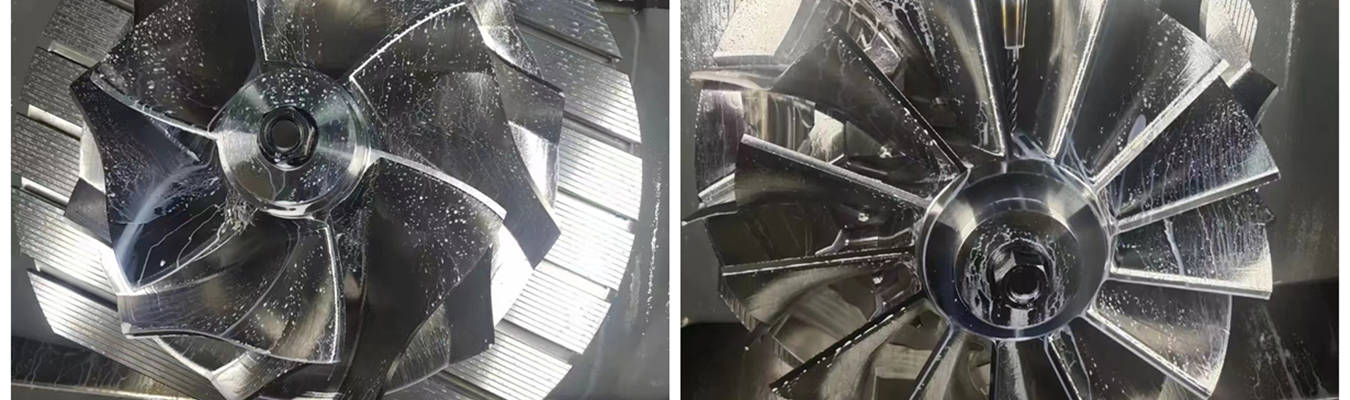
The manufacturing of industrial impellers involves several types of processes such as machining centrifugal impellers used in pumps, machining turbine impellers used in aerospace applications, and machining pump impellers used in fluid systems. All of these processes have the same core challenges.
Thin-walled impeller blades are designed to promote good fluid flow dynamics and weight reduction, typically having very low-rigidity due to their thin nature. When the cutting tool contacts the blade of an impeller, the thin blade flexes away from the cutting tool causing an inconsistency in dimension as well as surface finish and overall geometry.
Thin-walled components are also very susceptible to chatter (vibration) when being machined. As the tool cuts deeper, the amount of chatter increases due to the constant changing stiffness of the workpiece. With materials like titanium or Inconel, which are commonly used in turbine impeller machining, this problem is compounded by poor thermal conductivity.
There are deep, narrow channels between blades of an impeller. In order to machine the hub surface, the tool must reach the bottom of the channel and then go back up both blade faces. Long reach tools flex when cutting. Standard tool holders can collide with blades. Additionally, the blades themselves are typically twisted into complex freeform surfaces which make accessing them continuously challenging.
The precision required by high speed turbomachinery impellers is exceptional. Failure to maintain tight geometries will result in dimensional and surface finish inconsistencies that create aerodynamic drag resulting in decreased efficiency and increased noise. Failure to maintain a properly positioned blade will result in disruption of flow. When taking into account dynamic balancing requirements, any inconsistency in machining will become vibration that cannot be balanced.
This is why tight tolerance impeller machining is critical in these types of applications. At Falcon CNC Swiss, we are specialists in the consistent maintenance of tight tolerances.
The order in which you process your parts impacts every aspect of your business. The right order ensures the component remains stable while balancing the components material removal, chip evacuation and heat while providing the ability to meet productivity requirements.
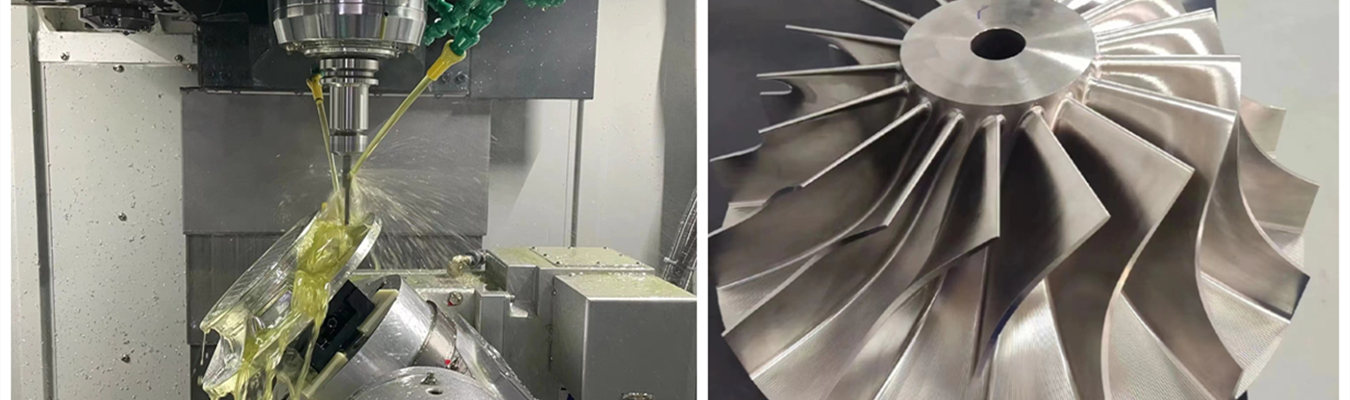
Typical five axis processing sequence for impellers starts from solid bars or forged blanks. Machining impeller from solid stock leads to higher quality parts, more design flexibility as well as increasingly replacing cast parts for use in high performance turbomachines.
Standard workflow:
Initial blank preparation – Turn the OD, face the ends, drill center holes for fixturing.
Three-axis pre-machining – Remove bulk material around the hub to allow five-axis tool access without excessive air cutting.
Five-axis roughing between blades – Remove material from each flow channel. Leave stock on blade surfaces for finishing.
Five-axis semi-finishing – Clean hub and blade surfaces to within 0.1–0.2mm of final dimensions.
Blade finishing – Final-pass machining using flank milling or point milling depending on curvature.
Hub finishing – Finish the hub surface between each set of blades.
Fillet finishing – Blend the radius where blade meets hub. These fillets are high-stress zones and must be smooth.
Dynamic balancing – Measure and correct unbalance according to ISO 1940.
Impellers have a symmetric shape, but clamping them can be somewhat difficult. Clamping from the outside diameter and through a bolt hole in the center do not work for complex five-axis work due to blocked access.
The best way to clamp an impeller is with a custom-designed machined fixture bolted to the impeller mounting face, where the fixture then mounts to the five-axis table. The impeller thus retains a repeatable orientation for its entire machining process.
Multi-axis CNC machining of impellers requires this degree of fixturing precision. Integrated clamping fixturing will allow for the entire machining process to occur in a single set-up with fewer errors and increased efficiency. In addition, turbine impellers with a high strength machined from higher-strength materials will require an entire machine-fixture system designed with sufficient rigidity to withstand cutting forces. Learn more about Falcon CNC Swiss precision CNC machining impellers manufacturing.
A malfunctioning impeller can lead to damage to the bearings, vibration, wasted energy, and early failure. Adding material (putty) to a machined component or drilling holes will only provide a temporary fix to a machining problem, but they are not solutions to the problem.
Pump impellers are typically created to meet ISO 1940 G6.3, G6.0, and G5.0 standards, but high-speed applications can require G2.5 or G1.0. These standards allow for a specific amount of unbalance based on the rotor operating speed. For example, a 10 kg pump impeller at 3,000 RPM would be required to have 8 g·mm residual unbalance to meet the G2.5 standard.
Pursuing a higher standard than required can increase costs without any significant benefits. By utilizing a precision dynamic balance, the vibration amplitude will be greatly reduced, and the consistency of the balancing of large numbers of impellers will be maintained.
To achieve consistent balance results:
Verify every blade has identical weight distribution
Ensure all blade surfaces are symmetric before the part leaves the machine
Use two-plane (dynamic) balancing rather than single-plane unless geometry justifies otherwise
The finishing stage separates good impellers from great ones. Surface finish directly affects aerodynamics, noise, and fatigue life. This is especially true for coated impeller machining—coatings adhere better to smooth surfaces, extending component life.
Proven finishing best practices:
Use dedicated impeller programming modules that understand blade-hub geometry
Choose between flank milling and point milling based on blade curvature
Control step-over distances—too large leaves ridges; too small extends cycle time
Apply tool-axis smoothing to prevent direction changes that leave witness marks
Design decisions made early in CAD profoundly impact manufacturing cost. Here is how.
What Drives Up Cost
| Design Feature | Why It Increases Cost |
| Large number of very thin blades | More toolpaths, smaller tools, slower feeds |
| Deep, tight-radius flow channels | Needs long-reach tools that deflect; more finishing passes |
| Non-symmetrical blade spacing | Complicates toolpath automation; more manual programming |
| Highly twisted blade surfaces | Complex five-axis motion; slower machining speeds |
| Unnecessarily tight tolerances on non-critical surfaces | Increases inspection time; expands production hours with no functional benefit |
Relax tolerances where possible – Only critical interfaces need micron precision.
Add chamfers or radii to sharp corners – Helps tool access and reduces stress concentration.
Consider post-machining operations – Bead blasting improves finish without expensive mirror-finish toolpaths.
Prototype first, then scale – Prototype impeller machining allows you to validate design before committing to high volume impeller production.
Use the right roughing strategy – Fixed-axis plunge milling often shows efficiency advantages for centrifugal impeller roughing.
For OEM impeller machining projects, these savings add up quickly. Falcon CNC Swiss offers free DFM analysis to help you optimize your design before production begins. Explore Falcon CNC Swiss precision CNC machining services for impeller manufacturing.
Material selection defines part performance and directly drives machining cost.
Aluminum 6061 and 7075 are really great choices for low-pressure pumps, aerospace and automotive prototypes. Aluminum offers good machinability, lightweight characteristics and low price. Centrifuge impeller machining is usually the quickest and most cost-effective way to produce them. Aluminum can provide yield strengths between 250 and 550 MPa, which will work for a number of industrial applications.
Stainless steels (304, 316, 17-4PH) are ideal materials for use in water pumps, chemical processing and marine applications. In addition to having excellent corrosion resistance, 17-4PH has a strength of 1100 MPa after being heat treated. However, pump impeller machining from stainless steel requires slower speeds, more rigid setups, and careful management of the tooling.
Titanium (Ti-6Al-4V) or Inconel 718 are typically used for high-performance pumps, gas turbines, and aerospace. Titanium has excellent strength-to-weight ratio (yield ~900 MPa) but is difficult to machine. Nickel-based alloys have good strength retention at high temperatures but are also very difficult and expensive to machine.
The cost of raw material is one aspect of the overall issue; high-performance materials tend to range from three to ten times greater than standard metals. In addition, high-performance materials require special tooling, reduced machining speeds, and tighter process controls, which contribute to the high cost of machining. Aluminum is still the favored material for prototype machines and moderate-load applications due to it's ability to be a low-cost option.
Our tight tolerance impeller machining capabilities cover all these materials. If you need an aluminum impeller for a cooling fan on an automobile or a stainless steel pump impeller for use in chemical processing, our highly skilled team can provide the right process and results for your needs.
At Falcon CNC Swiss, we bring precision, capability, and engineering discipline to every impeller project. Our expertise spans OEM impeller machining, industrial impeller machining, multi-axis CNC impellers, and tight tolerance impeller machining for demanding applications.
| Capability | Specification |
| Equipment | 5-axis CNC mills, multi-axis turning centers, Swiss-type lathes |
| Precision | Tolerances down to ±0.005mm; surface finishes to Ra 0.2μm |
| Materials | Aluminum (6061, 7075), titanium (Grade 5), stainless steel (304, 316, 17-4 PH) |
| Finishing | Bead blasting, passivation, anodizing, polishing |
| Quality system | ISO 9001:2015; full CMM inspection and traceability |
| Volume flexibility | Prototype to high-volume production |
24-hour DFM analysis – We review your design and provide actionable feedback
Complex geometry expertise – Five-axis roughing, finishing, and fillet blending in one setup
Dynamic balancing ready – We incorporate balancing into our machining process
Global delivery – Serving North America, Europe, and Asia
Flexible production – From one prototype to millions of parts
Whether you need prototype impeller machining to validate a new design or high volume impeller production for an existing product line, our processes scale with your demand. We also offer coated impeller machining and specialized impeller turning for hybrid components. Explore our impeller CNC machining capabilities.
The process of impeller machining can be complicated, but it becomes much more manageable if the processes in place for that particular piece are in the right order, have a rigid fixturing setup and optimized toolpaths, as well as proper material selection. All these will eventually yield highly accurate and uniform results.
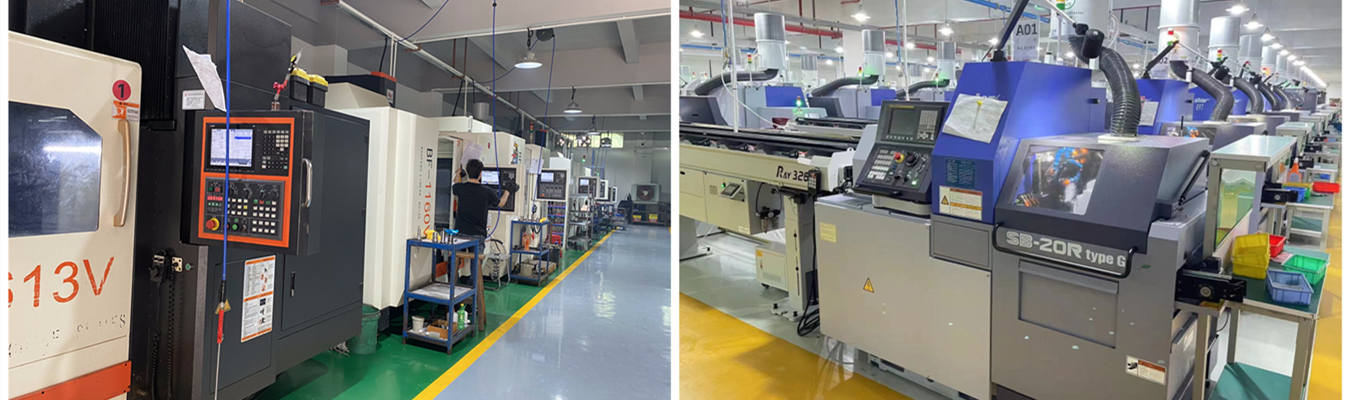
At Falcon CNC Swiss, we utilize state-of-the-art five axis machines and an engineering driven, hands-on approach to create impellers to meet your specifications for both performance and cost. From a single prototype through high production quantities, we can deliver whatever your needs are.
Contact us today for a free DFM analysis and to receive a competitive quote. Take some time to explore our capabilities to produce impellers and discover why we are able to provide our customers who are OEMs all over the world with the most demanding types of rotating components.
A: The principal cause of chatter is a low rigidity of the workpiece. Thin-walled impellers are subject to vibration due to the cutting forces imparted on them. The longer the tool is, the more it will cause vibration to occur. Solutions to reduce chatter are: reducing your depth of cut, utilizing a variable flute pitch end mill, and optimizing the spindle speed to avoid having your tool hit its resonant frequency.
A: Per ISO 1940 standards, we use two-plane dynamic balancing machines to balance the impeller. The impeller is rotated at the operating rpm, and sensors measure the vibrations through an analog signal to establish the location of the unbalance. The weight is removed from predetermined areas until the residual unbalance has been satisfactorily reduced to within tolerable limits.
A: For very high-speed applications and where lightweight is desired, titanium (Ti-6Al-4V) is ideal for the application, however it is costly. Another great option at lower speeds is aluminum 7075-T6, as it has an excellent strength-to-weight ratio and is significantly less costly than titanium.
A: Yes, we have many customers who provide us with castings to finish machine to tolerance. This is much more efficient than machining from solid bar stock, as it saves a lot of time when doing the rough operations and material that would otherwise be wasted.
A: The more blades on an impeller, the more programming time required to produce the machining program, and the longer it takes to machine each blade. For instance, if you double the number of blades, you will basically double the total time you would have spent on both roughing and finishing all of the blades on the impeller. If a project is sensitive to the overall cost, you may want to consider reducing the number of blades on the impeller if its performance remains at an acceptable level during normal operation.