English
  日本語
日本語  한국어
한국어  français
  Deutsch
  Español
  русский
  العربية

Jul
Learn More
14

Tight tolerances on small diameter shafts which have a high ratio of length to diameter mean that the deflection, vibration, run-out, and dimensional stability must all be carefully monitored during the manufacturing process. In this case study, a project is provided about the production of Swiss machining small diameter shafts.
By employing Swiss CNC turning, aided bar stock, improved cutting parameters and regulated inspection process, new manufacturing method was developed to reduce shaft deflection and ensure constant geometry along the entire length of the shaft. The goal of the project was to prove that Swiss CNC machining shafts is an effective solution for high precision shaft machining in both prototype and series manufacture
The case also highlights key considerations discussed in our Swiss Machining DFM Guide and Swiss Machining for Small Diameter Parts resources.
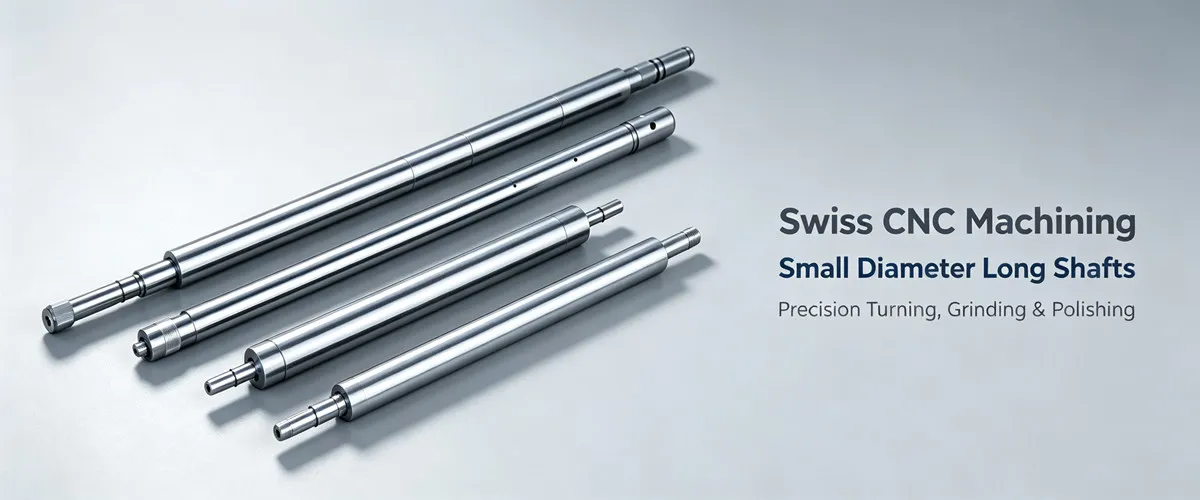
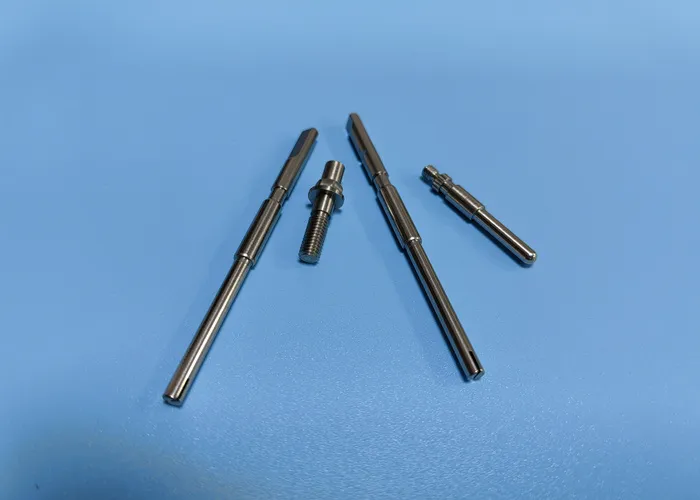
Shafts with small diameter have been in demand in high precision mechanical assemblies where accuracy in measurements, concentricity and surface quality of the product play a significant role. The aim of this project is to manufacture a custom made shaft with small diameter giving great importance to geometry and diameter accuracy, which has high speed and reliability in terms of repeatability of processes that are involved in manufacturing the product.
The component in the precision shaft machining program was subjected to a machining technology that was able to produce parts with incredibly tight tolerances along the length of the shaft and with fewer complications of slender pieces such as deflection and vibration problems. The precision shaft was obtained through a process of Swiss CNC turning which assures good support and control for the complex precision machined shafts of small diameter.
The shaft was made as part of Falcon CNC Swiss's Swiss Machined Components capability, including precision pins, shafts, and other small features where high dimensional stability is necessary. The same is true for Pins and Shafts applications, which require an accurate diameter, straightness, and concentricity to ensure proper assembly performance.
| Parameter | Specification |
| Component | High-Precision Small Diameter Shaft |
| Manufacturing Process | Swiss-Type CNC Turning |
| Material | Stainless Steel 316 / Precision Alloys |
| Part Geometry | Long Slender Multi-Diameter Shaft |
| Diameter Range | Ø3–12 mm Typical |
| Shaft Length | Up to 300 mm |
| Diameter Tolerance | ±0.005 mm Typical |
| Runout / Concentricity | ≤0.005 mm TIR Typical |
| Surface Finish | Ra 0.4–0.8 μm Typical |
| Machining Challenges Controlled | Shaft Deflection, Vibration, Tool Pressure |
| Critical Features | Precision Diameters, Shoulders, Grooves, and End Features |
| Inspection Methods | Micrometer Measurement, CMM Inspection, Runout Testing |
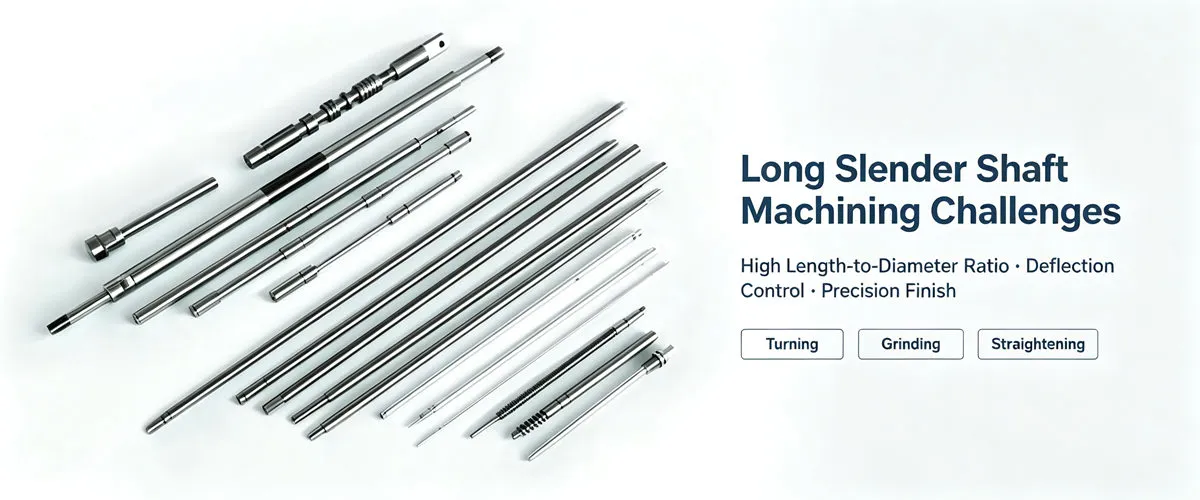
Long, thin shafts create challenges that are not an issue when working with short and robust parts. The more the length-to-diameter ratio increases, the more vulnerable the workpiece is to forces during machining, vibrations, and heat fluctuations. If the process is not adequately controlled, various problems, such as dimensional inaccuracies, tapering, defects on the surface, and excessive runout may occur.
When dealing with Swiss machining long slender shaft, the most important consideration is keeping the workpiece stable during machining. The thin diameter means that it has low structural rigidity and the length of the unsupported portion increases the deflection caused by the tool. This makes shaft machining deflection one of the key factors affecting dimensional accuracy.
Another common issue is shaft bending during machining. Other causes might include misuse of cutting tool, too much cutting force being employed, or poor machine settings causing movement of the shaft in an undesired way. In turn, the above problem will manifest after machining in the form of diameter changes, problems with straightness, or increase in eccentricity.
Workpiece deflection: Cutting forces can temporarily bend a slender shaft and affect dimensional accuracy.
Vibration and chatter: Insufficient support or unsuitable cutting parameters can create vibration and poor surface finish.
Diameter consistency: Long shafts require stable cutting conditions to maintain tight diameter tolerances from one end to the other.
Runout and concentricity: Small positioning errors can become significant when multiple diameters, shoulders, and grooves must remain concentric.
Tool pressure: Tool geometry and cutting conditions must be controlled to avoid excessive radial forces.
For these reasons, long slender shaft machining challenges must be addressed at the process-planning stage rather than relying solely on final inspection.
One of the most critical factors in tight tolerance shaft machining is controlling shaft machining deflection during cutting. Slender shafts, having smaller diameters and longer lengths, have a much lower value of bending stiffness than regular turned parts. Thus, even small cutting forces will cause shifts in the position of shaft during cutting.
During the machining process, excessive tool pressure and instable cutting conditions may lead to bending of the workpiece shaft during machining operation resulting in a change in dimension across the length of the shaft. The only way to tackle these issues is ensuring that manufacturers handle the aspects of part setup, tooling, cutting parameters, and support conditions in a competent manner.
In precision shaft applications, dimensional stability is acquired with the help of optimized manufacturing practices in conjunction with monitoring through every step of the process. By eliminating unintended motion during the machining process, Swiss CNC turning ensures consistent geometry and repeatable accuracy for complex precision machined shafts.
Keeping the conditions of cutting steady is important when making precision shafts of small diameter. Thanks to their slender design, these components are prone to vibrations that can influence the quality of the surface, the precision of the dimensions, and the performance of the final shaft with regard to runout parameters.
Establishing effective vibration control in Swiss machining is dependent on assuring appropriate workpiece support in conjunction with minimizing any unnecessary movement throughout his/her cutting process. In the case of Swiss-style CNC turning machines, the guide bushing system allows for holding of the material very close to the cutting edge, providing higher rigidity and lesser deflection than any regular turning methods.
Moreover, optimized choice of tools, the selection of appropriate cutting parameters, and proper chip control all contribute to maintaining the stability of the machining process. The above factors allow the user to achieve repeatable precision in Swiss CNC shaft machining of complicated three-dimensional shapes such as shafts with steps, precision diameters, grooves, and many other important features.
For demanding precision shaft machining applications, controlling vibration is essential to maintaining surface quality, concentricity, and long-term production consistency.
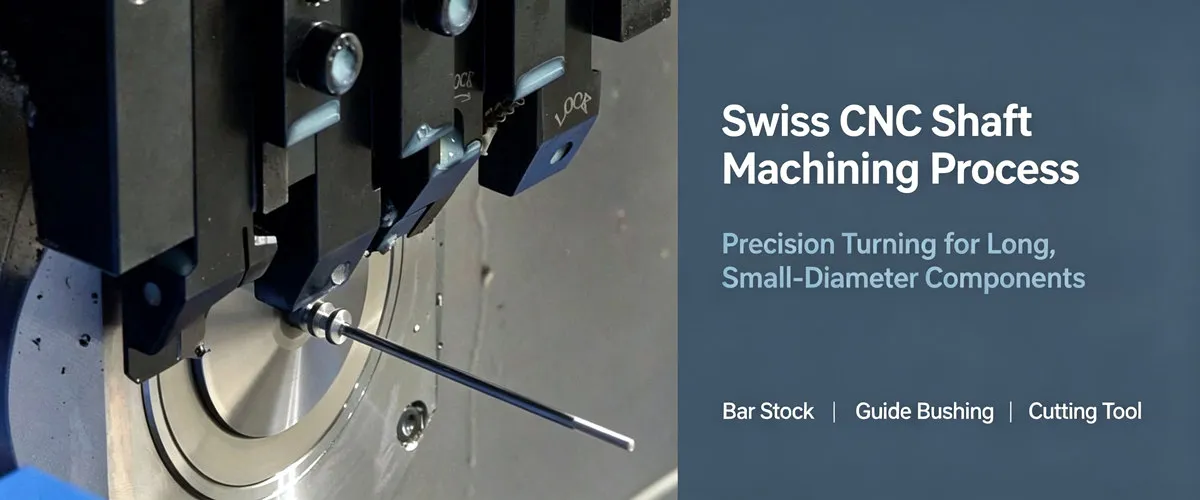
In order to create a small diameter shaft of highly precise specifications, it is necessary to control both geometry of the component in addition to the stability of the material used. The selected method involved Swiss-style CNC machining which allows the production of long and thin products with stringent tolerances.
Unlike traditional turning methods, Swiss-style machining places the cutting tool near the guide bushing thereby limiting the unsupported section of the component being machined during cutting. This approach improves rigidity, minimizes vibration, and helps control deflection when performing Swiss turning for long shafts.
The manufacturing process included multiple controlled operations:
| Process Step | Manufacturing Approach |
| Material Preparation | Precision Stainless Steel Bar Stock |
| Swiss Turning | Multi-Axis Swiss CNC Machining |
| Feature Machining | Precision Diameters, Shoulders, Grooves, End Features |
| Process Control | Optimized Tooling and Cutting Parameters |
| Finishing | Deburring and Secondary Operations When Required |
| Inspection | Dimensional and Concentricity Verification |
Falcon CNC Swiss offers Swiss Machining Services that are meant to facilitate prototyping and serial production of precise components. Since Swiss turning is combined with sophisticated precision CNC machining techniques, manufacturers can achieve consistent outcomes where accuracy and reproducibility are paramount, as well as in cases where intricate shaft shapes are involved.
The approach is not limited to obtaining the desired dimensions but also to achieving process stability in the course of production. This is particularly important in small shafts manufacture since small variations of operating conditions may change the final outcome of the process.
The guide bushing support system in Swiss-type machining is among the main advantages and it ensures the stability of production when machining parts with long length-to-diameter ratios. In a Swiss machining long slender shaft application, the material is supported further away from the cutting area, resulting in lower control of the workpiece during the turning process.
The conventional turning processes might lead to a longer section of the workpiece, causing greater risks of deflection and vibration that can hinder the accuracy of the diameter and concentricity measurements. The Swiss machining system manages to eliminate such problems due to the uninterrupted support of the material used in the machining process.
This method of support becomes important in Swiss turning of long shafts since it is necessary to preserve perfect straightness, surface quality, and size tolerance across the whole shaft. Swiss CNC technology helps overcome common long slender shaft machining challenges and provides reliable results for precision shaft applications.
In order to attain good results in high precision shaft machining, it is necessary to ensure careful control of the tools, machining conditions, and process parameters. In case of small diameter shafts, choosing the wrong tools or excessive cutting forces may result in vibrations, which will lead to increased tool wear and loss of dimensional stability.
Tool geometry, cutting speed, feed rate, and depth of cut are chosen based on the part characteristics, which provide vibration control in Swiss machining. Appropriate tool selection reduces radial cutting force, which is very important for precision shaft machining.
Process optimization is critical in Swiss machining because chip removal and stable cutting parameters can be improved which also leads to vibration control in Swiss machining. For specific materials such as stainless steel 316, the right parameters allow for the achievement of desired surface quality while ensuring minimum burr formation and dimensional alterations.
Thanks to optimized tool usage and repeatable processes, Swiss CNC technology permits productive and precision shaft machining involving complex shapes and strict tolerances.
It is necessary to produce reliable small diameter shafts even when individual target dimensions are achieved. In precise tolerance shaft machining, companies should achieve consistency between different characteristics as diameter, shoulder, groove, as well as end shape. Minor differences can influence performance, especially of an assembly that has to perform precise movements in details.
For this project quality control was applied throughout the machining process, not just after production. Frequent monitoring of the work process tool state checks and inspection procedures ensured stable results while working with Swiss CNC turning machine.
The inspection was done in terms of important parameters such as dimensional accuracy, straightness, surface quality, and rotation alignment.
| Inspection Item | Measurement Method | Purpose |
| Shaft Diameter | Precision Micrometer / Gauging Equipment | Verify Critical Dimensions |
| Overall Length | Caliper / Height Measurement Equipment | Confirm Part Geometry |
| Shaft Runout | Dial Indicator / Rotational Measurement | Check Rotational Accuracy |
| Concentricity | CMM Inspection | Verify Feature Alignment |
| Surface Finish | Surface Roughness Tester | Confirm Machined Surface Quality |
Falcon CNC Swiss combines in-process control and final verification to meet stringent precision shaft inspections for custom components. This technique assures that each shaft is functional and retains repeatability for both prototype and production runs.
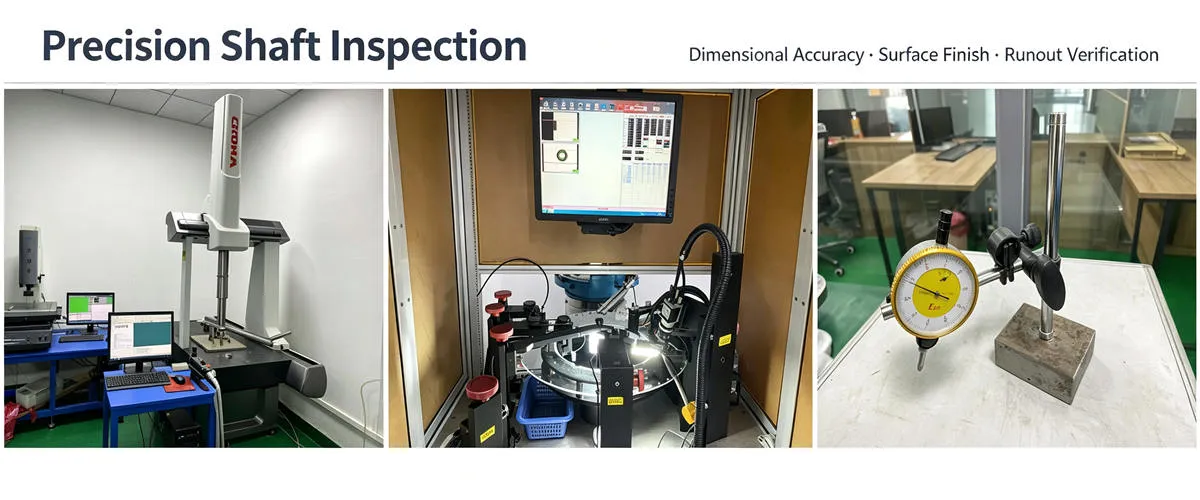
The accurate measurements of the geometry of the shafts are covered by a thorough complex precision shaft inspection process. The verification of some important shaft characteristics was done through dimensional measurements and measurements of alignment in order for shape performance to be consistent.
Inspection focused on:
Shaft dimensional inspection: Verify critical diameters, lengths, shoulders, grooves, and other machined features.
Shaft concentricity inspection: Confirm alignment between multiple cylindrical features and maintain a common axis.
Shaft runout measurement: Check rotational accuracy and minimize vibration during operation.
Surface quality verification: Ensure the finished shaft meets required surface finish specifications.
By combining Swiss CNC machining with controlled inspection procedures, Falcon CNC Swiss supports the production of precision machined shafts requiring tight tolerances, repeatability, and stable quality.
Swiss CNC turning, together with optimized cutting strategies and controlled inspection methods made it possible to manufacture high-precision small diameter shafts in a stable way. The machining process dealt with such problems as deflection, vibration and runout to have uniform dimensional accuracy along the length of the shaft.
Key manufacturing results included:
Stable dimensional control: Maintained consistent critical diameters and feature positions for complex shaft geometries.
Low runout performance: Controlled concentricity between multiple precision features to support reliable assembly and rotational performance.
Improved surface quality: Optimized tooling and cutting parameters to achieve smooth finishes required for precision applications.
Repeatable production capability: Supported prototype development and repeat production with consistent quality standards.
Complex feature machining: Produced stepped diameters, shoulders, grooves, and other functional features in a single Swiss machining process.
These outcomes show the benefits of high accuracy shaft manufacturing in applications where precision and repeatability are critical. Falcon CNC Swiss provides custom precision shafts and precision engineering shafts through Swiss CNC technology to meet the needs of industries and engineering.
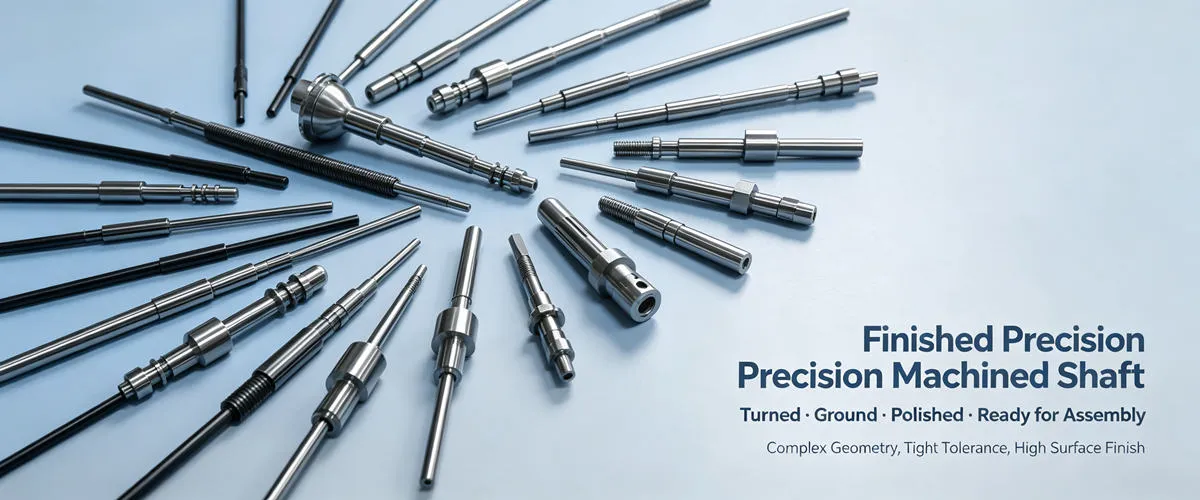
Processes of machining should support the manufacture of small diameter shafts to ensure stability, precision, and repeatability of production over the entire process. Compared to traditional turning methods, Swiss CNC technology is superior in terms of holding the workpiece and cutting, which means it is appropriate for manufacturing complicated shaft shapes.
For a Swiss machining small diameter shaft application, key advantages include:
Improved workpiece stability: Guide bushing support reduces deflection during machining.
Better vibration control: Stable cutting conditions help maintain surface quality and dimensional accuracy.
High precision capability: Swiss CNC turning supports tight tolerances for complex shaft features.
Efficient production: Multiple operations can be completed with consistent repeatability.
These benefits allow Swiss machining to be a good choice for precise shaft machining, particularly for making long shafts, reduced diameter shafts, and other Swiss machined products that need tight tolerance.
Falcon CNC Swiss works with advanced Swiss CNC shaft machining technology and engineering-oriented process planning so customers could create dependable Swiss machined components in any type of production.
Need high-precision shafts for your next project?
Falcon CNC Swiss provides custom precision shafts with Swiss CNC turning, tight tolerance control, and reliable inspection capabilities. Contact us for a Swiss machining solution tailored to your part requirements.