English
  日本語
日本語  한국어
한국어  français
  Deutsch
  Español
  русский
  العربية
Dec
Learn More
04

Motor shafts are a crucial part of every electric motor, servo, stepper and industrial pump used in many advanced applications. High-speed rotation creates large amounts of vibration, due to even minor imbalance (in the micron range). This can result in premature bearing wear, failure and ultimately shortened useful life of the motor assembly. Falcon CNC Swiss combines many manufacturing techniques (Swiss machining, screw machine products and in-house dynamic balancing) to manufacture precision motor shafts with tight tolerances, mirror finishes and optimal mass distributions.
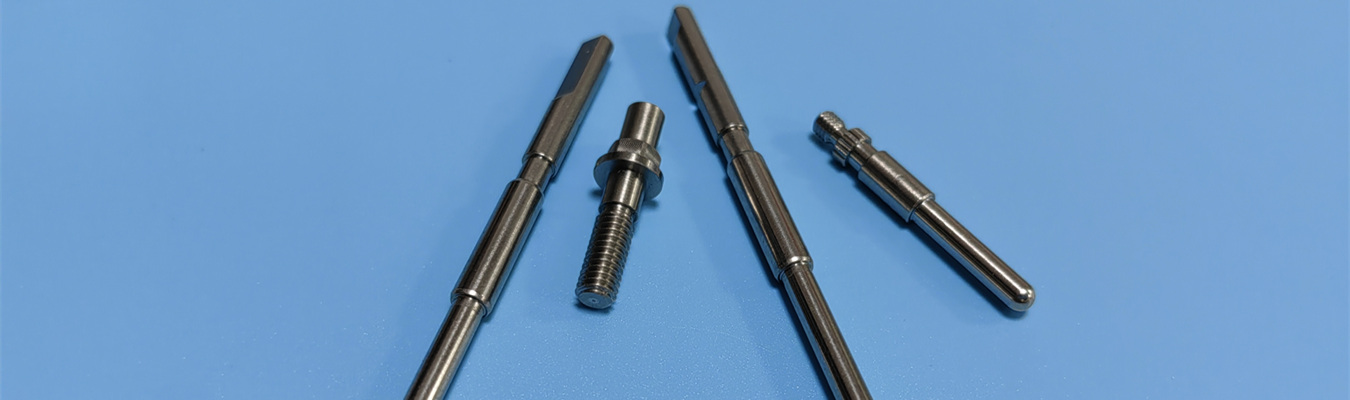
As a design or manufacturing engineer, you understand that a motor shaft consists of much more than just a turned part. It serves to transmit torque from the rotor to the load, support rotating weights, and very often act as a reference point for the bearings, gears, and encoders on the drive. When a shaft is poorly made, it can result in runout, vibration, noise, and decreased motor life. Conversely, a shaft that is precision ground and well balanced can be operated at speeds greater than 20,000 RPM with very little energy loss and extended bearing life.
For manufacturing motor shafts, Swiss-type automated lathes (also known as Swiss screw machines) are the optimal type of process, with diameters of less than 32 mm and lengths of 300 mm maximum. The Swiss machining process supports the part being machined directly adjacent to the cutting tool using a guide bushing, eliminating any possibility of deflection from the part during machining, and allowing for an extremely concentric relationship of the diameters, threads, and splines. At Falcon CNC Swiss, we are able to provide all aspects of custom motor shaft fabrication, from prototypes through high volume precision motor shaft production while providing integrated high-speed rotation balancing services.
The motor shaft transfers the torque from the rotor of the motor to whatever load (e.g. a fan, pump, gearbox, or wheel) the motor will be used to drive. The motor shaft also supports the rotor assembly and usually supports or positions bearings, commutator disks (in DC motors) or encoder disks. The geometry of the shaft has an influence on the dynamic performance level of the motor, the noise level and the life of the motor.
Common design variations in motor shafts include:
| Shaft Type | Key Features | Typical Applications |
|---|---|---|
| Straight / cylindrical shaft | Uniform diameter, simple geometry, low cost | Fractional horsepower motors, fans, pumps |
| Stepped / tapered motor shafts | Multiple diameters for bearing seats, shoulder for axial location | Servo motors, industrial AC motors |
| Keyed motor shafts | Keyway cut along shaft for positive torque transmission | Heavy-duty industrial motors, conveyors, mills |
| Splined shaft manufacturing | External or internal splines for high-torque, sliding applications | Automotive steering, transmission, off-road equipment |
| Double-ended motor shafts | Protrusions on both ends of rotor for dual loads or encoders | Servo motors, stepper motors, compact drives |
| Hollow motor shafts | Reduced inertia, allows wiring or cooling fluid passage | Robotic joints, spindle motors, medical devices |
As a full-service motor shafts manufacturer, Falcon CNC Swiss produces all of the above geometries using Swiss turning, milling, and cylindrical grinding – all within a single setup or with minimal secondary operations.
High-speed Rotational Balancing is done to fix unbalanced forces by redistributing mass along the axis of rotation of the shaft. An ideally machined rotating shaft can have unbalanced forces because of density variation between the parts, variations in how parts were made (i.e., swashing, spline machining), and any holes through the cross section of the rotating shaft. At increasingly faster rates of rotation (i.e. Time to complete one revolution of rotating shaft), an imbalance on the shaft will induce quadratically increasing unbalanced forces to be produced due to increased velocity of the unbalance from its original position. For example, if the rotational speed of a rotating shaft is 20,000 RPM, a force imbalance of 10mm radial distance from the center of rotation of the shaft will create a resultant reactive force of approximately 44N (10 lbf) which produces a significant amount of vibration, bearing failure and audible noise in the system.
Balancing grades are defined by ISO 1940-1 (which supersedes ISO 1940). Common grades for motor shafts:
| ISO Balancing Grade | Typical Application | Max Residual Unbalance (e·ω) |
|---|---|---|
| G 16 | General industrial machinery, fans, pumps, small electric motors | 16 mm/s |
| G 6.3 | Better quality motors, machine tool spindles, medium-speed drives | 6.3 mm/s |
| G 2.5 | High-speed motors (servo, spindle), turbochargers, precision grinders | 2.5 mm/s |
| G 1 | Extremely high precision (gyroscopes, dental drills, aerospace) | 1 mm/s |
As part of our motor shaft balancing services at Falcon CNC Swiss, we perform balance testing on precision (hard-bearing type) balancing machines after performing machining and grinding to help ensure that after balance testing, the shafts will achieve G 2.5 or more for high-speed applications. The correction of the balanced motor shaft is made by either drilling or milling to remove material from the shaft or adding counterweights.
Need a reliable OEM motor shaft supplier for a new servo motor or industrial pump design? Share your 2D drawing or 3D model. Our engineers will recommend optimal material, balancing grade, and manufacturing process within 24 hours. Get your free DFM review →
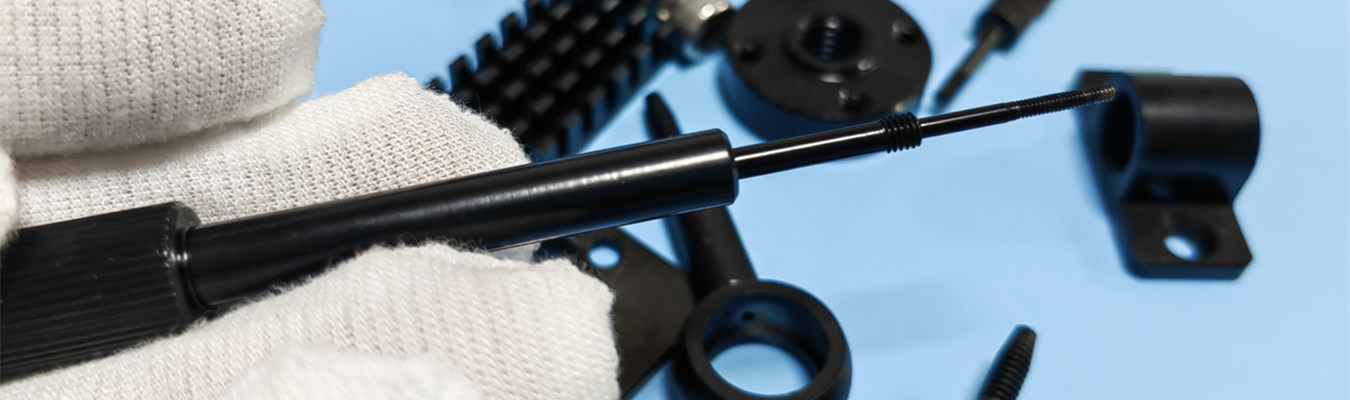
The choice of shaft material directly impacts torque capacity, wear resistance, environmental durability, and cost. Below are the most common materials we machine at Falcon CNC Swiss, along with their typical applications.
The standard stainless steel motor shafts are made of stainless steel (303, 304, 316, 17-4 PH) are used in: food processing, medical devices, marine and chemical applications. The 303 grade of stainless steel is great to machine, while grade 316 has superior corrosion resistance to salt-water and acids compared to other grades of stainless. The 17-4 PH (precipitation hardening) stainless material achieves high (up to 1100 MPa) tensile strength after being heat-treated; therefore, they are great for high-torque applications. The Falcon CNC Swiss machines use Swiss lathes to machine the stainless steel coupled with specialized tooling to prevent work hardening, achieving surface finishes of as low as Ra 0.2 μm.
Carbon steel shaft manufacturing typically uses grades 1045, 1144, or 12L14. For industrial motors, pumps, and conveyors, carbon steel shafts are usually made of grades 1045 (medium carbon), 1144 (high-strength), or 12L14 (lead-free). Carbon steel is very easy to machine and has great overall strength at a very economical price point. With that being said, carbon steel shafts must be protected from moist or corrosive conditions with some type of surface treatment (paint, plating, or oil) to avoid corrosion. For applications requiring higher strength, we use 4140 or 4340 alloy steels that can be hardened by either heat or induction methods.
Alloy steel motor shafts, automotive-transmissions and off-highway equipment utilize alloy steel motor shafts (4140, 4340, 8620, 9310) for their superior tensile strength (800 - 1200 MPa) and high fatigue resistance. Case-hardened grades (8620) have a hard exterior surface of 58-62 HRC but consist of a strong core material resistant to shock.
Hardened motor shafts surfaces that make contact with bearing inner rings, lip seals or spline couplings require hardened motor shafts. At our facility, you can specify either through-hardening (complete hardness) or induction hardening (hardening only the surfaces of journals and spline ends). Depending on your application, we would expect to produce shafts with an average hardness of 50-55 HRC for use in applications requiring extended wear life, and for very high cycle applications (58 to 62 HRC). After hardening, the shafts would be precision ground to provide a final diameter tolerance of ±0.005 mm or tighter. Explore our pins and shafts capabilities →
Chrome plated motor shafts with a chrome plated finish (hard chrome plating @ a 10-25 micron layer thick) provide low-friction, high wear resistance and enhance corrosion protection with hardness equivalence in the 65-70 Rockwell hardness range of scale C. The chrome plating process has been applied to hydraulic motor shaft, piston rods and linear motion shaft components. To ensure consistent coating without edge build-up or hydrogen embrittlement, we will work closely with our certified plating partners.
In terms of manufacturing high-torque applications (mining conveyor systems, wind turbine generators), we manufacture shafts from 17-4 PH, Inconel 718, or Nitronic 60 material for any extreme torque application. For corrosion-resistant motor shafts used in aggressive chemical and/or saltwater environments, we recommend 316L, duplex 2205 or titanium grade 2/5 for any of these applications. Falcon CNC Swiss has an extensive material inventory available for use in both prototype and production.
A complete motor shaft manufacturing workflow typically includes several steps. At Falcon CNC Swiss, we integrate as many operations as possible to reduce handling and improve accuracy.
Motor Shaft Turning by Citizen and Tsugami Swiss CNC Lathes - Citizen and Tsugami Swiss CNC lathes are perfect machines for processing expertly motor shafts. The guide bushings support the bar stock within 5mm of the cutting tool, thereby effectively eliminating deflection. This permits the ability to machine numerous motor shafts with L/D ratios as high as 25:1 while providing between the two diameters average concentricity below 0.005mm TIR. Also, unlike traditional lathes, Swiss turning has the capability of performing live tooling (milling, drilling, cross holes, keyways) during the same cycle.
To regain the dimensional accuracy, precision ground shafts must be ground after they have undergone a heat treatment process to develop the final surface finish. Our company specializes in using two types of grinding operations to produce high-precision, ground shafts: centerless grinding (for long, through-feed shafts) and cylindrical grinding (for stepped shafts with shoulders). Some of the typical tolerances we achieve through grinding include: ±0.002 mm on diameter; Ra 0.1 μm on surface finish; and roundness < 0.001 mm. As a shaft grinding company, we provide both in-house and partner grinding services.
CNC milling using indexing attachments and wire EDM (internal splines) is the method used to manufacture keyed motor shafts and splined shafts manufacturing. The keyways will be manufactured to H9 or more exacting tolerances. Keyways will be manufactured to DIN 6885 and ANSI B17.1. The splines will be manufactured to DIN 5480, ANSI B92.1, or to custom specifications. All keyways and splines will be concentric to the center line of the shaft within 0.02 mm TIR.
For the purpose of mounting a rotor, fan, or pulley using the interference fit method, there are various designs of tapered motor shafts (for example: 1:10 and 1:50 tapers). Servos and Swiss turning machines with a C-axis allow for very precise taper angles to be produced in addition to them having consistent dimensions across production batches resulting from machine set-ups. To assure that the taper angles are correct, they will be verified using Optical Comparators or CMM.
Both ends of double-ended motor shafts require good machining to the same amount of concentricity. Our Swiss lathes equipped with an additional sub-spindle (pick-off) can machine the first end, then mechanically transfer it to the sub-spindle for machining of the second end without being re-chucked. Because of this we know that the bearing seats and shaft ends will be aligned correctly.
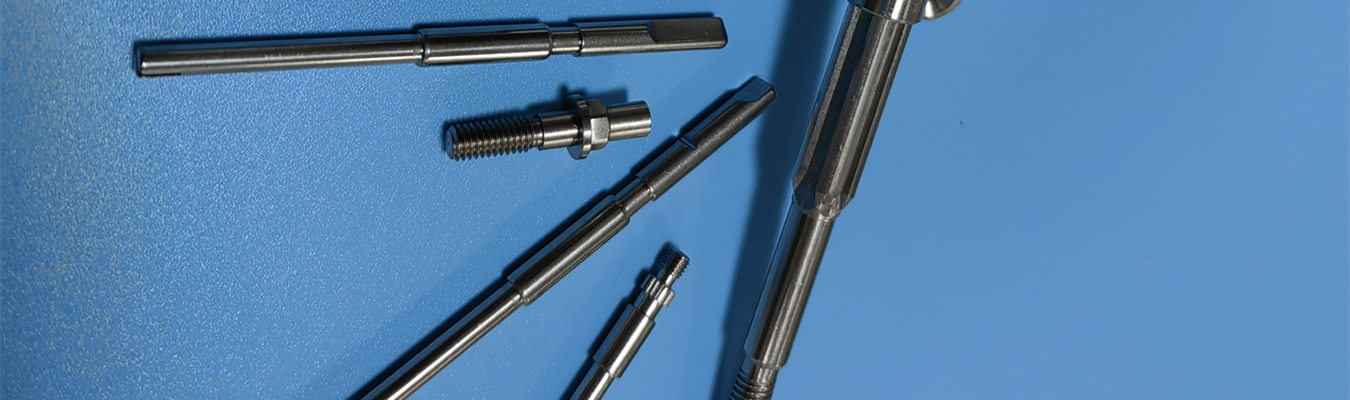
Falcon CNC Swiss serves customers across multiple industries, each with unique shaft requirements.
As electric motor shaft suppliers, we produce shafts for fractional to 50 HP motors. Press fit rotor mounting diameters, snap ring grooves, keyways and threaded ends for fan retention are typical features. We obtain ultra-close concentricity (≤0.005 mm) to achieve ultra tight tolerances on the production of servo motor shafts manufacturing with dynamic balance costs to the G 2.5 or G 1.0 levels. Our step motor shaft manufacturing involves precision flat alignment of encoder disks as well as providing consistent diameters to fit bearings.
Automotive motor shafts are used in electric power steering (EPS), starter motors, window lift actuators, and electric vehicle drive units. Some of these components will have production volumes of over 100,000 pieces per-year. Falcon CNC Swiss offers support for automotive programs by producing Swiss screw machine products that are 100% inspected for critical dimensions (diameter, runout, hardness). Processes are IATF 16949-compliant. See our automotive precision machining →
To resist the effects of corrosion, wear on seal faces, and fatigue due to continuous operation, industrial pump shafts must be made of corrosion-resistant materials. Industrial pump shafts are manufactured from 316 stainless, 17-4 PH or duplex alloys that have been machined with a fine journal surface finish to accommodate mechanical seals. Low carbon steel or stainless steel materials are commonly used for fan motor shafts which include threaded ends for retaining blades and flat surfaces for set screws.
Generator shaft manufacturing requires large diameters (up to 32 mm on our Swiss lathes, larger on partner CNC turning centers) and high torque transmission. We produce generator shafts for backup power units, wind turbine pitch drives, and portable generators.
The majority of our clients approach us with specific performance metrics (RPM, torque, environmental constraints) that they need fulfilled. Our engineers will assist you in designing your motor shaft by selecting the right material, calculating the appropriate diameter for critical speeds, identifying bearing fits, and designing balancing correction planes using a collaborative method which results in fewer iterations, and faster time-to-market. Explore more Swiss machined components for all industries.
As an ISO certified shaft manufacturer (ISO 9001:2015), Falcon CNC Swiss implements rigorous motor shaft quality control for every batch.
Our inspection protocol includes:
100% dimensional inspection of bearing journals, keyways, splines, and thread features using CNC vision systems, laser micrometers (resolution 0.0001 mm), and CMM.
Surface finish measurement (Ra, Rz) on all contacting surfaces – bearing seats (target Ra ≤ 0.2 μm), seal journals (Ra ≤ 0.4 μm).
Hardness testing per batch using Rockwell or Vickers testers; case depth verification for induction-hardened shafts.
Runout and concentricity measured between bearing journals and centerlines – typically ≤ 0.005 mm TIR.
Dynamic balancing per ISO 1940-1 on hard-bearing balancing machines. Reports include residual unbalance (g·mm) and balancing grade achieved.
For tight tolerance shaft machining, we maintain process capability indices (Cpk ≥ 1.33) on critical diameters. Material certifications (EN 10204 3.1) are provided upon request.
A. A motor shaft is an element in a rotating assembly that transfers torque from the rotor in a motor to an outside load. Motor shafts can also support bearings, rotors, and encoder components. They come in various shapes (ex: straight, stepped, keyed/splined, hollow) depending on how they will be used.
A. The balancing process involves measuring and correcting for mass unbalance across a rotating shaft. The existence of unbalance will produce vibration, noise, and cause premature wear on bearings. Properly balancing a rotating assembly will reduce the amount of vibration experienced and extend the life of the motor. The ISO 1940-1 standard defines balancing grades, typically G 2.5 or better for precision motors.
A. 303, 316 and 17-4 PH stainless steel (for corrosion resistance); 1045 and 1144 carbon steel (general use, low-cost material); 4140 and 4340 alloy steel (high strength); and hardened steel (for wear resistance). Chrome plated finishes add low-friction surface and corrosion resistance.
A. Standard manufacturing methods include: Swiss turning or CNC turning; possibly heat treatment after machining; grinding for final sizing of bearing journals; milling for making keyways/splines; and dynamic balancing. Swiss machining is often used due to its ability to produce tight concentricity of long-length/small-diameter shafts.
A. As one of the tight-tolerance shaft machining specialists within the industry, Falcon CNC Swiss routinely holds +/- .005mm on diameter, +/- .01mm on length, and 0.005mm TIR on runout. Grinding achieves +/- .002mm or better tolerances.
A. Yes. We are capable of supplying OEM motor shafts in production volumes of anywhere from 500 to 500,000+ pieces per year, with the option to use kanban delivery systems, electronic data interchange (EDI) for ordering, and extended pricing agreements.
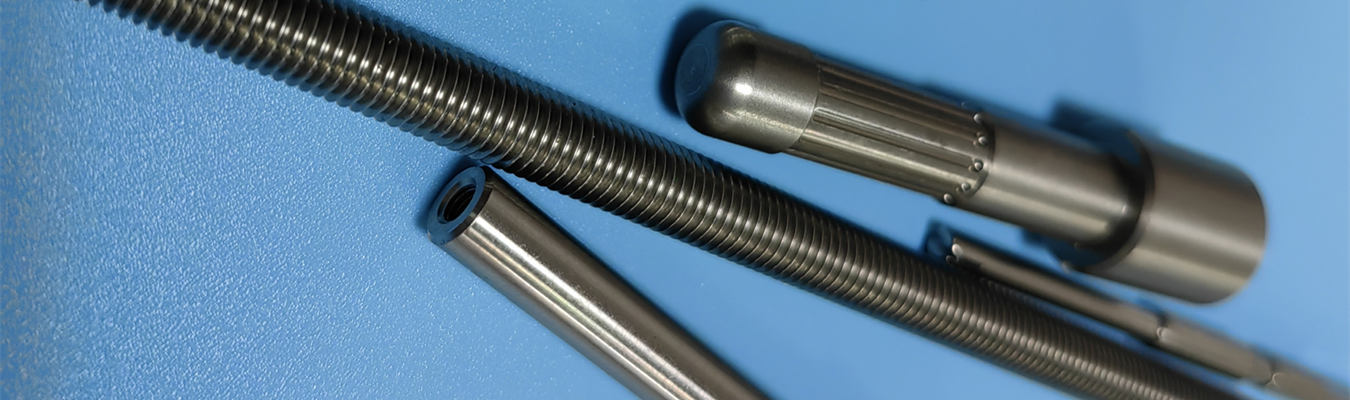
We combine Swiss turning, cylindrical grinding, dynamic balancing, and quality inspection under one roof – or tightly coordinated with certified partners.
Here’s a summary of our core capabilities:
| Capability | Falcon CNC Swiss Standard |
|---|---|
| Max shaft diameter | 32 mm (Swiss lathe); larger on secondary CNC lathes |
| Max shaft length | 300 mm (longer with steady rest) |
| Typical diameter tolerance (turned) | ±0.005 mm |
| Ground tolerance | ±0.002 mm |
| Surface finish (turned) | Ra 0.2 μm |
| Surface finish (ground) | Ra 0.05-0.1 μm |
| Concentricity (between journals) | ≤0.005 mm TIR |
| Balancing capability | G 2.5 standard, G 1.0 upon request |
| Materials in stock | Carbon steels, alloy steels, stainless steels (303, 304, 316, 17-4 PH), brass, titanium |
| Heat treatment partnersThrough-hardening, induction hardening, case hardening, nitriding | |
| Plating/coating partners | Hard chrome, electroless nickel, zinc, black oxide |
Our team of Swiss-trained machinists and quality engineers ensures that every shaft – whether a prototype or a million-piece production run – meets your print and performance requirements. Explore our precision electronic machining capabilities →
Don’t let vibration, runout, or long lead times compromise your motor design. Contact Falcon CNC Swiss for a no-obligation quote on custom motor shaft fabrication. We provide DFM feedback, balancing recommendations, and firm pricing within 48 hours. Request your quote now →