English
  日本語
日本語  한국어
한국어  français
  Deutsch
  Español
  русский
  العربية


Jun
Learn More
02

Swiss machining is defined as a process of precision manufacturing to achieve specifically small, lengthy, and complex components that require high dimensional accuracy. Unlike conventional turning, Swiss machining provides support to the workpiece by being closer to the cutting area, minimizing instability when providing the production for small diameter or lengthy features.
This Swiss machining guide provides information about manufacturing aspects required by engineers when analyzing the possibility to use Swiss CNC machining for new applications. Instead of repeating the description of Swiss machining, it explains how the technique can be applied in diverse part designs and requirements.
The guide discusses the main elements in the selection and planning process involved in Swiss precision machining, including the manufacturing processes, capabilities of the machine, selection of the material, quality control process, design for manufacturing as well as comparison of the machining process with the traditional CNC turning.
Apart from that, it also provides information on where Swiss precision machining gives the best manufacturing benefits as well as the situations when it is better to use some other CNC methods. Hence, this guide will be useful for engineers who are considering new designs of components, choosing a machining technique, or planning the whole production from prototypes made to order to mass production.
To learn about the manufacturing processes determined by the application, you can head to Falcon's Swiss machining services.
Swiss-type machining is especially appropriate when the detail has small size and small size features such as long or narrow shapes, has to have several machining features, and has to meet strict dimensional specifications. Nonetheless, it is not necessarily the best process for every turned product, as it depends on the geometry of the product, its required operations, material type, tolerances, and production volume.
The following factors can help determine when Swiss machining is appropriate:
| Part Requirement | Swiss Machining Suitability |
| Small-diameter components | High |
| Long or slender geometry | High |
| Multiple turning features | High |
| Cross holes, flats, or grooves | High |
| Tight dimensional requirements | High |
| Repeated production quantities | High |
| Large-diameter components | Often better suited to conventional turning |
| Simple, short turned parts | Conventional CNC turning may be more economical |
For small part Swiss machining, maintaining stable support near the cutting area can be particularly valuable when machining long or slender geometries. This kind of process allows to combine turning with other operations including drilling, threading, grooving, and live-tools milling which minimizes the number of setups needed for complex parts.
Thus, production volume is another issue to consider. In cases of big runs of parts, benefits of Swiss machining become evident due to automated bar feeding as well as standardized cycles of machining, which enable the process to be habitual for production of larger batches. However, in cases of a simple part with insignificant production run, a set of operations needed is too complicated for Swiss machining making conventional CNC turning more suitable.
Whether Swiss machining is a better process cannot be questioned. The main thing to be considered is whether Swiss process meets the needs of a particular component.
The creation of a Swiss-machined component usually involves a series of machining operations instead of a single process of turning. The specific approach varies based on the CAD drawing, type of material, component geometry and the requirements of the tolerance.
A typical Swiss machining process may include the following stages:
| Manufacturing Operation | Typical Features or Purpose |
| Bar stock preparation | Establishes the starting material and required bar diameter |
| OD turning | Produces diameters, shoulders, tapers, and stepped profiles |
| Grooving | Creates reliefs, retaining grooves, and functional details |
| Drilling | Produces axial holes and internal passages |
| Threading | Produces internal or external threads |
| Cross drilling | Creates radial holes and intersecting features |
| Live-tool milling | Produces flats, slots, hex features, and other milled details |
| Knurling | Adds functional or gripping surfaces where required |
| Part-off | Separates the completed component from the bar |
| Inspection | Verifies critical dimensions and specified requirements |
One of the most significant benefits of merging these Swiss machining processes is the chance to achieve a variety of operations without transferring the part from machine to machine. A decrease in the number of secondary setups may increase positional accuracy and ease of production management for complicated small parts.
The order of technological operations is fixed in the process planning stage. For instance, a part that has to be turned, threaded internally, drilled crosswise, and milled requires a sequence of processes that need to be modified along the way in order to eliminate any danger of losing accessibility to the necessary tool.
When preparing for production, it is necessary to take into consideration the choice of tool, process parameters, method of holding the workpiece, coolant, method of chip disposal, and need for inspection. Such factors become crucial when machining small features or introducing materials producing chips that can be difficult and wear out tools.
Thus, the process of Swiss turning can be viewed as a unified manufacturing process rather than simple turning. The aim is to utilize the needed machining processes in the most solid way without losing dimensional accuracy. For additional information on the range of manufacturing options available for high-precision parts, see Falcon's precision machining services.
Swiss machining's true worth relies on its capacity to integrate precision turning and numerous machining functions for small and elaborate components. As a result, the Swiss machining capabilities include dimensional accuracy, as well as size and complexity of parts, tool accessibility, and multiple feature production.
When it comes to small parts Swiss machining, essentially tiny shafts, pins, bushings, screws, fittings, and other parts with precisely formed turned features can be produced. The use of live tooling allows getting even more complex components, for example, those involving cross holes and grooves.
| Capability | Typical Application |
| Small-diameter turning | Pins, shafts, screws, and miniature components |
| Precision OD turning | Bearing, sealing, and mating surfaces |
| Internal turning and boring | Bores and internal functional features |
| Threading | Internal and external precision threads |
| Grooving | Retaining, sealing, and clearance features |
| Cross drilling | Radial holes and intersecting features |
| Live-tool milling | Flats, slots, hexes, and other milled features |
| Bar-fed production | Repeatable production of multiple components |
Precision Swiss machining is very advantageous when parts have numerous common sections that should be dimensionally and spatially stable. The fewer setups used, the less handling and movement there is in the process; bar feeding ensures production is always reproduced accurately.
However, machine specifications should not be mistaken for achieving a guaranteed tolerance for each individual piece. There are many factors influencing the actual outcome of such work, like material, geometry, feature size, tools, machining conditions, machine's state, thermal stability, and control requirements. For example, processes required to make a long and thin part differ from those required to make a short and robust part, even though both are manufactured on the same type of Swiss CNC machine.
In addition, the manufacturing strategy should be determined by its production volume. The use of an automated high-precision Swiss machine is appropriate for a number of small items that require repeatable cycle times. As such, when assessing the parts, engineers need to ask not whether a Swiss machine is capable of producing, but whether the size, geometry, features, accuracy, and production specifications make Swiss machining an ideal manufacturing method.
The materials selected for Swiss machinings influence directly on the life of the tool, control of chips, dimensional stability, surface quality, and efficiency of production. The different types of materials that are used for Swiss machining give vast opportunities for CNC Swiss machining in the manufacturing of parts made for the needs of such spheres as electronics, medicine, automotive, aviation, and industry.
Common materials for Swiss machining include aluminum, stainless steel, brass, titanium, carbon steel, copper, and some engineering plastics. The choice of material depends on the needs of the material in terms of its physical characteristics and usability as well.
| Material | Key Considerations for Swiss Machining |
| Stainless Steel | Strength, corrosion resistance, and chip control |
| Aluminum | Low weight, good machinability, and surface finish |
| Brass | Excellent machinability and suitability for small precision parts |
| Titanium | High strength-to-weight ratio and increased tool wear |
| Carbon & Alloy Steel | Strength, hardness, and heat treatment requirements |
| Copper | Electrical conductivity and heat generation during machining |
| Engineering Plastics | Dimensional stability, low weight, and thermal behavior |
Swiss machining stainless steel is commonly selected when corrosion resistance and mechanical strength are important, while Swiss machining aluminum is well suited to lightweight components requiring efficient material removal. Brass is particularly attractive for precision electrical and mechanical components because of its machinability.
However, titanium and certain other tough alloys require different approaches to cutting conditions, tools, heat generation, and chip evacuation. Such materials lead to higher costs and more wear of tools which makes process planning more important. It is also true for working with engineering plastics since this process requires different parameters such as heating, deformation, and dimensional stability, which differ from those used in case of metals.
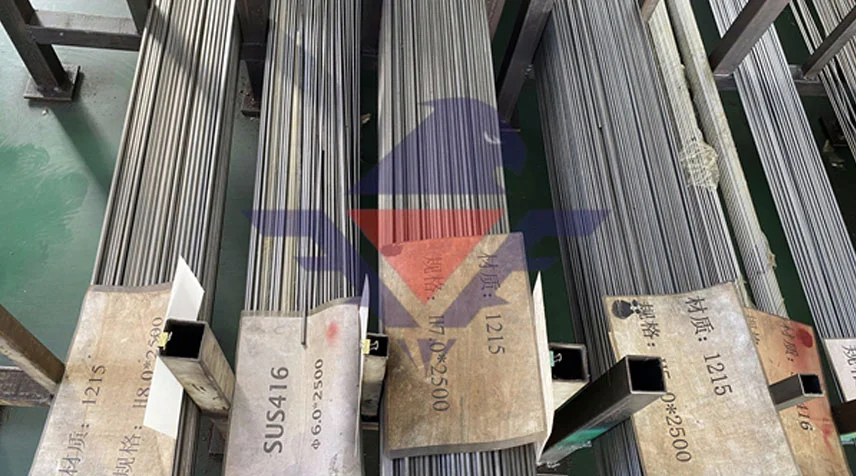
Choosing the right material requires knowing its diameter and availability. Swiss machining starts with bar stock, the material grade, condition, diameter tolerance, and straightness are important for successful machining. For object-specific recommendations including stainless steel, aluminum, brass, titanium, etc see Falcon's guide for Swiss machining materials.