English
  日本語
日本語  한국어
한국어  français
  Deutsch
  Español
  русский
  العربية
May
Learn More
28

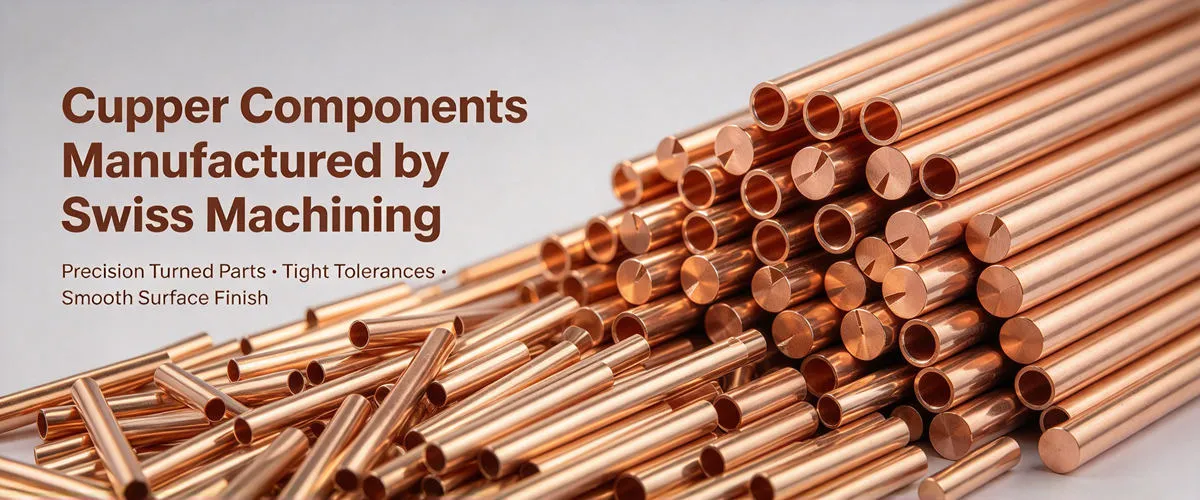
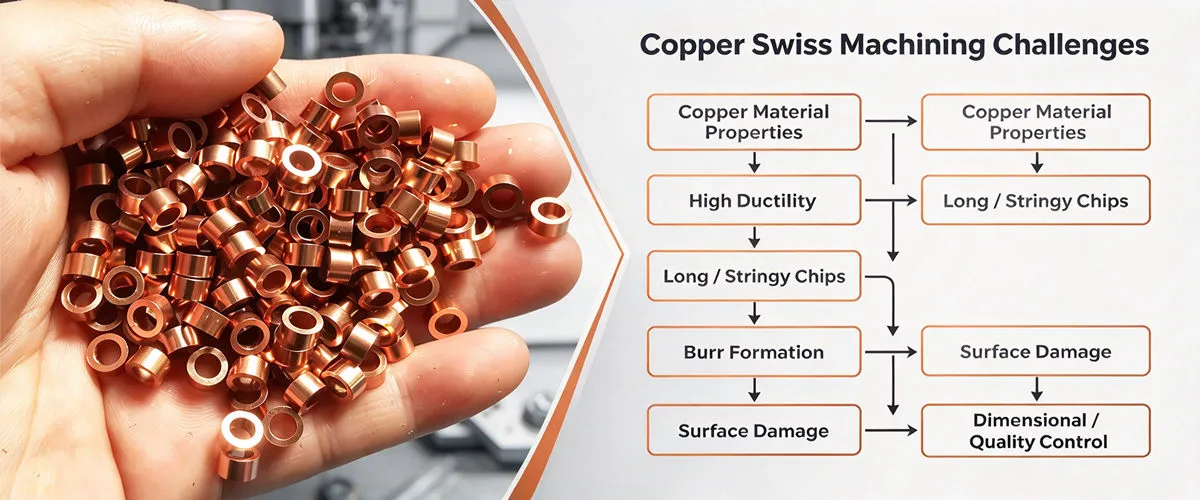
The properties that make copper desirable in terms of excellent electrical properties, thermal conductivity and corrosion resistance, However, these same material properties can make copper Swiss machining more demanding than machining many conventional metals. Due to copper's high ductility and low hardness, copper can produce long chips, burrs, and other unfavorable effects during Swiss machining processes when the focus is on small or complex geometry.
When it comes to copper components, the selection of the proper alloy and machining process is essential. Copper alloys such as C110 copper and C145 tellurium copper possess various features that can help in terms of conductivity, machinability, dimensional stability, and performance in use.
Swiss machining is effectively used in producing tiny copper pieces where repeatable sizes, watermarks, threads, grooves, and high-value production are required. However, getting good results comes down to having assistance in proper tool management, chip removal, workholding, tolerances, and inspection. Aside from that, it allows engineers to explore other material options presented in our guide to Swiss machining materials.
This guide looks at copper Swiss machining from the perspective of an engineer: choosing copper alloy, challenges during the process, possible tolerances, design considerations, inspection ideas, and the applications of this technique including manufacturing electrical contacts, connector pins, terminals, and different copper parts produced using Swiss machining. For custom copper parts from prototype quantities through production runs, explore our Swiss machining services to review available manufacturing capabilities.
Copper possesses high conductivity, both electrically and thermally, along with excellent resistance to corrosion, which makes it a useful option for precision components used in electrical, electronic, automotive, and industrial applications. Due to the above properties, copper is also a good option for Swiss machining, when components need to be manufactured with high accuracy and in large volumes.
Copper is especially good for Swiss machining when there are thin parts or too small features of a part like bolts, axes, or narrow sections. Besides, the support of a guide-bushing helps with Swiss-making stability if a detail has a long and narrow shape.
Key advantages include:
Electrical conductivity: Suitable for contacts, terminals, connector pins, and conductive components.
Thermal conductivity: Useful for components that must transfer heat efficiently.
Good machinability: Selected copper alloys can produce clean cuts and suitable surface finishes when properly processed.
Dimensional consistency: Controlled Swiss machining processes can support repeatable production of small precision parts.
Material versatility: Different copper alloys allow engineers to balance conductivity, machinability, strength, and application requirements.
Nonetheless, it is important to note that copper should not be regarded as one single manufacturing material. Pure copper and free machining copper alloys may behave differently during the cutting operation and thus the correct choice of alloy should be done before the manufacturing process is defined.
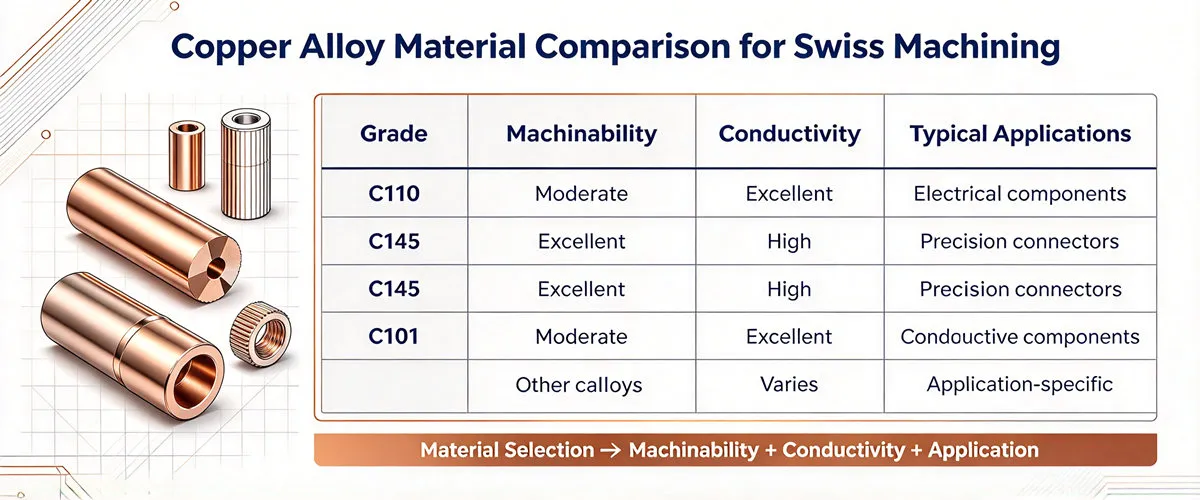
The selection of the best copper for Swiss machining depends upon the trade-off between thermal/electrical conductivity, machinability, geometry of the part, and production parameters. Copper must not be regarded as a single machining material, as each grade behaves differently in precision turning. In this regard, C110, C145, and C147 are of particular importance when choosing the copper grades for Swiss machining.
| Copper Grade | Machinability | Key Advantage | Typical Swiss Machining Applications |
| C110 | Lower | Excellent electrical and thermal conductivity | Electrical contacts, terminals, conductive components |
| C145 Tellurium Copper | High | Improved chip breaking with good conductivity | Connector pins, threaded parts, precision turned components |
| C147 Sulfur Copper | High | Good machinability and conductivity | Electrical components and precision machined parts |
When conductivity is a key functional aspect of the product one needs C110 copper Swiss machining. However, despite close to 100% IACS electrical conductivity C110 does tend to produce long chips and burrs.
Thus, for making, for instance, parts with threads, cross-holes, grooves and other complicated features, it may be better to go for C145 tellurium copper Swiss machining. The use of tellurium enables breaking of the chips and improves machinability while retaining adequate electrical conductivity levels. The C145 alternative is also good for machined pieces as it provides good machinability properties.
Thus, when deciding on a material, one must begin with the basic functional requirement of the part in question. C110 is suitable in instances where conductivity is a priority whereas C145 and C147 perform well when the geometry of the part is intricate or the need for efficiency and constant machining properties is greater than that of conductivity.
It is possible to create high precision parts by applying Swiss machining to copper; however, tolerance must be determined based on five criteria: (type of copper alloy used for machining), ( geometry of the feature), (size of the part), and (part function). For copper Swiss machining tolerances, critical dimensions should be identified separately rather than applying unnecessarily tight tolerances to the entire drawing.
Key factors affecting copper machining precision include:
Material grade: C101 and C110 pure copper are relatively soft and ductile, while free-machining grades such as C145 can provide better chip control and more predictable machining behavior.
Workholding pressure: Soft copper can deform or develop surface marks when excessive clamping force is applied. Stable, controlled workholding is particularly important for thin or small-diameter components.
Tool condition: Sharp tooling helps reduce material smearing, burr formation, and dimensional variation, particularly when machining highly conductive pure copper.
Thermal stability: Copper transfers heat rapidly and dimensional measurements can be affected by temperature. Production and inspection conditions should therefore be kept consistent when tighter tolerances are required.
Part geometry: Long, slender features, thin walls, small bores, and closely related diameters generally require more process control than simple turned features.
Surface finish: Where appearance, sealing, electrical contact, or assembly performance matters, specify the required surface finish for Swiss machined copper directly on the drawing rather than applying a tight finish requirement to every surface.
Inspection: Critical dimensions can be verified using calibrated gauges, micrometers, optical measurement, or CMM inspection depending on the geometry and tolerance requirement.
For instance, published machining sources show normal tolerances for copper features of around ±0.025 mm. It is possible to obtain tighter tolerances for certain features under controlled conditions. The performance characteristics of Swiss-style machining suppliers show that these suppliers can achieve a much tighter tolerance for some geometries. These figures should be considered something like a practical performance rather than general specifications.
A general extension of the dimensional control is the connection to Swiss machining tolerances in this case.
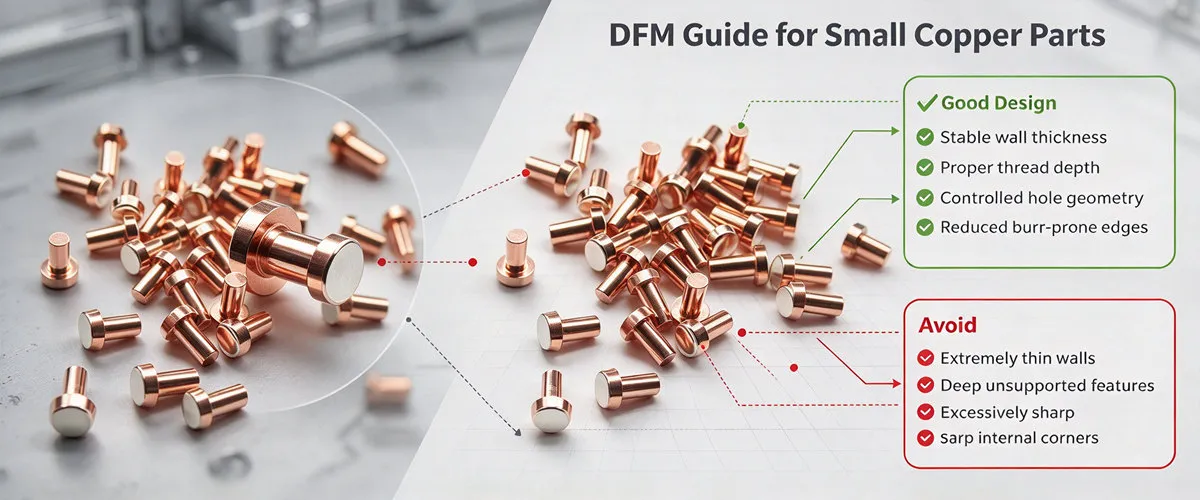
Effective copper Swiss machining design guidelines have to consider both the softness of the material and the stability requirements of Swiss-type machining. Copper is subject to deformation or burr accumulation when machining thin walls, narrow features, or unsupported edges. Designing these elements for the specific manufacturability can help to enhance dimensional accuracy and minimize the amount of finishing process required.
When designing copper parts for Swiss machining, consider the following:
Maintain adequate wall thickness. Avoid unnecessarily thin walls, especially on unsupported sections. Copper's relatively low stiffness can allow thin features to deflect during cutting. The appropriate minimum depends on wall height, alloy, support, and tolerance requirements rather than a single universal value.
Add chamfers to sharp edges. Copper can produce persistent burrs at exits, cross-holes, grooves, and intersecting features. Defined edge breaks make burr control more predictable and easier to inspect.
Use practical hole and feature proportions. Deep, small-diameter holes can restrict tool access and chip evacuation. Where possible, use practical depth-to-diameter ratios and provide sufficient clearance for drilling and inspection.
Design threads with adequate relief. Thread runouts and tool-access areas should be specified where functional geometry permits, particularly for small-diameter threaded copper components.
Apply tight tolerances selectively. Reserve the tightest dimensional and GD&T requirements for functional diameters, mating surfaces, threads, and other critical features rather than applying unnecessarily tight tolerances across the entire drawing.
In the case of more complicated copper parts, having things like material grade, temper, critical dimensions, surface finish requirements, and inspection criteria provided on the drawing will enable the planning of the production around the functional needs.
The best method for producing a copper part is determined by its diameters and geometry, tolerance specifications, amount of production, and number of machining processes involved. Swiss machining vs CNC turning for copper is an important consideration when making small conductive components with strict dimensional tolerances.
| Machining Process | Best Suited For | Typical Copper Applications |
| Swiss machining | Small-diameter, slender, precision parts | Connector pins, terminals, contacts |
| CNC turning | Shorter and more rigid cylindrical parts | Bushings, fittings, larger turned components |
| CNC milling | Prismatic or complex non-rotational features | Blocks, housings, thermal components |
Swiss machining enables good support for small copper components with extended or thin designs in the proximity of the cutting operation, thus minimizing part deflection and vibration. This is valuable in cases in which the size of small copper parts factors into the need for keeping the diameters uniform, as well as maintaining the required level of surface finish and concentricity.
Regular CNC turning may be used for making short, robust, or uncomplicated copper parts since the additional setup involved in Swiss machining does not add much value in these cases. For making larger or mainly prismatic copper parts, CNC milling may be the better option.
Engineers should therefore select the process based on the part geometry and functional requirements, rather than material alone. For conventional turning requirements, see our CNC Turning Service capabilities.
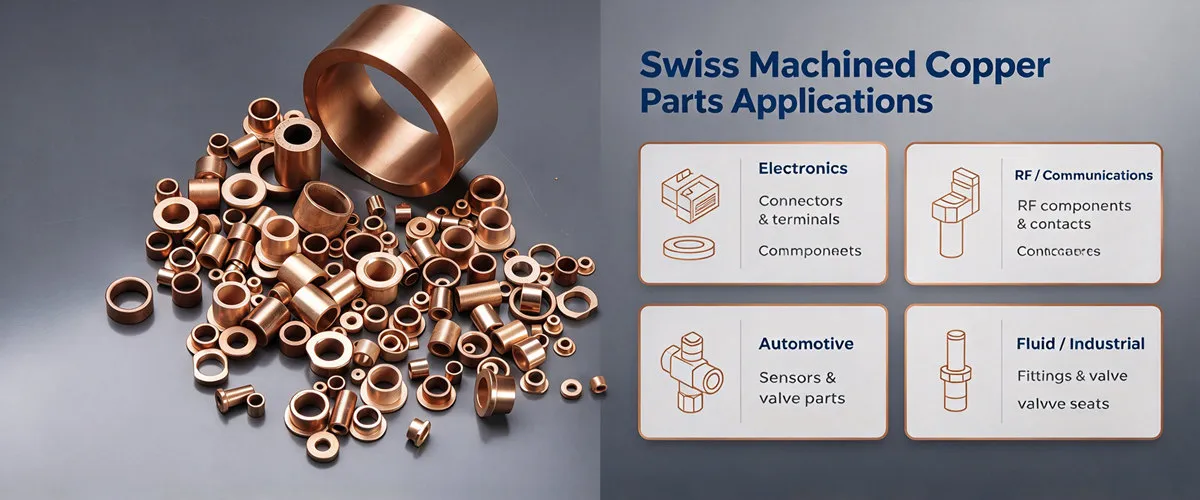
Copper is especially advantageous in the manufacture of precision parts where it is essential to have good electrical conductivity, high thermal efficiency and uniformity in size. Due to these properties, the use of Swiss machining copper has moved from traditional machining to making small electrical parts and industrial components which have the same size on all pieces.
Common applications include:
Electrical contacts and terminals: Small copper contacts, terminal pins, and conductive components benefit from the combination of conductivity and precise dimensional control.
Connector pins and sockets: Swiss machining is well suited to small-diameter pins with multiple diameters, grooves, shoulders, or threaded features.
RF and telecommunications components: Copper and copper alloys are used for conductive connector elements and RF components where dimensional accuracy and electrical performance must work together.
Industrial and fluid-control components: Precision copper fittings, valve components, and small conductive hardware can be produced when the part geometry favors turning-based production.
Thermal-management components: Copper's high thermal conductivity makes it useful for selected heat-transfer and thermal components, although larger or predominantly prismatic designs may be better suited to CNC milling.
The most suitable applications are generally small, precision copper components with turned features and repeatable production requirements. When it comes to the complex ones requiring varying diameters, threads, cross-holes and other secondary features, Swiss machining can save on operations while ensuring dimensional consistency.
Also, when talking about more component applications and various materials, this page can be naturally transitioned to Swiss machined components being the next segment.
Send us your 3D CAD file or drawing for a review of copper grade, tolerances, part geometry, and production requirements.
Request a Copper Swiss Machining Quote →
Indeed. The application of copper Swiss machining is appropriate for producing small-diameter components with precise tolerances, including electrical contact, connector pins, terminals, and other electrical parts. The proper type of copper must be chosen along with the suitable tooling, workholding, and chip-control method based on the design and specifications of the part.
The optimal copper grade relies on its application. For instance, C110 grade is common in instances when electrical and thermal conducting properties are key; conversely, free-machining copper alloys like tellurium copper (C145) provide better machinability. The grade selection process involves balancing factors including conduction properties, machining, dimensions, and application conditions.
The tolerance limits of copper Swiss machining are determined by the type of alloy used, the diameters and shape of the components, where the tolerances need to be used, and what kind of equipment is employed. Although it is possible to achieve very tight tolerances for elements requiring precision, in this case, every critical dimension should be estimated.
Pure copper is soft and highly ductile, which can contribute to long chips, built-up edge, burr formation, and surface-quality problems. Sharp tooling, effective chip evacuation, appropriate cutting conditions, and stable workholding are important for consistent precision copper Swiss machining.