English
  日本語
日本語  한국어
한국어  français
  Deutsch
  Español
  русский
  العربية

Jun
Learn More
04

Stainless steel is commonly used in making precision components that need to be corrosion-resistant, strong, and stable. However, different stainless steel grades behave differently during stainless steel Swiss machining, while most processes for making small diameters, threads, grooves, and other precision features are affected by a proper grade choice.
Using the proper grade helps in cutting performance, chip control, tool life, surface quality, and dimensional accuracy. When it comes to austenitic grades such as the 303, 304, and 316L, the work hardening and chip control issues may arise, while precipitation hardening grades such as 17-4 PH contribute to tool and cutting issues.
This guide examines the key stainless steel grades for Swiss machining, the machining properties of these grades, the issues in production and how to consistently achieve quality. It also touches upon tools, cooling agents, surface finishing, accuracy of dimensions, and treatments after machining, like passivation. For makers of stainless steel elements, see our Swiss machining services for capabilities and production support.
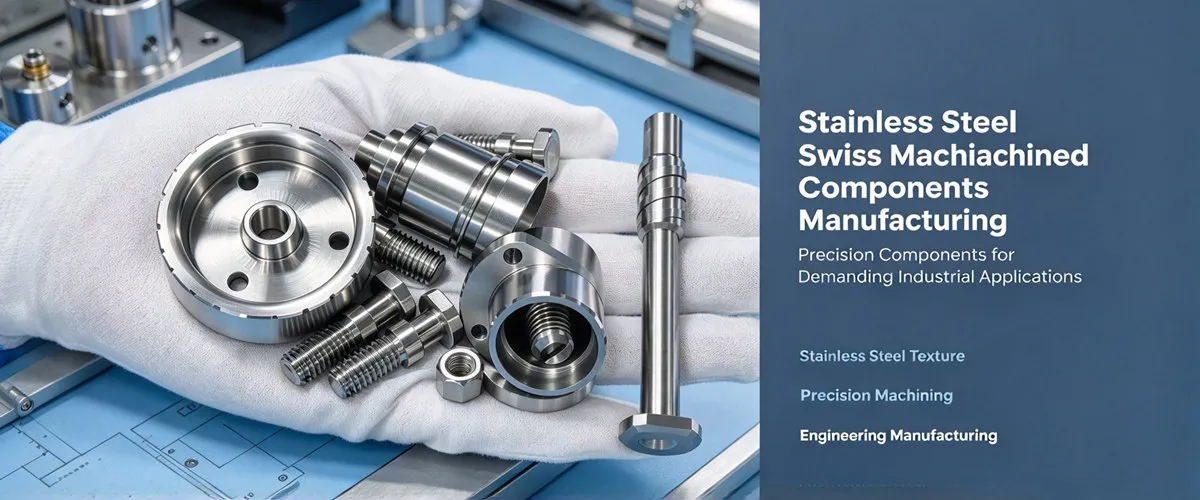
In choosing stainless steel, two aspects need to be examined: service requirements and machining performance.
In Swiss machining, different grades impact chip formation, strain hardening, tooling wear, surface quality, and dimensional tolerances, among other things. Among the common grades, the most common are the 303, 304, 316L, and 17-4 PH, but each of those grades meet various requirements in regards to machinability, strength, and corrosion stability.
303 stainless steel — A free-machining grade with good chip-breaking characteristics, making it well suited to turned parts with extensive threading, grooves, and repetitive features. Its corrosion resistance is lower than 304 and 316L, so it should be selected when machining efficiency is important and the application environment permits.
304 stainless steel — A general-purpose austenitic grade offering a balance of corrosion resistance, availability, and mechanical properties. Its tendency to work harden requires controlled cutting conditions and consistent tool engagement.
316L stainless steel — Preferred where improved resistance to chloride and chemical environments is required. Its machining behavior requires particular attention to work hardening, heat generation, and tool wear.
17-4 PH stainless steel — Selected when higher strength and heat-treatable properties are required. The material condition should be specified because its machining behavior changes significantly with heat treatment.
For a broader selection of available alloys and their machining characteristics, see our Swiss machining materials guide.
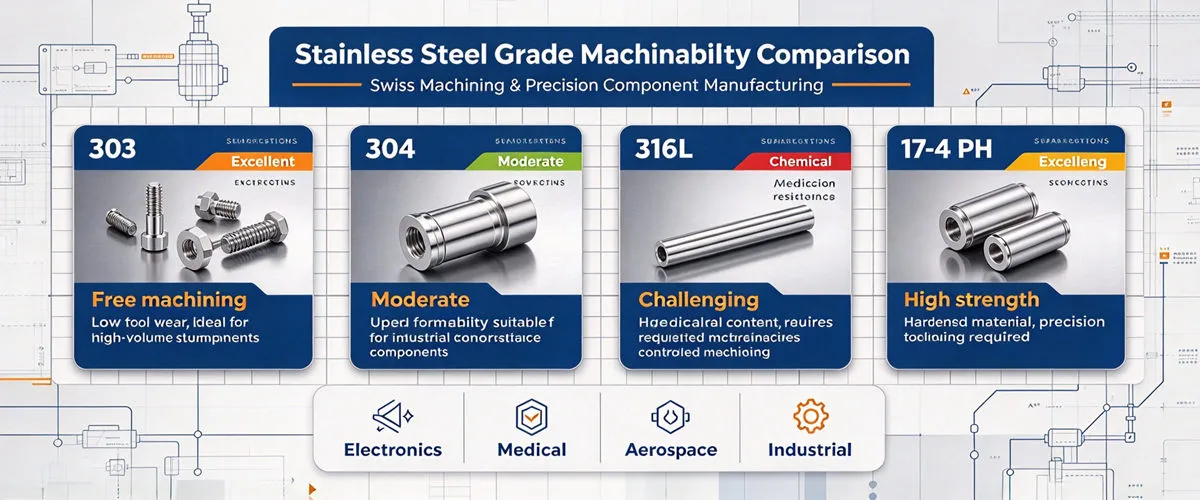
Different types of stainless steel do not behave the same way during Swissmachining operations. The hardness of the material used will affect the cutting force, the way the chips are formed, the rate of wear of the tool, the quality of the surface of the component being cut, and the accuracy of dimensions. The most commonly used grades of stainless steel when Swiss turning parts are 303, 304, 316L, and 17-4 PH.
| Stainless Steel Grade | Machining Characteristics | Key Challenges | Typical Swiss Machining Considerations |
| 303 | Free-machining stainless steel with good chip-breaking characteristics | Lower corrosion resistance than 304/316L | Well suited to small precision turned parts, threads, grooves, and high-production components |
| 304 | Tough and corrosion-resistant austenitic stainless steel | Significant work hardening and relatively difficult chip control | Maintain a consistent cutting engagement and avoid tool rubbing or repeated passes |
| 316L | Excellent corrosion resistance with good weldability | Tougher cutting behavior, work hardening, and long chips | Careful tooling and chip evacuation are important for small-diameter and threaded parts |
| 17-4 PH | High strength with good dimensional stability when properly processed | Higher cutting forces and tool wear, particularly in hardened conditions | Machining condition, material condition, tooling, and heat-treatment sequence should be considered together |
303 stainless steel is generally a good option to use when you need a high machinability level. Because it is able to chip better, it can be easier to produce high quantities of small turned products that have grooves, threads, and other repeated features.
304 stainless steel is useful because it combines good resistance to corroding and useful mechanical qualities. However, it has a tendency to strain harden and needs special cutting conditions. This can be essential especially while working with thin diameters that require less tool abrasion.
316L stainless steel is typically used when corrosion resistance is a top priority. Its toughness and strain hardening make it necessary to bond chips and take care of the tool during Swiss machining.
17-4 PH stainless steel is different from other steel types as its properties depend on its state and thermal treatment. Because of that, the machining methods should differ depending on the state of material.
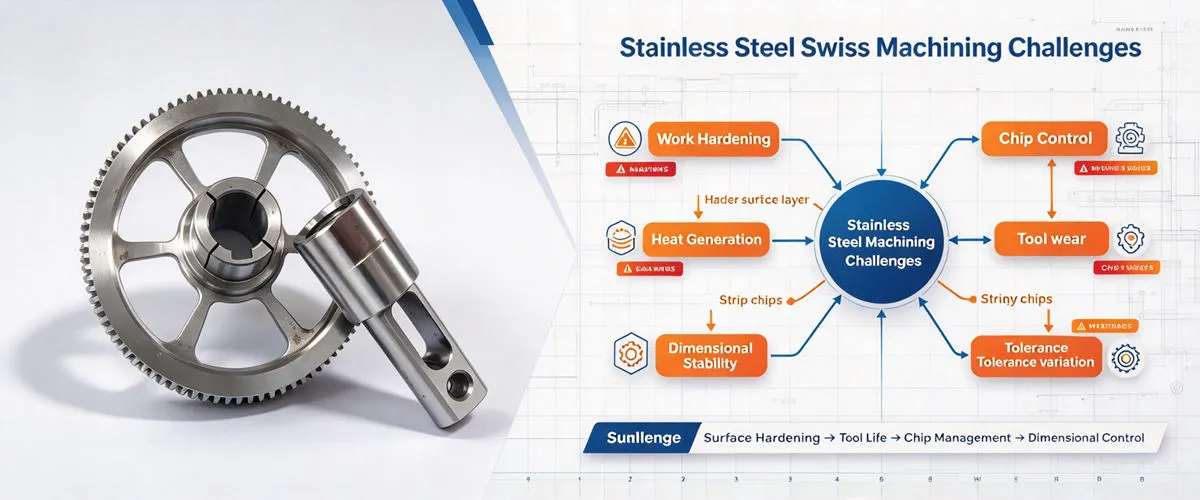
Stainless steel, although possessing superior mechanical performance and corrosion resistance, introduces a number of manufacturing problems in the stainless steel Swiss machining process. When compared to free machinable metals like brass, stainless steel often requires more accurate machining parameters, due to the difficulty of stone cutting.
For small sized Swiss machined parts, even small changes in the chip removal process can affect the dimensional consistency and surface quality of the parts. Thus, understanding these problems enables manufacturers to implement consistent machining technology when manufacturing precise stainless steel parts.
Working with many stainless steel grades — especially austenitic grades such as 304 and 316L — can lead to a phenomenon called work hardening. If cutting tools rub against the material instead of cutting through it, this will lead to the formation of the hardened surface layer, which enhances cutting resistance.
In Swiss machining, this issue is especially important when producing small features such as:
fine threads
narrow grooves
thin walls
small-diameter shafts
Proper tool geometry, sharp cutting edges, and stable feed rates help minimize work hardening and maintain consistent machining performance.
Stainless steel often produces long, stringy chips that can interfere with machining operations if not properly managed. Poor chip evacuation may cause:
surface scratches
tool damage
interrupted cutting
reduced production efficiency
Chip control is crucial in Swiss machining applications since many components are processed using a series of operations in a limited space. The use of the appropriate parameters of the cutting process, along with proper selection of tools and cooling system lead to better chip breaking and stable processing.
Stainless steel has relatively low thermal conductivity, which means heat generated during cutting can remain concentrated near the cutting zone. Excessive heat may accelerate tool wear and affect surface finish or dimensional stability.
Common issues include:
premature tool edge wear
built-up edge formation
inconsistent part dimensions
reduced tool life
Selecting suitable carbide tooling, maintaining proper cutting conditions, and controlling coolant flow are important factors for achieving reliable results in stainless steel Swiss machining.
Precision stainless steel components often require close control of:
diameter variation
concentricity
surface finish
feature location
Parts with small diameters are particularly affected by changes in temperature and wear of tools and fluctuations in cutting forces. Stable machining accompanied by control during execution and inspection after manufacturing guarantees stable part quality.
In the cases where strict dimensional tolerances are required, Falcon CNC Swiss uses reliable testing methods to check important part characteristics and guarantee producing the same results over and over again. Learn more about our approach to Swiss machining tolerances for precision component manufacturing.
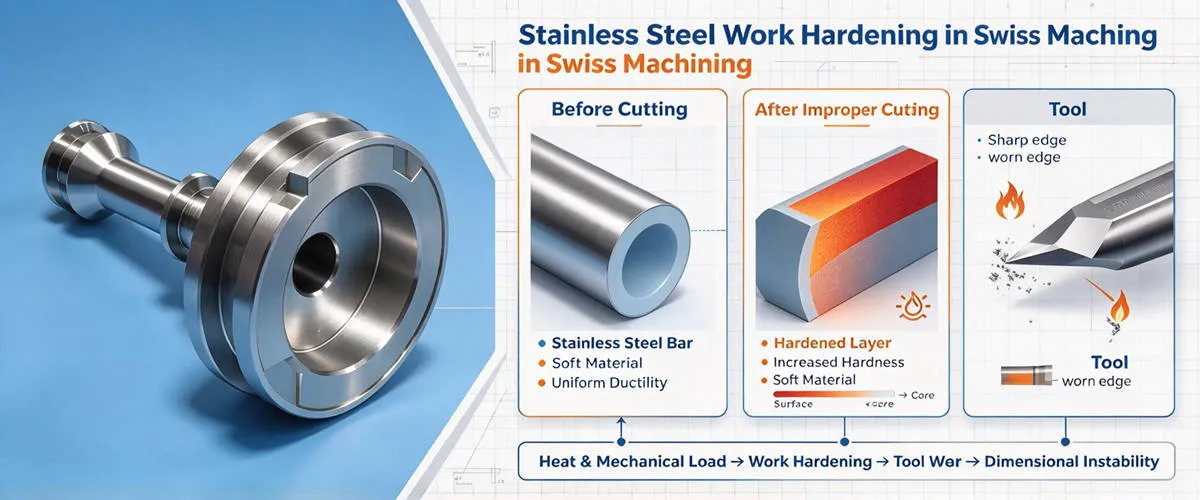
One of the primary issues encountered in machining Swiss stainless steel is controlling the cutting conditions due to work hardening and heat generation during machining. Austenitic types such as 304 and 316L are much more susceptible to work hardening. When the cutting tool rubs, stays in one position, or consistently works on the same spot, the layer of material becomes hardened, eventually increasing the required cutting force and tool wear.
For stainless steel work hardening, it is essential to maintain the position of the cutting edge rather than allowing it to rub against the workpiece. Adequate cutting tools, constant feed speed, appropriate cutting depth, and good toolholder rigidity will make the cutting tool penetrate the material instead of just compressing or rubbing it.
Another important factor is chip control. Chips that are long and stringy can be produced by stainless steel, resulting in interference with the tool, workpiece, or guide bushing and damaging the surface finish if recutting occurs. Good tool geometry and chip breakers together with efficient coolant supply will aid in the breaking and removal of chips from the cutting area.
Practical strategies for Swiss machining stainless steel
Use sharp, grade-appropriate tooling to reduce rubbing and cutting forces.
Maintain consistent tool engagement and avoid unnecessary dwell or spring passes.
Control chip formation with suitable chipbreaker geometry and cutting conditions.
Deliver coolant effectively to reduce heat and assist chip evacuation.
Monitor tool wear before edge deterioration begins to affect dimensions or surface finish.
Maintain machine and tool rigidity, particularly when machining small-diameter components.
These controls become increasingly important as part diameter decreases or the component contains threads, grooves, and other closely spaced features.
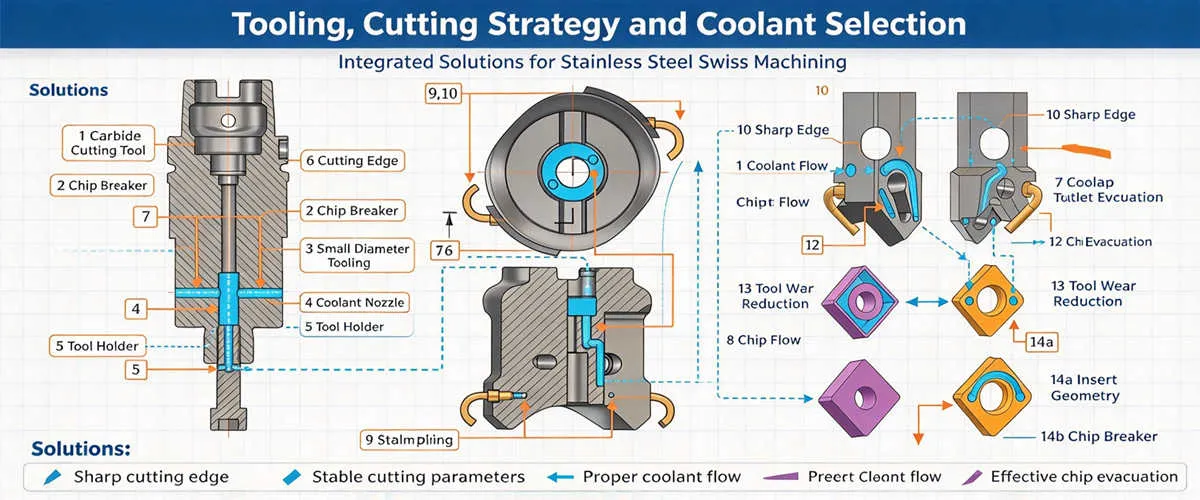
Choosing the proper tooling and cutting strategy is very important in Swiss machining of stainless steel, especially when dealing with small-diameter mechanical components with very restrictive tolerances. For instance, stainless steel materials such as 304, 316L, and 17-4 PH have greater cutting forces, heat generation, and more complicated chips than free-machining materials.
Tool selection must take into account not only hardness of the material used in Swiss machining, but also such parameters as shape, diameter, complexity of the part, and amount produced. Small tools required for operations such as threading, grooving, drilling, and turning must be rigid enough and possess proper geometry to provide necessary accuracy.
Carbide tooling with appropriate coatings and edge geometry is commonly used for stainless steel Swiss machining because it provides the hardness, wear resistance, and stability required for precision production.
Important tooling considerations include:
Sharp cutting edges: Reduce cutting pressure and minimize material adhesion, especially when machining austenitic stainless steels such as 304 and 316L.
Positive rake geometries: Help reduce cutting forces and improve chip flow during small-diameter machining.
Grade-specific coatings: Coated carbide inserts can improve tool life by reducing friction and resisting built-up edge formation.
Rigid tool holders: Minimize vibration and maintain consistent dimensional accuracy during long production runs.
Specialized Swiss tooling is employed for intricate components with grooves, threads, and small precision features to allow efficient repeatability and minimize secondary operations. Find out more about our procedures of Swiss screw machining guide.
Chip management is one of the toughest problems when it comes to machining stainless steel. Austenitic stainless grades produce lengthy and ductile chips that can disrupt the cutting process, harm the surface finishes, or affect the stability of the machining.
In Swiss machining operations, chip removal becomes even more crucial as the cutting area being located close to the guiding bushing and small diameter workpiece. The lack of proper chip management might result in:
Surface scratches on finished parts
Tool edge damage
Interrupted production
Unstable dimensions
To improve chip control, manufacturers typically optimize:
Insert chipbreaker geometry
Feed rate and cutting engagement
Tool positioning
Coolant direction and pressure
Specialized Swiss tooling systems with optimized chipbreakers and coolant delivery are designed to improve chip evacuation during difficult stainless steel applications.
Thermal conductivity of stainless steel is moderate thus heat does not pass through the material and stays concentrated near the cutting edge. Therefore, it is important to supply cooling aid properly to keep temperature under control, increase tool lifetime and ensure the quality of surface processing.
Common coolant approaches include:
| Coolant Strategy | Application Benefits |
| Flood coolant | General stainless steel turning and chip evacuation |
| High-pressure coolant | Improves cooling and removes chips from difficult cutting areas |
| Through-tool coolant | Delivers coolant directly to the cutting edge |
| Optimized coolant direction | Reduces heat concentration and built-up edge |
For precision Swiss machining, high-pressure coolant can be particularly beneficial when machining stainless steel parts with deep features, threading operations, or difficult chip evacuation conditions.
Successful machining of stainless steel revolves around finding the right balance between tooling, conditions, coolant delivery and machine stability. High cutting speeds have a negative effect since they speed up wear and lower feed rates cause rubbing which increases the work hardening of the metal being machined.
Key production practices include:
Monitoring tool wear before dimensional variation occurs
Maintaining consistent chip load
Avoiding tool dwell during cutting
Adjusting tooling strategy according to stainless steel grade
Performing first article inspection before production release
By combining appropriate tooling selection with optimized machining parameters, manufacturers can achieve reliable surface finish, dimensional consistency, and repeatable performance for stainless steel Swiss machined components.
While stainless steel is capable of achieving good surface finish and dimensional accuracy in Swiss machining, its performance is contingent on proper management of heat generation, tool wear, material condition, and finishing. Austenitic grades such as 304 and 316L are particularly prone to the effects of work hardening and heat generation, which may influence the tool life and dimensions in the course of production.
It is important to specify the surface finish of stainless steel parts using measurable Ra value instead of using ambiguous terms like smooth or fine finish. Sharp cutting tools, appropriate tool geometry, constant cutting conditions and the controlled finishing pass help reduce the effects of tearing, built-up edge and visible machining marks during the production process.
For more complex requirements, secondary finishing processes like polishing or electropolishing can be applied. In this case, the appropriate process of finishing must be chosen as per the functional requirements of the part instead of being too stringent in defining the surface requirements.
Achieving dimensional consistency involves much more than getting the right dimensions in the first part. Due to tool wear or wrongly applied heat, diameter, holes, and location of characteristic features can alter slowly over time throughout production. Measurement during the production process and controlled tool changes can help achieve repeatable manufacturing quality, especially for tiny stainless steel parts.
When it is necessary to describe important characteristics of a part, engineers should differentiate between critical and important dimensions. Only those dimensions that are necessary for the proper functioning of mated parts, bearing surfaces, and threaded surfaces should have tight tolerances.
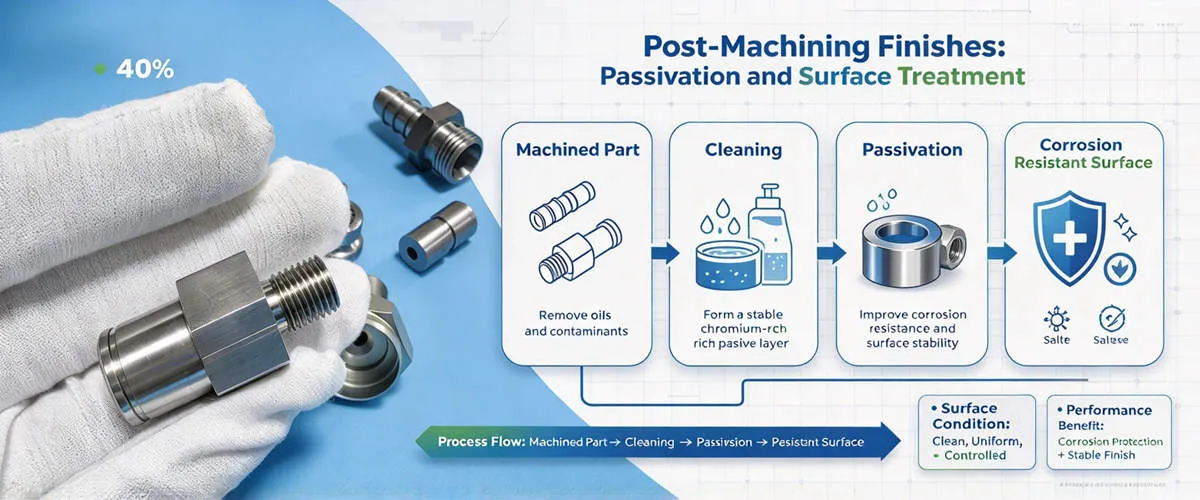
After stainless steel Swiss machining, it may be necessary to carry out surface finishing before it can effectively resist corrosion, be clean, or be in good condition. This is due to the fact that during machining, the stainless steel surface may get exposed to free iron, residual production materials, and other contaminants. Hence, passivation is often used.
Passivation is a chemical procedure for removing contaminants and facilitating formation of the passive oxide layer instead of using a coating. It has a special role to play in precision stainless steel parts where dimensional tolerance in screws, holes, etc. is especially important. The general standard for stainless steel passivation is ASTM A967.
The process of electropolishing could be employed in cases when smoother, cleaner or more precisely defined surface appearance is needed. While passivation does not involve material removal, electropolishing indeed entails such removal, which allows eliminating micro-roughness. Electropolishing thus becomes relevant for certain medical, food processing, semiconductor and similar equipment, though its dimensional impact must be taken into account in process design.
Need Stainless Steel Swiss Machining?
Send your drawings and material requirements to Falcon CNC Swiss for engineering review and a stainless steel Swiss machining quote.
Common grades include 303, 304, 316L, and 17-4 PH stainless steel. The appropriate grade depends on the required corrosion resistance, strength, machinability, dimensional requirements, and application.
316L is often harder to machine than some of the free-machining grades due to its work hardening tendency and stringy chip formation. Therefore, effectiveness will depend on proper tooling and conditions, as well as the management of chips and cutting fluids.
Employ rigid, cutting edges and use the proper cutting action to prevent rubbing and thereby avoid dwell. Proper chip removal and sufficient cooling will help control overheating and minimize any risk of the work pieces becoming work-hardened.
Certainly. Swiss machining is excellent at producing small components that need dimensional accuracy of high precision. However, actual tolerance values depend on material, shape, dimension of the part, and type of tooling used in the production process.
The process of passivation is often employed for enhancing corrosion resistance and eliminating any free iron from the surface of the machined component. The specific type of treatment will depend on the grade of stainless steel as well as the application requirements.