English
  日本語
日本語  한국어
한국어  français
  Deutsch
  Español
  русский
  العربية

Mar
Learn More
09

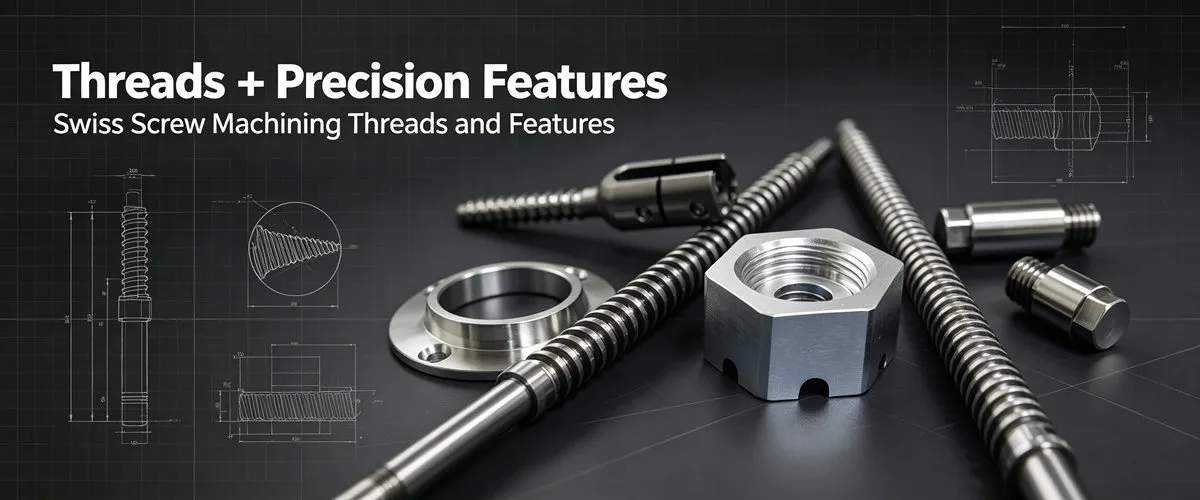
Swiss screw machining is excellent for precise components that feature such items as small diameters, threads, grooves, holes, shoulders, and other closely situated features in one single step. Modern Swiss machines can merge turning with drilling, tapping, milling, knurling, and many other processes to produce complicated parts without secondary operations.
Machine capability is important for engineers involved in Swiss screw machining parts, but it is not the only factor that affects manufacturability. The design of the thread as well as the spacing of features, access of the tooling, properties of the material, chip removal, and work sequence may influence the manufacturability and therefore the cost of the part being manufactured. Even if a feature is technically feasible, it can still require expensive tooling or more time during production due to its inappropriate position or unnecessary complexity.
This guide focuses on the engineering considerations behind Swiss screw machining threads and features, including thread design, grooves, shoulders, cross holes, knurling, tooling, material selection, production plan, and inspection. The objective is to assist designers in making engineered components by Swiss turning with the best precision and repeatability.
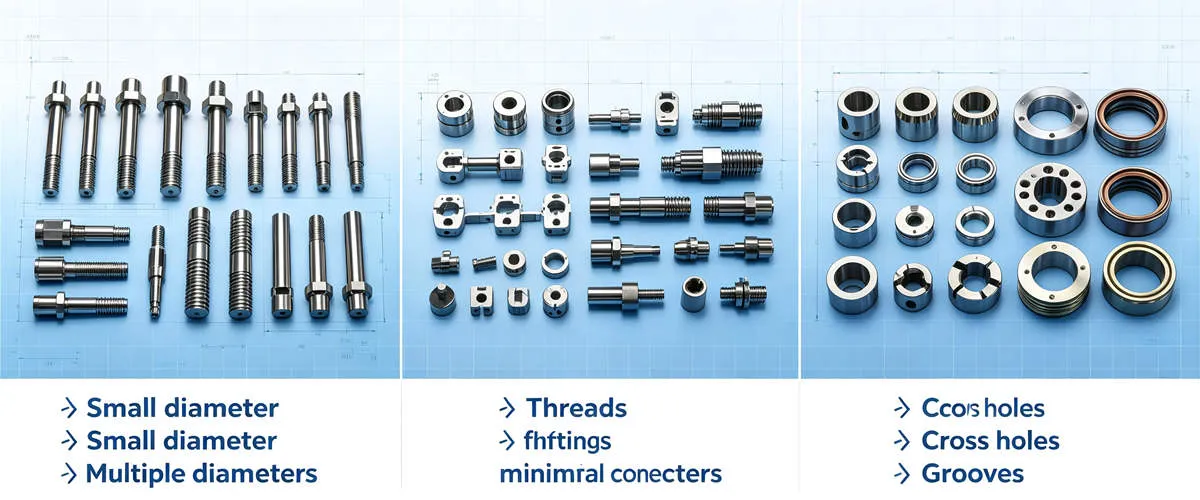
Swiss screw machining is especially effective in the manufacture of parts that have small diameter geometry, multiple precision features, and demanding positional relationships. The method is particularly advantageous for the production of parts where several machining operations—such as turning, threading, drilling, tapping, grooving, or milling—are performed in one set-up. Recent technical literature indicates that small-diameter parts with complex geometries represent the main field of application of Swiss screw machining.
Typical parts are a good fit when they include:
Small diameter screw machining requirements where conventional turning may have difficulty maintaining stability
Long or slender sections with a high length-to-diameter ratio
Multiple turned diameters, shoulders, grooves, or undercuts
Internal or external threads that must remain accurately related to other features
Cross holes, flats, slots, tapping, or knurling that would otherwise require secondary operations
Production quantities where eliminating additional setups can improve consistency and efficiency
One important thing to bear in mind is that it is not just the size of the workpiece that matters. Conventional CNC turning may be more appropriate for a small rigid component with simple geometry. On the contrary, Swiss machining is better suited for a small workpiece that is composed of intricate geometries and is experiencing complex operations in which the workpiece is supported close to the cutting area making it easier to carry out different processes.
For engineers, the most useful process-selection questions are therefore:
How small is the part? How slender is it? How many features must be related to one another? And can those features be completed efficiently in one setup?
When the answer points toward small, slender, feature-dense geometry, Swiss screw machining becomes a strong process candidate.
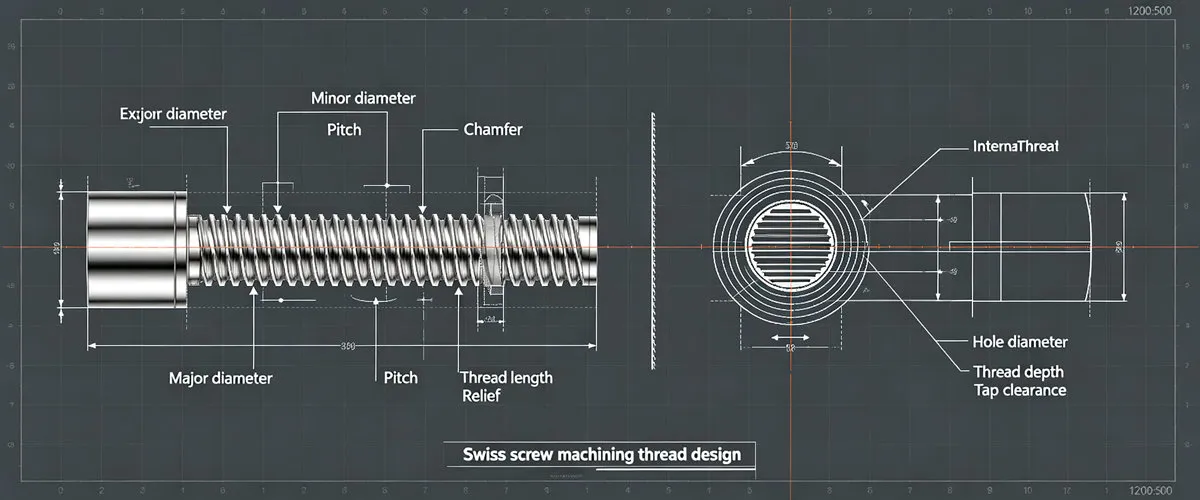
Threads are one of the most important elements of Swiss parts since they affect assembly performance, sealing properties, adjustment and reliability of the mechanical connection. Correct Swiss screw machining thread design requires balancing functional parameters with production capabilities, especially regarding the matter of small diameters, fine pitches, and small thickness of the material.
The diameter dimension isn't the only aspect of threading that needs to be measured and controlled. Various aspects of pitches (major diameter, minor diameter, pitch, thread depth, engagement length, and runout) must be taken into account when making them. If thread specifications do not consider tooling access and material, it can lead to problems during machining.
External threads are commonly produced through single-point threading, thread rolling, or specialized threading operations depending on material, quantity, and performance requirements.
When designing external Swiss screw machining threads, engineers should consider:
Appropriate thread diameter and pitch selection
Sufficient thread length for the required engagement
Adequate relief or runout space near shoulders
Avoiding unnecessary thread length that increases cycle time
A thread relief feature can provide the tool with clearance at the end of the thread, helping maintain a consistent profile and preventing interference with adjacent shoulders.
The making of inside threads demands special consideration since there may be some problems with the availability of tools and the evacuation of chips during the making of internal threads. When it comes to small threaded holes, the effect of tapping depth, hole diameter, thread engagement, and machinability of materials is especially high.
For miniature threads machining, designers should avoid unnecessarily deep blind threads or extremely fine pitches unless required by the application. Smaller tools are more sensitive to cutting forces and wear, which can influence thread quality during longer production runs.
The appropriate method depends on the material, thread size, production quantity, and required performance.
| Method | Suitable Applications |
| Single-point threading | Flexible custom thread requirements |
| Tapping | Internal threads and standard sizes |
| Thread rolling | High-strength threads and larger production runs |
| Specialized threading tools | Small or complex thread geometries |
With the help of Swiss machined threads, thread quality can be maintained by manufacturers without the need for complicated tooling and costly production processes. The thread's function, accessibility, and manufacturing needs should be considered toward the beginning of the design phase to allow engineers to come up with easy-to-manufacture and reliable components.
Thread production is amongst the most important portions of Swiss screw machining, especially when components must be conjoined for assembly, sealing, or other mechanical engagement. Although drawing the busbar may seem straightforward, successful processing greatly depends on the selection of its geometry, tooling, materials employed, and inspection requirements.
Because thread performance depends on dimensional control and functional fit, thread tolerance should be evaluated together with overall part requirements. See our Swiss machining tolerances guide for more information.
When external threads machining, it is important for engineers to pay attention to the thread diameter, pitch thread length, relief requirements, and tool accessibility. Machining threads extending directly into a shoulder or larger diameter design element may create problems with tool clearance and uniformity of threads. Proper thread relief and chamfering can enhance manufacturability and alleviate interference during machining.
The process of internal threads machining calls for extra consideration since the chip removal process, the strength of the tool, and the depth of the hole can all have a significant impact on the quality of the thread. For internal threads that are quite deep or extremely fine, it may be necessary to utilize special thread mills or taps or to establish strict cutting conditions.
In the case of precision screws, thread quality is influenced by a number of factors, such as nominal diameter, pitch diameter, profile accuracy, and surface finish. Hence thread gauges, optical inspection and dimensional measurements are widely used to verify the quality of screws'in a wide range of applications.
Appropriate engineers must keep in mind the balance between functional requirements and the manufacturing process when designing Swiss machined threads. The use of standard thread forms as well as practical thread lengths offers better manufacturing efficiency than custom thread specifications.
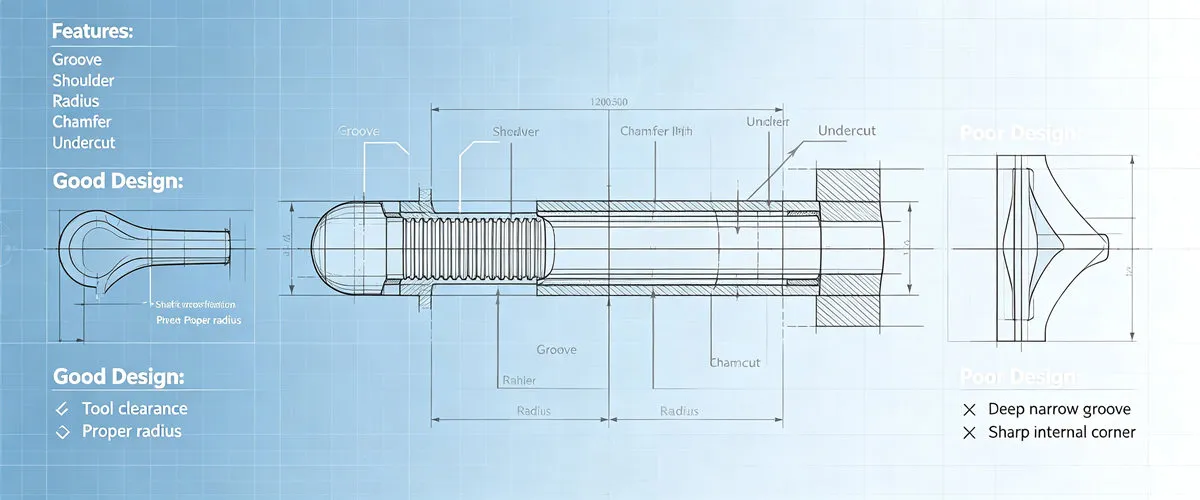
Beyond threads, the success of Swiss screw machining features depends heavily on how other turned geometries are designed. Elements in Swiss machined parts include grooves, shoulders, undercuts, and diameter changes. However, each shape impacts not only access to tools but also stability of cutting, lead time, and effectiveness of production.
Screw machining grooves are often used for retaining ring, sealing components, thread relief, and assembly clearance applications. However, the scoring depth and the width should be taken into account during the design process. Very narrow or deep grooves would involve utilizing more complex cutting tools, which can result in increased tool deflection, wear, and longer machining time.
As much as possible, groove dimensions must ensure enough clearance for the tool and enable performing its functioning purpose. Thread relief grooves are very important in this case because they allow the tool to exit appropriately and avoid interference with shoulders.
Swiss screw machining frequently involves multiple diameter sections along a single component. Properly designed shoulders help maintain part rigidity and simplify machining sequences.
For multi-diameter screw machining, engineers should consider:
The order of diameter reductions
Available tool access
Required corner radii
Functional contact surfaces
Inspection requirements
Sharp transitions between diameters may increase tool stress, while appropriate radii can improve tool life and surface quality.
Screw machining undercuts can assist the clearances for assembly, reduce the weight and generate functional relief sections. Swiss machines make use of the undercut features efficiently due to the closeness of the cutting tools working to their work area. Extremely deep and narrow undercuts might need specialized tool designs and should be considered in the design phase.
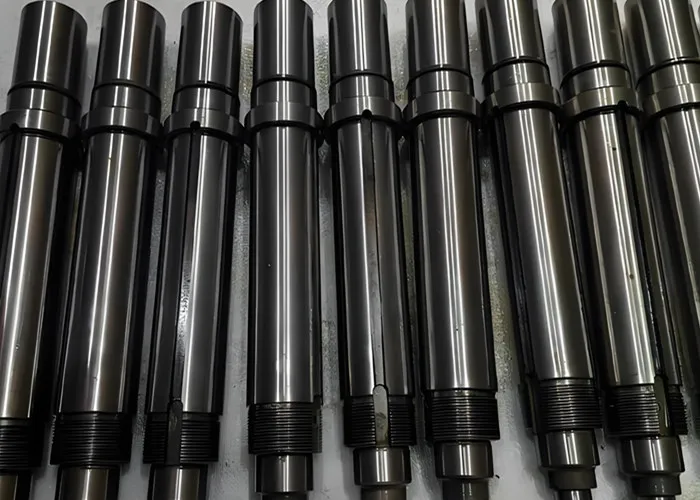
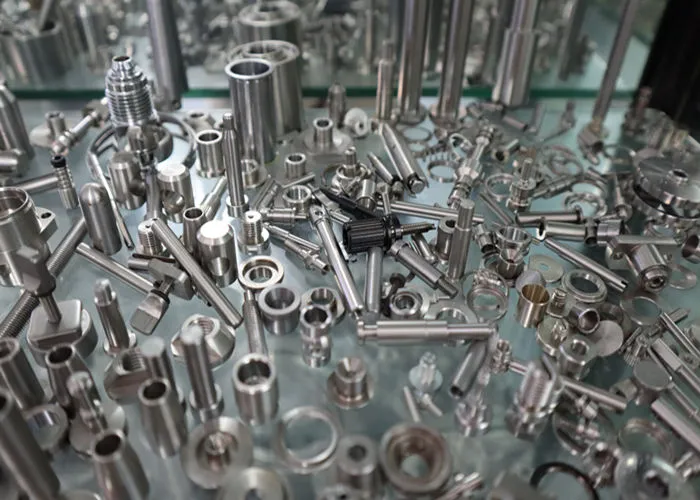
The essential technique for impact feature design is to achieve a required function using the simplest geometry possible. Removal of unnecessary grooves, excessive change of diameters or hard to reach features increases the stability of the manufacturing process. Many of these capabilities are commonly used in screw machine products, including threaded components, precision shafts, fittings, and miniature hardware.
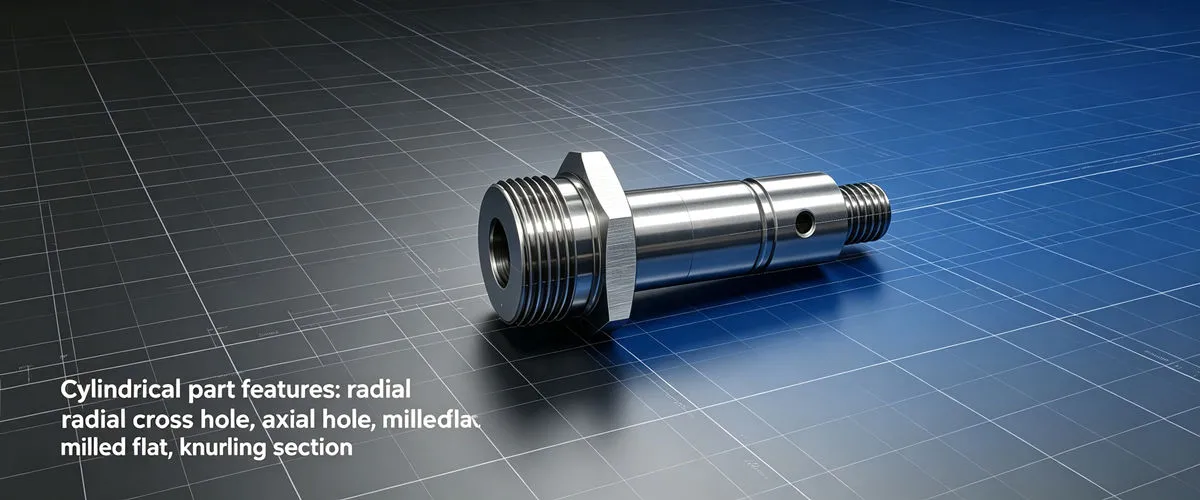
Apart from turning and threading operations, various Swiss screw machined components need some extra features to boost their positioning, assembly, functionality, and performance. One of the significant advantages of Swiss screw machines is the ability to create these details during one machining cycle. Live tooling enables cross drilling, milling, tapping, knurling, and slotting while keeping the workpiece in place.
Screw machining cross holes require careful consideration of hole diameter, depth, location, and tool access. For tiny components, even a slight error in position can impair the quality of the assembly. Designers should, whenever possible, minimize the number of deep holes unnecessary and consider the way that the cutting tool enters the feature.
Cross holes are commonly used in:
Connector components
Precision shafts
Valve parts
Fasteners
Medical components
Swiss machines with live tooling can create flats, slots, and other non-round features without transferring the component to another machine. This helps maintain positional accuracy and reduces secondary handling.
When designing these features, engineers should consider:
Tool clearance
Feature width and depth
Material strength
Chip evacuation
Screw machining knurling is usually applied to enhance grip, create surfaces for adjustments, or produce areas for press-fit. However, one should take into account that knurling entails the application of additional forming forces that may complicate the process especially when working with small-diameter or thin-wall pieces.
Suitable features planning enables a manufacturer to get complex parts manufactured. Combining turning, threading, cross features, and secondary operations in one Swiss process reduces the time of production and improves consistency. For examples of finished components using these manufacturing approaches, explore our Swiss machined components capabilities.
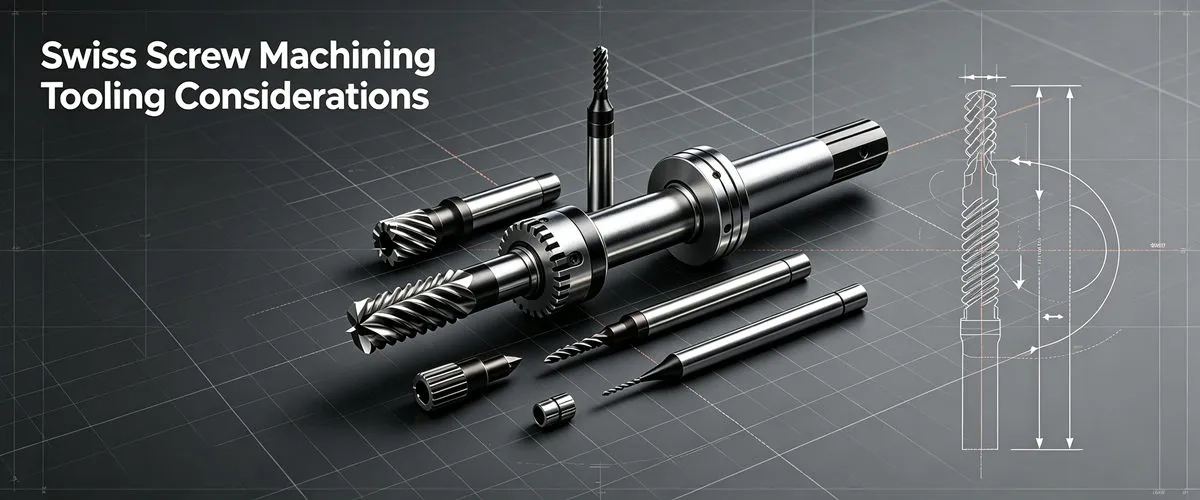
The performance of tools for Swiss screw machining is determined by the choice of materials and tools used. Unlike CNC turning, Swiss screw machining requires a steady bar support, accurate tooling, and consistent cutting factors for effective production of smaller, complex parts. The mechanical characteristics of the material influence stability in machining operations.
Common materials used for Swiss screw machined parts include:
| Material | Key Manufacturing Considerations |
| Stainless steel | Requires appropriate tooling and chip control, especially for work-hardening grades |
| Brass | Excellent machinability and clean chip formation for efficient production |
| Aluminum | Fast machining speeds but requires control of burrs and chip evacuation |
| Titanium | Higher cutting forces and heat generation require optimized parameters |
| Engineering plastics | Lower rigidity requires careful control of cutting pressure |
For screw machining materials, the ideal option is influenced by application needs and the ease of production. Choosing a more machinable type of alloy will result in shorter production time, better surface quality, and longer tool service life.
Choosing the right tooling is just as important. Small cutting tools are to be chosen for thread cutting, grooving, drilling, and precision stamping while ensuring the required robustness and accessibility when machining complicated shapes.
Key considerations include:
Tool diameter and rigidity
Tool overhang length
Cutting edge condition
Tool coating and material
Chip evacuation capability
Managing screw machining tool wear is especially important during production runs. As tools gradually wear, cutting forces may increase and affect feature consistency. By checking the status of the tools and modifying the cutting parameters, production stability and repeatability can be maintained.
The successful Swiss screw machining process is achieved through a combination of proper material selection, optimized tools, and controlled production conditions.
To carry out successful Swiss screw machining production, there is need for more than just getting a high-tech machine. The success of the production run depends on how the design of the part and tools, materials used, and the process planning come together.
Unlike simple turning operations that use just a single tool, Swiss screw machining involves additional tools utilized during production. There is need to ensure proper coordination of the turning, drilling, threading and other auxiliary operations at all times. The overall efficiency of the process can be increased if proper planning is carried out.
Key production considerations include:
Swiss-cutting machines have the capability of utilizing many tools in order to manufacture sophisticated parts in one setup. The right choice of tools, correct location of tools, and correct setup quickly reduce setup time while improving machining stability.
The efficiency of a production process is strongly connected to the balancing of machining operations. The characteristics that can be processed using tools available at that moment have less influence on the time of cycle, whereas the usage of additional setups and secondary operations drives a cost of production up.
Tool wear during long production cycles can impact the quality of threads, finish of the surface and accuracy of size. Tool condition monitoring and implementing adequate tool changeover intervals allow Swiss screw machining repeatability.
The nature of the material also affects manufacturing efficiency. The use of hard-to-work with materials may necessitate slower rates of machining, more complex tooling, or more extensive process control than is required for machining easier materials.
Although Swiss screw machining produces parts quickly and efficiently, manufacturing successfully involves the balancing of part complexity, tooling design, and process consistency. When it comes to applications that require tight tolerances and consistent production, our Precision Screw Machining capabilities provide insights regarding production-oriented solutions.
Quality control is necessary in ensuring the excellence of Swiss screw machining particularly with regards to small threads, multiple diameters, and complicated machined parts. The importance of quality control lies in the fact that it is not enough for a part to conform to a drawing in terms of individual dimensions; it must also retain its properties during the entire manufacturing process.
Inspection planning starts with the design and technology planning stage. Key characteristics comprising the dimensions of threads, ratios among diameters, locations of features, and surface characteristics must be defined well before the manufacturing process.
Common inspection methods for Swiss screw machined parts include:
Thread inspection using thread gauges or specialized measurement equipment to verify pitch, fit, and thread form
Dimensional inspection using precision measuring tools, optical systems, or CMM equipment for critical features
Surface finish verification for functional surfaces requiring controlled roughness
In-process checks to monitor production stability and detect tool wear
For complicated threaded parts, inspection might go beyond basic dimensional measurements. Characteristics such as thread shape, concentricity, and position precision can have an effect on functionality in assembly operations and reliability in products.
The inspection policy ensures consistency in production by detecting manufacturing variability before it impacts large production runs. When metrology techniques are combined with controlled machining technologies, it becomes possible to manufacture screw machined components according to a prescribed engineering specification.
Need Custom Swiss Screw Machining Support?
Falcon CNC Swiss provides precision Swiss screw machining solutions for threaded components, complex features, and production parts. Send your drawings today for engineering review and a machining quote.
Swiss screw machining can create all sorts of threads. Among them are not just fine and miniature threads, but also custom-designed threads, as well. Moreover, during the design of the part, it is necessary to take into account the kind of thread which is appropriate for producing the part, its pitch and diameter and thread depth and length.
Apart from that, engineers will have to consider such aspects as thread runout, relief features, and inspection requirements before they develop the piece of equipment they are going to manufacture.
When it comes to designing threads for Swiss screw machining, there are various factors such as type of material being used, type of thread being machined, access to the different tools, as well as functionality requirements that must be taken into account. Deep threads should be avoided as much as possible, and appropriate thread relief and clearance should also be given for improved stability during machining and possible tooling complications.
Definitely. Swiss screw machining allows different operations like turning, drilling, tapping, milling, grooving and knurling to be combined together to produce complex precision components in one setup. However, placement and access of features should be carefully considered during the design stage. The various tolerances, spacing as well as tool clearance must also be considered to improve productivity.
Several factors affect the cost of Swiss screw machining, including choosing the materials, the complexity of the part, the type of threads, the complexity of features in the part, the type of tools used, the time needed to manufacture the part and so on.
The more complex the threads, the more tool changeover will be necessary, and this will also apply to features that add complexity to the manufacturing process.