English
  日本語
日本語  한국어
한국어  français
  Deutsch
  Español
  русский
  العربية

Mar
Learn More
30

If you’ve ever looked at an impeller—inside a turbo or in a pump or compressor—you’ve probably wondered how those little curved blades are made accurately. Impellers are tricky. They have tight spaces, curves, and are expected to spin at high speed without shaking or breaking. So what are the methods of designing impellers?
The most common:
Casting: Liquid metal poured into a mold. Good for volume, but opens potential for porosity and inconsistent surface finish. Welded assembly: Designing blades separately and welding onto a hub. Cheaper, but weaker and not accurate.
CNC machining: Finalizing the whole part from a block of material. This is the standard for performance applications. This guide will focus on machined impellers: why they’re better, how they’re made, and what to look for in an impeller machining company.
The answer depends on what the impeller needs to do. Different applications demand different materials. Here’s a breakdown:
| Material | Best For | Key Properties | Common Applications |
| Aluminum | Lightweight, cost-effective applications | Lightweight, good machinability, corrosion-resistant | Automotive turbochargers, blowers, low-to-medium speed pumps |
| Stainless Steel | Corrosive or sanitary environments | Strong, corrosion-resistant, durable | Food processing pumps, marine applications, chemical pumps |
| Titanium | High-performance, extreme conditions | Excellent strength-to-weight ratio, heat-resistant, biocompatible | Aerospace turbines, high-performance pumps, medical devices |
| Brass | Low-friction, decorative, or marine | Good machinability, corrosion-resistant, low friction | Marine pumps, fuel pumps, decorative applications |
When you’re working with a reliable impeller machining supplier, they’ll help you match the material to your operating conditions—temperature, pressure, fluid type, and speed requirements. Explore more information about our multi-axis impeller machining materials →
That’s a frequent question we get from engineers. The brutal truth? It really varies depending on, well, complexity, size, and material. But here’s a realistic ballpark:
| Impeller Type | Complexity | Typical Machining Time | Notes |
| Simple aluminum blower impeller | Low (open blades, basic geometry) | 2–6 hours | 3-axis or 4-axis milling |
| Automotive turbocharger impeller | Medium (curved blades, tighter tolerances) | 4–12 hours | 5-axis machining typically required |
| Stainless steel pump impeller | Medium–High (closed or semi-closed design) | 8–24 hours | Harder material slows things down |
| Titanium turbine impeller (aerospace) | High (complex blade geometry, tight tolerances) | 20–40+ hours | 5-axis machining, slower feeds due to material hardness |
Other factors influencing lead time:
Programming: Complicated 5-axis toolpaths can take a full day or more depending on the level of video game simulation that you require to make your mother proud.
Setup: Fixturing for an impeller, particularly a closed impeller, isn’t trivial.
Inspection: Impellers often require CMM inspection and dynamic balancing, which all take time.
For custom impellers, plan on 2 to 4 weeks from order to delivery for complex parts. Simple parts in aluminum can sometimes ship in 1 to 2 weeks.
Before we talk about 5-axis, let’s understand 4-axis milling.
In basic 3-axis milling, the cutting tool moves in three directions: X (left-right), Y (front-back), and Z (up-down). The part stays fixed. This works for simple shapes, but for impellers with curved blades, 3-axis has limits.
4-axis milling adds a rotary axis (usually called the A-axis) that rotates the part. This allows the machine to reach features on multiple sides without manually repositioning the part. It’s a big step up from 3-axis, but still has limits when it comes to complex undercuts and blade surfaces.
For impellers, 5-axis is the real game-changer. Here’s why:
5-axis milling adds a second rotary axis, allowing the tool to approach the part from virtually any angle.
This means the cutter can follow the natural curve of the blade surface, maintaining constant contact and getting better surface finish.
It also eliminates the need for additional setups which improves accuracy and reduces lead time.
When you see multi-axis impeller machining mentioned, it usually means 5-axis. This is the standard for high-performance turbocharger impellers, compressor impellers, and aerospace turbine components.
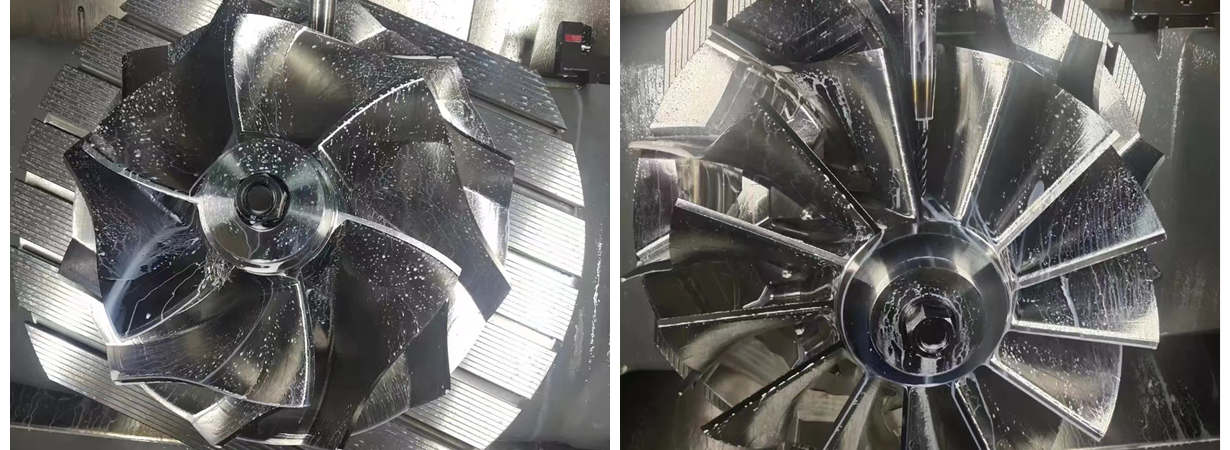
Let’s take a closer look at how a custom impeller is manufactured, from block of metal to finished part.
This is where the magic happens. Impeller milling requires special CAM (Computer-Aided Manufacturing) software that generates effective toolpaths for all the complex blade geometry. The programmer:
Defines the surfaces of the blades using your 3D model
Chooses the right cutting tool for the job (usually a ball nose end mill is used for the blade surfaces)
Creates roughing passes to remove most of the material
Creates finishing passes for the blades and hub
Validates the entire process for collision free machining using simulation.
The machine takes the bulk of the material down to a rough shape that is very close to final dimensions. For aluminum impeller machining, roughing can be carried out fairly quickly. Stainless steel impeller machining or that for titanium is a little slower and with more tool wear to manage.
Here’s where the accuracy is achieved. The machine tool follows the complex toolpaths that form the shape of the blades to exact geometry. For turbocharger impeller machining (or compressor impeller machining, the finish of the blade surfaces is a critical control parameter; rough blades create turbulence, reducing efficiency. All surface and radius finishes will be carefully monitored.
Finished impellers are measured using CMM (Coordinate Measuring Machine) against the following standards:
Blade profiles against CAD model
Hub dimensions
Bore concentricity
Blade thickness.
Impellers are designed to spin at high speeds, many tens of thousands of RPM in some cases, and even a small imbalance will cause vibration, noise and premature failure. After machining, impellers are dynamically balanced to lay down as perfect a product as possible. This operation is critical when it comes to turbocharger impeller machining—and turbine work.
Learn more about Falcon CNC Swiss precision impeller machining processes →
| Industry | Application | Typical Material | Why CNC Machining? |
| Aerospace | Turbine impellers, compressor wheels | Titanium, Inconel | Extreme temperatures, high strength, reliability |
| Automotive | Turbocharger impellers, superchargers | Aluminum, stainless steel | Lightweight, high RPM, efficiency |
| Industrial Pumps | Pump impellers for chemical, water, oil | Stainless steel, brass | Corrosion resistance, durability |
| Energy | Compressor impellers for turbines | Titanium, stainless steel | High pressure, long service life |
| Marine | Boat pump impellers | Brass, stainless steel | Saltwater corrosion resistance |
If your project falls into any of these categories, working with an experienced custom CNC impeller manufacturer makes a significant difference in performance and reliability.
Not every machine shop can do complex work on impellers. Here’s what to look for:
5-axis capability.
If they don’t have 5-axis machines, they probably aren’t doing the complex impeller work you need done. Ask.
CAM expertise.
Impeller programming is specialized. The shops doing impeller machining services regularly have CAM software specifically for blade geometry, like HyperMill, NX, or Mastercam with impeller modules.
Material experience.
Aluminum is not the same as stainless steel, which is not the same as titanium, etc. Ask about experience machining your specific material.
Quality Systems.
Look for ISO 9001 certification. For critical applications, ask about their inspection process, if they provide CMM reports and balancing documentation.
Balancing capability.
If your impeller is going to spin at high speed, you need dynamic balancing. Some shops outsource this, while others do balancing in-house. Shops that do it in-house generally will be able to turn jobs around more quickly and with better quality control.
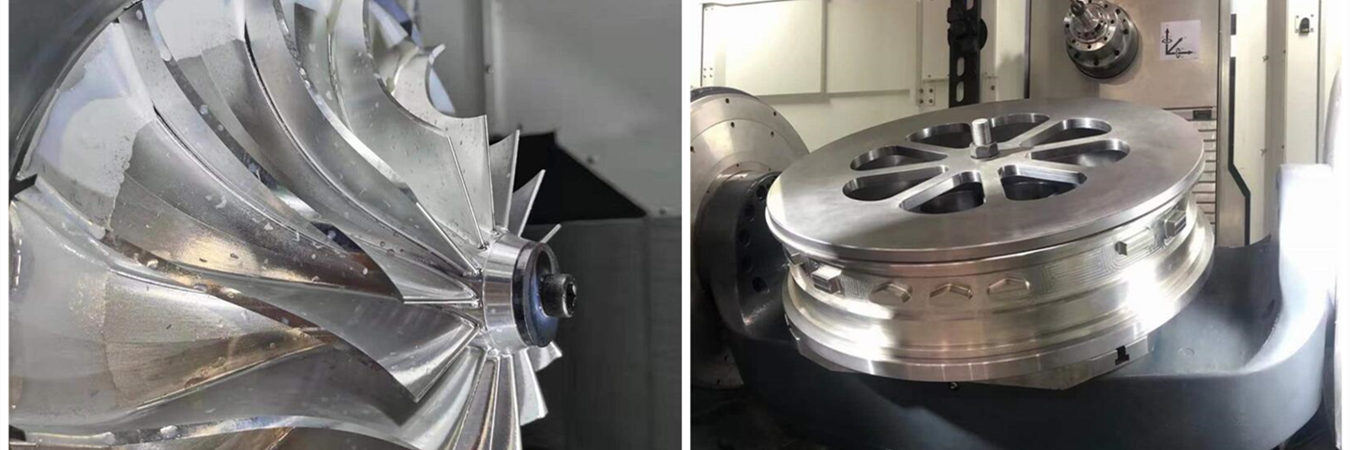
At Falcon CNC Swiss, we specialize in custom impeller machining for demanding applications.
Here’s what we bring to the table:
| Capability | Detail |
| Equipment | Advanced 5-axis CNC machines for complex blade geometry |
| Materials | Aluminum, stainless steel, titanium, brass—we machine them all |
| CAM Expertise | Specialized impeller programming for smooth blade surfaces |
| Quality | ISO 9001:2015 certified; full CMM inspection |
| Balancing | In-house dynamic balancing for turbo and turbine impellers |
| Finishing | Surface finishing, coatings, and polishing in-house |
| Industries | Aerospace, automotive, industrial pumps, energy, marine |
Whether you need aluminum impeller machining for an automotive turbo, stainless steel impeller machining for a pump, or titanium impeller machining for an aerospace application, we have the equipment and experience to deliver.
We’re not just an impeller machining supplier—we’re a partner that helps you get the right design, the right material, and the right quality for your specific application.
Impellers are some of the hardest features to cut—but when machined correctly, they can provide outstanding performance and reliability. No matter if you are designing a turbocharger, pump, or turbine, the right impeller machining company is paramount.
At Falcon CNC Swiss, we leverage our capabilities in 5-axis equipment, CAM expertise, and quality to produce impellers to your specifications.
Upload your CAD file for free DFM review and impeller machining quote within 24 hours
Contact our engineering team to discuss your material and application requirements
Learn more about our precision CNC machining capabilities and how we achieve precision for aerospace, automotive, and industrial applications
Open impellers: Blades are attached to a hub with no shroud. They are easier to machine and clean, but slightly less efficient.
Closed (or shrouded) impellers: Blades are enclosed between two walls. More efficient and stronger, but much harder to machine. These require advanced 5-axis machining.
Yes, but it’s usually better to machine from solid billet for high-performance applications. Billet impellers have no porosity, consistent material properties, and better strength.
Yes. We typically provide impeller machining quote within 24–48 hours after receiving your 3D model and specifications.
We do both prototypes and production runs. For custom impellers, we often start with 1–10 units for testing, then scale to higher volumes.
Send us your CAD file. Our engineers will review it and provide DFM (Design for Manufacturing) feedback—usually within 24 hours.