English
  日本語
日本語  한국어
한국어  français
  Deutsch
  Español
  русский
  العربية

Mar
Learn More
27

When submitting custom bolt and nut specifications for CNC manufacturing, engineers must provide more than just basic measurements. In order to create an accurate specification, all information regarding the desired material, threads, tolerances, surface treatment, inspection tests, and production requirements should be specified to ensure the desired characteristics of the produced fasteners.
When developing customized fasteners, engineers must provide manufacturers clear technical information so that they can choose the right method of machining and assess feasibility. Essential components, like bolt dimensions, nut form, thread specifications, material grades and quality must be carefully described before the manufacturing process starts.
In this guide, you will find detailed information about how to write custom bolt specifications, make drawings with high precision, define the manufacturing, and communicate your technical needs to the CNC fastener manufacturer.
To complete your understanding of custom fastener design, materials, manufacturing, and qualification aspects, refer to our Custom Precision Fasteners Engineering Guide.
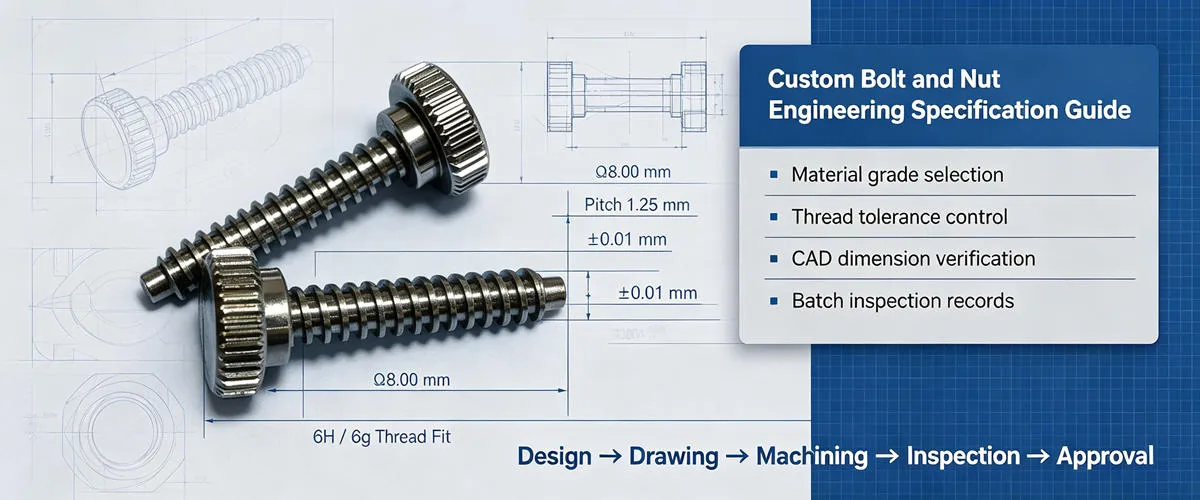
Complete specifications of custom nuts and bolts are key for successful CNC manufacturing. By providing precise data or technical information, the manufacture can assess the feasibility of manufacturing operations, pick the right machining technology to produce fasteners with desirable functionality.
When preparing custom bolt specifications or custom nut specifications, engineers should identify the main requirements affecting performance, production, and inspection.
Important information typically includes:
Part dimensions and geometry — Overall length, diameter, head design, nut profile, and other critical features should be clearly defined on the engineering drawing.
Thread requirements — Specify thread size, pitch, thread type, tolerance class, and whether internal or external threads are required.
Material requirements — Identify the required material grade, such as stainless steel, brass, titanium, or alloy steel, along with applicable material standards.
Tolerance requirements — Define critical dimensions and functional tolerances rather than applying unnecessary tight limits to all features.
Surface finish and coating requirements — Include surface roughness, plating, passivation, or other finishing requirements when applicable.
Inspection requirements — Specify dimensional inspection, material certification, and quality documentation requirements.
A custom fastener specification that is carefully prepared minimizes the risk of uncertainty during the quotation and manufacturing phases. Furthermore, it provides guidance for the manufacturers to give precise advice on machining, tooling, and process capabilities.
In production applications, Falcon collaborates with the project components and technical specifications for the production of high precision bolts and nuts for industries where accuracy of measurement and reliability of assembly process are paramount.
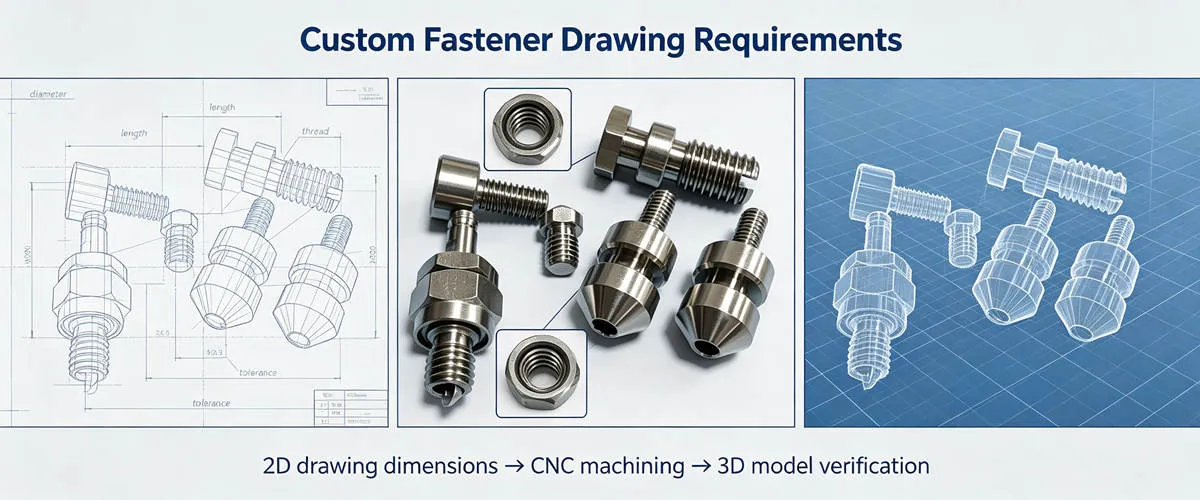
Precision engineering drawings are significant documents when detailing the design of custom nut and custom bolt for CNC machines. An ideal drawing conveys the design requirements, any conditions related to manufacturing, and any requirements for inspecting the item after production. When creating a custom bolt drawing or custom nut drawing, engineers must provide all relevant manufacturing and quality assessment information.
Key drawing elements should include:
Complete dimensions and geometry — Define all critical dimensions, including diameter, length, head features, nut dimensions, chamfers, radii, and functional surfaces.
Thread specifications — Clearly identify thread size, pitch, thread direction, thread type, and tolerance requirements. For metric or inch threads, the applicable standard should be specified.
Datum references and tolerances — Establish important reference points and define geometric tolerances for features affecting assembly, alignment, or performance.
Material and heat treatment requirements — Specify the material grade, applicable standards, and any required mechanical properties.
Surface finish requirements — Include surface roughness values and any required coating or surface treatment.
Inspection requirements — Identify critical dimensions that require verification during production.
For CNC manufacturing, providing a 3D CAD model alongside the engineering drawing will improve communication, especially in relations to complicated bolt heads, custom nut profiles, and unusual shapes.
Clear custom fastener drawing requirements will enable producers to assess possibilities of machining, detect design defects, and suggest possible improvements before the start of production.
Defining dimensions and thread requirements correctly is crucial when you are preparing custom bolts and nuts for CNC machining. Incomplete or ambiguous criteria may lead to misunderstanding of the information, has to do some changes in engineering process, or lead to delays in production.
For custom bolt dimensions, engineers should identify all features that affect assembly and performance, including:
Major diameter and shaft dimensions — Define the required diameter, length, and any stepped or reduced sections.
Head geometry — Specify head size, shape, drive features, height, and any special configurations.
Functional lengths — Include thread length, shoulder length, and engagement requirements where applicable.
Critical tolerances — Apply tighter tolerances only to dimensions that directly affect fit, alignment, or function.
For custom nut dimensions, important specifications typically include:
Outside profile and thickness — Define external geometry and installation requirements.
Internal thread specifications — Include thread size, pitch, thread standard, and required fit.
Special features — Such as slots, flats, locking features, or custom shapes.
Thread information should always be clearly identified on the drawing. Engineers should specify:
Thread size and pitch
Metric or inch thread standard
Internal or external thread type
Thread tolerance requirements
Required thread engagement length
Although precision applications may necessitate tighter tolerances, some limits are an impediment to efficient manufacturing and lead to increased costs. The appropriate course of action is to employ tolerances that are relevant to the function of the fastener assembly.
To create products with complicated specifications, producers can give feedback related to design factors that can be applied during fasteners' manufacturing before production begins.
It's important to specify the material and surface finish from the standpoint of mechanical requirements of the fastener; its environment and assembling conditions. A type of material that may work well in one particular application may not be able to provide the necessary characteristics in another application, such as strength, corrosion resistance, conductivity, or wear resistance.
When defining custom bolt materials and custom nut materials, the engineer should indicate the grade of the material on the engineering drawing, as opposed to simply mentioning the type of material.
Common options include:
Stainless steel — Suitable for applications requiring corrosion resistance and dimensional stability.
Alloy steel — Often selected where higher strength and mechanical performance are required.
Brass — Useful for applications requiring corrosion resistance, machinability, or electrical conductivity.
Titanium — Used where low weight, corrosion resistance, and high strength-to-weight ratio are important.
Aluminum — Suitable for lightweight applications where the required mechanical properties can be achieved.
The specifications of the surface must also be clear-cut. These may include surface roughness, passivation, plating, electropolishing, or other protective finishes. Should the finish influence the functional geometry of the threaded item, the drawing must indicate those requirements.
In order to fulfill the requirements relating to a custom fastener surface finish, engineers must specify the finish type, related standard, and critical surfaces, rather than relying on the concept of smooth finish.
When specifying the characteristics of a material and finish, one should also take into account the application, dimensions, and manufacturing process.
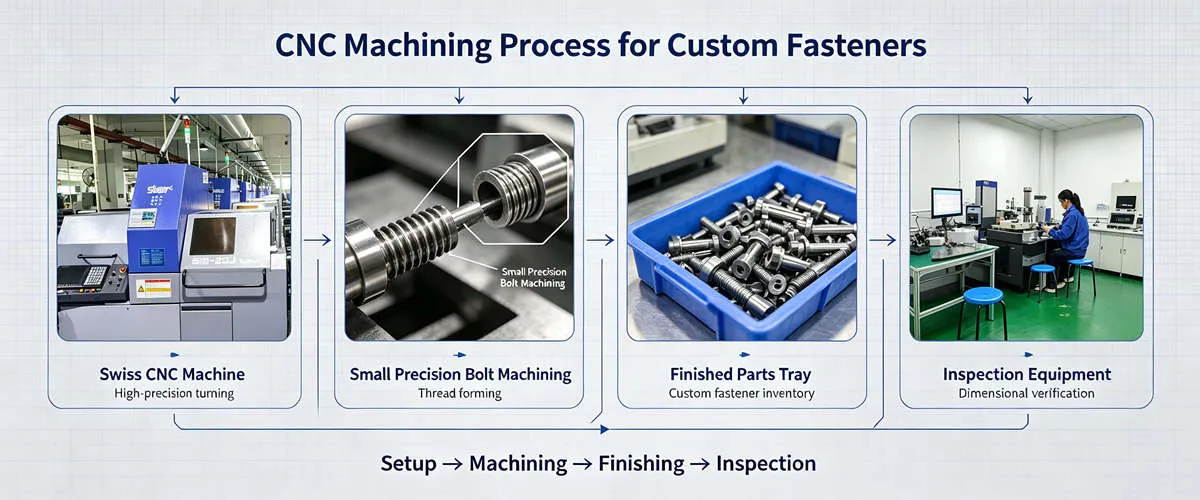
A custom fastener specification must specify not only the final dimensions but also the manufacturing and inspection requirements relevant to the application. The specification of precise requirements helps the CNC manufacturer choose the suitable method of production and establish efficient inspection methods before beginning production.
In the case of CNC custom bolts and nuts, the engineering drawing or purchase specification must specify which features must be given special attention during manufacturing. This can include features like small diameters, long threads, thin sections, complex head shapes, concentric features, or surfaces with specific surface finish requirements.
For custom bolt machining and custom nut machining, engineers should communicate:
Required production quantity and expected annual volume
Prototype or first-article requirements
Critical dimensions and applicable tolerances
Thread specifications and functional fit requirements
Surface roughness and finishing requirements
Material certification requirements
Required inspection reports or documentation
Packaging and traceability requirements
The inspection requirements must be consistent with the functional significance of each feature. While critical features may need to undergo 100% inspection, other less crucial features may only need to be validated through sampling. Depending on the feature and its tolerance, possible inspection methods may include thread gauges, optoelectronic systems, micrometers, and CMM inspection.
Additionally, establishing acceptance criteria before the production process is valuable. This will eliminate any doubt about the dimensions requiring extra inspections and any necessary documentation for the finished products.
If a project is complicated or the production volume is high, the manufacturer should get in touch with the engineer at an early stage, as this will ensure the establishment of an effective procedure for manufacturing and inspection. Falcon offers precision CNC machining services for custom parts manufactured according to customers' specifications and stated inspection criteria.
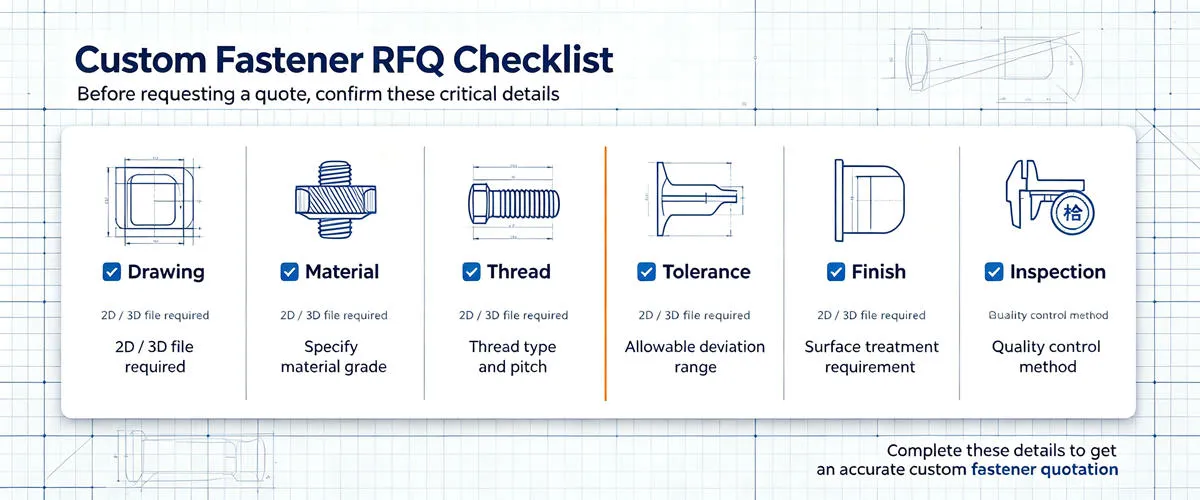
In order to ask for a quote for bolts and nuts, it is important to provide as much technical information as necessary to the manufacturer to allow them to assess the project correctly and minimize clarification required during both quoting and production stages. A well-prepared RFQ is expected to contain as much information as necessary to identify the part, its performance abilities, and the conditions of future production.
The following checklist can be used when preparing a custom fastener RFQ:
| Requirement | Information to Provide |
| Part identification | Part number, revision and drawing status |
| Engineering drawing | 2D drawing with dimensions, tolerances and notes |
| CAD model | 3D CAD file when geometry is complex |
| Material | Exact material grade and applicable standard |
| Threads | Size, pitch, thread type, tolerance class and length |
| Critical dimensions | Functional dimensions and required tolerances |
| Surface finish | Roughness, coating, plating or surface treatment |
| Quantity | Prototype, pilot and annual production volume |
| Quality requirements | Inspection, FAI, material certification and COC requirements |
| Packaging | Quantity per package and special protection requirements |
When asking for a custom bolt RFQ or custom nut RFQ, it is crucial to define the application and any key characteristics that are critical to assembly or performance. Knowing this information allows the manufacturer to carry out the design for manufacturability (DFM) review and the process planning accordingly.
Engineers have to make sure that the revision of the drawing, CAD model, specifications for the materials, and the purchasing requirements are compatible before they send out an RFQ. Any missing information can lead to a redundancy in engineering assessment and may change the price of the product or the time of delivery.
A proper specification will provide the manufacturer with a sound background for the evaluation of the manufacturability, inspection requirements, and production costs.
One of the foremost causes of delays, extra expenses, and manufacturing challenges related to custom fasteners is insufficient specifications. An appropriate specification should contain sufficient details for the manufacturer to understand the intention of the design and the specifics of production prior to the start of production.
Common specification mistakes include:
Providing incomplete drawings — Missing dimensions, undefined critical features, or unclear revision control can result in incorrect interpretation.
Over-specifying tolerances — Applying unnecessarily tight tolerances to non-critical features may increase machining complexity and cost without improving performance.
Missing thread information — Thread size, pitch, standard, tolerance requirements, or engagement length should always be clearly defined.
Ignoring manufacturing considerations — Some geometries may require additional machining operations, special tooling, or process adjustments.
Not defining inspection requirements — Without clear acceptance criteria, manufacturers may not know which dimensions require additional verification.
Changing requirements after quotation — Material, finish, quantity, or tolerance changes after quoting can affect cost and lead time.
Excellent custom bolt specifications and custom nut specifications strike a balance between engineering requirements and actual manufacturing capabilities. Communicating early with the manufacturer helps to highlight any design prospects before the beginning of production and tooling.
Providing detailed drawings and obvious specifications encourages engineers to reduce risk and improve the entire custom fastener manufacturing process.
A complete fastener specification is the foundation for reliable production. Falcon helps engineers review drawings, evaluate manufacturability, select suitable materials and machining processes, and develop custom bolt and nut solutions based on application requirements.
Send your drawings, CAD files, material requirements, and production details to our engineering team. We can provide DFM feedback, manufacturing recommendations, and a quotation for prototype or production quantities.
Request a Quote for Your Custom CNC Machined Fasteners Today.