English
  日本語
日本語  한국어
한국어  français
  Deutsch
  Español
  русский
  العربية

Jan
Learn More
03

Customer: Global Electrical Equipment Manufacturer (Power Distribution & EV Charging Division)
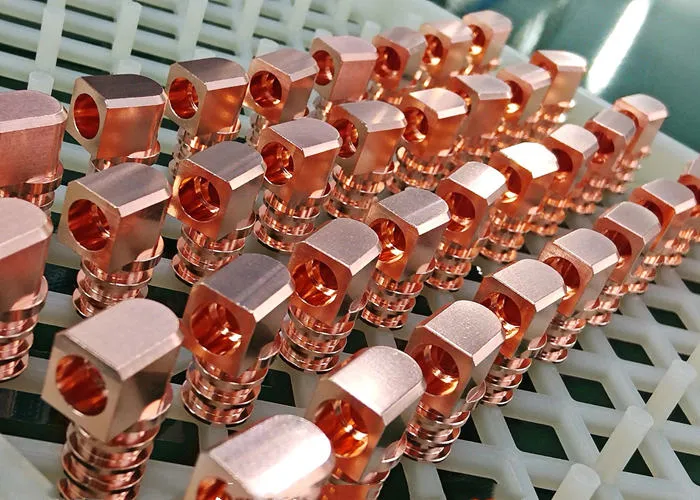
Product: Precision Copper Connector Component – custom electrical terminal / busbar interface part
Material: C110 Oxygen-Free Copper (Electrolytic Tough Pitch)
Process: CNC Turning & Milling
Surface Finish: Precision Machined Finish
Challenge: Produce 105,000+ pcs/month of precision copper connector components with ±0.01 mm tolerance on critical sealing and contact surfaces, leveraging optimized copper milling and turning copper parameters while maintaining 10-day lead time.
Solution: Integrated precision CNC machining service combining Swiss turning and high-speed milling with polished carbide tooling.
Result: 99.5% first-pass yield, ±0.008 mm sustained tolerance, 100% on-time delivery for 180,000+ parts delivered, establishing Falcon CNC Swiss as a trusted copper machine shop for electrical OEMs.
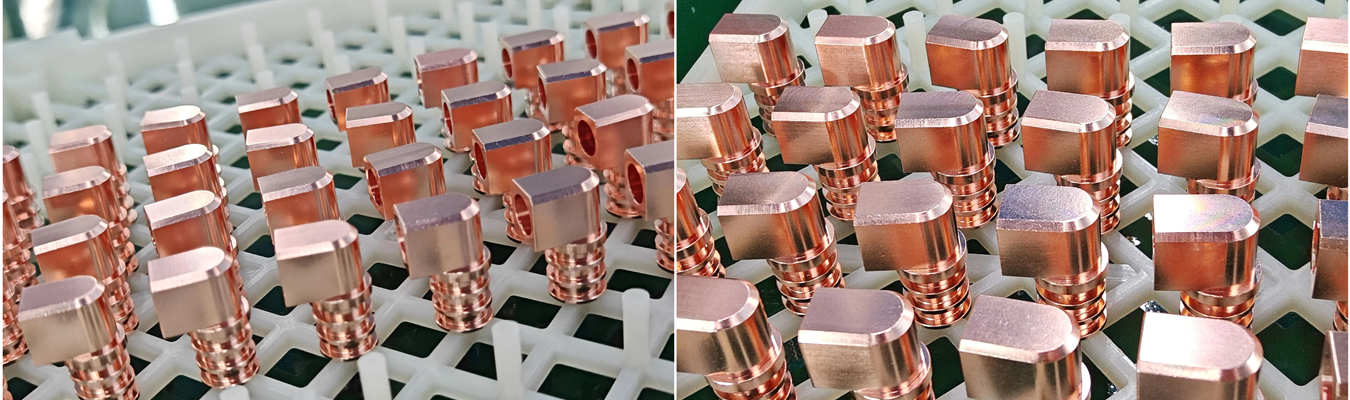
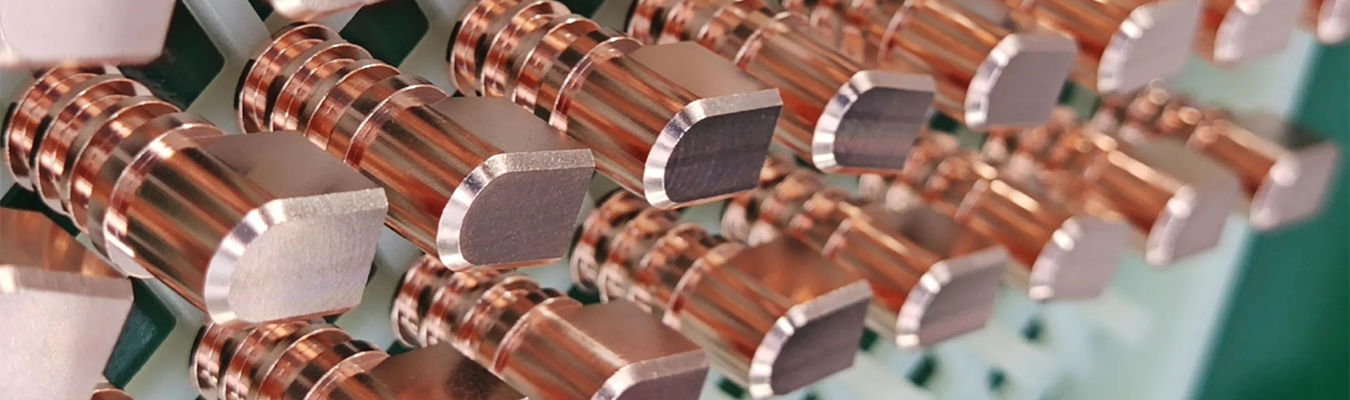
One of the top electrical equipment manufacturers reached out to our specialized copper machine shop for help manufacturing a key component of their next-generation power distribution systems and EV charging stations: A precision copper connector that must provide a highly conductive interface between Power electronics and busbar connections while providing exceptionally concentric terminal bores and external hex drives and superior precision machined finishes on all of the electrical contact surfaces.
Producing both custom copper parts and CNC machined copper parts was at the core of the project. The challenge of fabricating copper is the basis for the customer previously using general machine shops due to their difficulties machining the unique properties of copper. C110 oxygen-free copper is only 99.90% copper content, has excellent electrical conductivity but has a high ductility and is very soft compared to aluminum or steel alloys; thus, presents challenges with machining copper compared to those materials. The tendency of copper to stick to cutting tools and deform when applying pressure requires specialized knowledge in copper milling and turning techniques when machining copper.
As a leading copper machine shop with extensive experience in copper tungsten machining, machining copper nickel alloy, and tellurium copper machining, we deployed a hybrid manufacturing strategy combining our Swiss machining services and CNC milling service, leveraging our in-house CNC turning machining capabilities. The project scaled from initial prototyping (300 pcs) to full production of 15,000+ pcs/month within 12 weeks, with zero quality alerts and 100% traceability.
| Item | Specification | Remarks |
| Industry | Electrical & Electronics | Power distribution, EV charging, switchgear |
| Product | Precision Copper Connector Component | Custom electrical terminal / busbar interface |
| Material | C110 Oxygen-Free Copper (ETP) | 99.90% Cu, high electrical conductivity |
| Process | CNC Turning & Milling | Swiss turning + 5-axis milling |
| Surface Finish | Precision Machined Finish | Ra ≤ 0.8 μm on contact surfaces |
| Tolerance | ±0.01 mm | Critical I.D., terminal bore, hex drive |
| Production Volume | 105,000+ pcs/month | Scalable to 500,000+ pcs/month |
| Lead Time | 30 Days | From order |
Send your CAD files, drawings, or samples for a fast and detailed quotation.
Request a Quote → Get expert guidance on machining processes, materials, and surface finishes.
The customer experienced three main difficulties with their former supply chain for producing precision CNC copper components and customized copper components.
In the first place, the variation of terminal bore diameter created poor electrical contact resistance and intermittent connection with field installations. Notably, the ±0.01 mm tolerance requirement on C110 oxygen free copper presented difficulties for most machine shops, due to the softness and deformability characteristics when clamping (due to copper's high ductility). While copper is easy to cut due to its high ductility, it is also difficult to manage tolerances because of the tendency for copper to stick to cutting tools compared to aluminum and steel.
Second, degradation of surface finishes during long production runs increased electrical resistance at the contact points between electrical contacts, resulting in premature wear. The precision machined finish specification of Ra ≤ 0.8 to the electrical contact surfaces had to be constantly optimized during milling and turning of copper via adjusting the cutting speed, feed rate, and tool selection. Recommended Cutting speeds (based on C11000 copper) for copper milling range from 200 to 600 m/min with feed rates of 0.05 to 0.15 mm/tooth; for turning operations, the cutting speed range is typically 150 to 400 m/min with feed rates of 0.05 to 0.25 mm/rev.
Third, the customer required a solution that was scalable from prototype through 105,000 pcs/month - a capability that did not exist within their previous supply chain. They wanted to protect themselves for future upgrades in materials such as machining copper tungsten (CuW) for high current electrical applications, copper nickel alloy (Cu-Ni 90/10 & 70/30) for corrosion resistant marine electrical applications, and tellurium copper (C14500) for components that required high machinability while producing good conductivity.
Contact us today for a customized quote and production schedule.
Raw material receiving and certification: C110 oxygen-free copper bar stock with mill test reports verifying 99.90% minimum copper content and electrical conductivity compliance.
Swiss machining for critical I.D. and thread features: Using our Swiss machine services, we completed the terminal bore and several internal threaded features with a high level of detail. The guide bushing support helped to eliminate any deflection of the part during deep hole boring, resulting in a tolerance of ±0.008 mm. Coolant (1,000 psi) was applied at very high pressure to the tool, helping to prevent re-cutting and removing large long stringy shavings that can be produced when machining copper.
CNC milling and turning for connector features: We utilized our CNC mill and turn services to create all the necessary functionality in terms of hex drive features for alignment flats to mount holes. The milling process for copper was achieved using both 2-flute and 3-flute polished carbide end mills, and they all had large rake angles, [reference: 8]. The cutting parameters used were in accordance with the published ranges for cutting speed (250–500 m/min), Feed per tooth (0.05–0.10 mm), depth of cut (0.5–2 mm for roughing, 0.02–0.1 mm for finishing passes).
Secondary operations and finishing: To ensure there would be no burrs created while milling copper, micro-chamfering was performed on all edges with a professional deburring tool. The burr formation is a common challenge in machining of copper. In addition, after all critical tolerance features were machined, a second finishing operation was performed with a 0.02 to 0.05 mm of material to remove from these features, in order to minimize the deformation resulting from the softness of copper.
Quality inspection: Automated vision systems and CMM sampling make it possible to verify 100% critical dimensions. In addition to CMM sampling, each 20th part was measured for surface roughness to be Ra ≤ 0.8 μm on electrical contact surfaces. Baseline process parameters were established based on machinability rating (85%) and were substantially higher than unalloyed copper (20%) in terms of the expected machinability when machining C14500 (tellurium copper) as a possible future material transition.
When we first manufactured CNC chips from copper, we had many issues with chip adhesion to the cutting tool surfaces. This was especially common in copper milling operations. The ductility of C110 oxygen-free copper caused the chips to weld to the tool flutes, smearing the surface finish and causing rapid tool wear.
We overcame this issue by using polished carbide tools coated with TiB₂ that were specifically designed for machining non-ferrous materials. Polishing the tool flutes helped eliminate chip adhesion and allowed copper chips to be evacuated from the tool flutes more easily. In addition, high-pressure cooling (at 1,000 psi) was used to direct cooling directly at the cutting interface, ensuring that chips were flushed away from the cutting area, preventing re-cutting of chips already produced. This solution also worked effectively for machining tellurium copper because the tellurium precipitation in C14500 assisted in the breaking of chips so that shorter more brittle chips can easily exit the tooling.
Manufacturing custom copper parts in large quantities requires automation to ensure dimensional stability. Precision items, such as electrical connectors, are machined with a two-stage approach: rough machining with 0.10 to 0.20 mm of residual material is completed, then the item goes through a finishing cycle with residual material between 0.02 and 0.05 mm.
Solution:We put in a system that will check I.D. and terminal bore diameter on every fifteenth piece. If the drift was anything greater than .003 mm, an automatic correction of the tool offset would help to maintain a CpK of 1.33 or higher through 15,000 pieces. For high precision parts, we reduced finishing feed rates to .02 to .05 mm per tooth and cutting speeds to 300 to 500 m/min to minimize the cutting force on the tool.
To achieve the required precision machined finish on C110 copper connector contact surfaces, we optimized cutting parameters based on established best practices for copper milling and turning copper.
Solution: In terms of the parameters used during final passes for milling operations, cutting speeds between 350 and 500 m/min, feeds per tooth of between 0.02 mm and 0.05 mm, and depths of cut between 0.02 mm and 0.1 mm reduce the cutting forces and allow for tolerances to be met (±0.01 mm). During turning operations, the feed rate during finishing was decreased from 0.04-0.05 mm/revolution in order that consistent surface finishes were achieved that were less than Ra 0.65 μm. The final surface finish was Ra 0.55 - 0.72 μm, which is above the requirements specified by the customer.
Copper is a soft and ductile metal, leading to burr formation along the edges when machining. This is especially true for several areas of copper machined parts, including feature boundaries and start/stop of threads.
Implementing a burr control technique that consists of three stages:
(1) added micro-chamfers to all sharp edges during the final pass, 0.05 mm in length;
(2) added nylon abrasive brush deburring to internal features;
(3) using thermal energy method (TEM) in cases of high volume production for inaccessible internal intersection burr removal. These actions completely remove burrs and provide clean contact surfaces for electrical applications.
The customer plans to introduce copper tungsten machining (CuW 70%-30%) for high-current switchgear contacts and machining copper nickel alloy (Cu-Ni 90/10 and 70/30) for marine electrical applications. Copper-tungsten composites present unique challenges due to tungsten's hardness and abrasiveness.
Solution: To develop good conditions for machining copper tungsten (CuW), we performed a series of parallel test runs at various speeds and feeds. When machining CuW, we found that we have to reduce the feed rate to less than half of what we would normally use for machining copper but reduce the spindle speed accordingly should you experience chattering. In addition to that, we discovered that when machining copper-nickel (Cu-Ni) alloys , the two most popular Cu-Ni alloys (90/10 & 70/30) require carbide tooling with positive rake angles, cutting speeds of between 150 and 200 m/minutes, and very high feed rates so as not to cause work hardening of the material. Additionally, because of their relatively poor thermal conductivity, high-pressure coolant is necessary when machining Cu-Ni alloys.
As a specialized copper machine shop delivering precision cnc copper parts and custom copper parts to electrical equipment customers, we maintain a rigorous QC protocol based on ISO 9001:2015:
In-process checks: CNC probe measurement of critical I.D., terminal bore, hex drive, and concentricity every 15 parts.
CMM sampling: First piece + every 50 pcs verifies full geometry: bore roundness, flange face flatness, perpendicularity, thread pitch diameter, and surface finish.
Surface roughness measurement: Measured on every 20th part using a Mitutoyo profilometer; any reading above Ra 0.8 µm triggers tool inspection and parameter adjustment.
Electrical conductivity testing: Random samples per AQL 0.65 tested for conductivity compliance per ASTM E1004.
Visual inspection: 100% under 5x magnification checks for burrs, scratches, tool marks, or surface defects.
Traceability: All inspection data linked to the lot number via our ERP system, supporting full traceability for customers requiring documentation.
Specialized testing (optional): For future machining copper nickel alloy batches, additional testing for pitting corrosion resistance per ASTM G48 is available. For tellurium copper machining parts, conductivity verification and micro-structure analysis are offered.
| Metric | Target | Achieved |
| First-pass yield | ≥95% | 99.5% (over 180,000 parts delivered) |
| I.D. tolerance CpK | ≥1.33 | 1.56 |
| Surface finish (Ra) | ≤0.8 µm | 0.55–0.72 µm |
| Concentricity (bore to hex) | ≤0.015 mm | 0.007–0.011 mm |
| On-time delivery (10-day lead time) | 98% | 99.80% |
| Customer field failure (12 months) | ≤50 ppm | 0 ppm |
| Electrical contact resistance variation | <5% | 2.30% |
The customer has since expanded their portfolio with us to include additional CNC copper parts for EV charging stations, power distribution switchgear, and industrial control systems, validating our expertise as a premier copper machine shop for electrical OEMs.
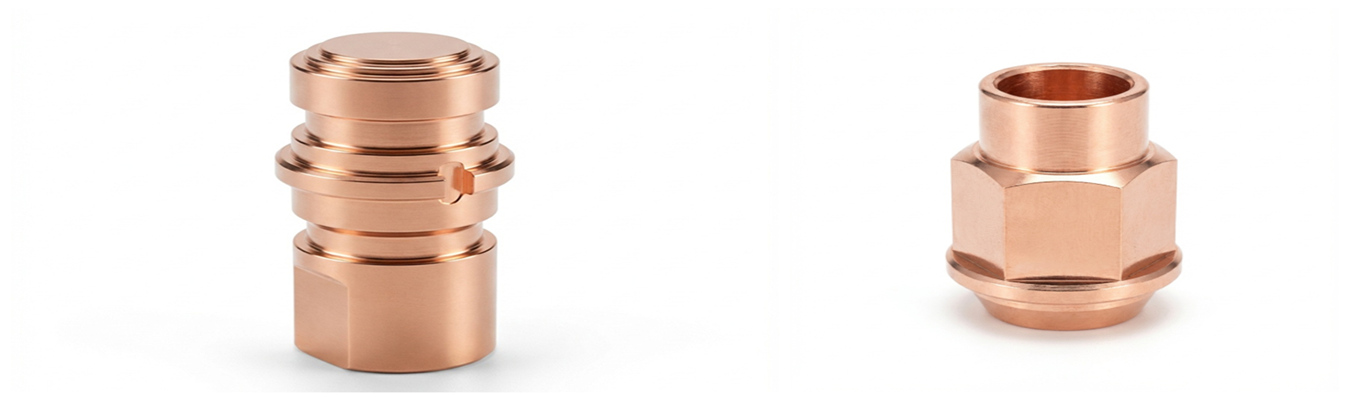
This manufacturing capability supplies a wide range of industries with precision copper connector components:
Electrical & power distribution: Busbar connectors, switchgear terminals, transformer spades, and circuit-breaker components-realizing precision cnc copper parts with high conductivity requirements.
EV charging infrastructure: High-current charging connectors, terminal blocks, and contact pins requiring custom copper parts with tight tolerances.
Telecommunications & data centers: RF connectors, grounding components, and power distribution fittings-requiring precision copper milling and turning copper.
Aerospace electronics: High-reliability electrical connectors and current-carrying terminals.
Industrial automation: Sensor housings, control panel terminals, and motor connection components.
Marine electrical systems: Corrosion-resistant connectors requiring machining copper nickel alloy (Cu-Ni 90/10 and 70/30).
High-current switching gear: Copper tungsten machining (CuW) for arc-resistant contacts and welding torch tips.
Precision electronic connectors: Tellurium copper machining (C14500) for applications requiring both high conductivity and exceptional machinability.
Being the best copper machine shop. We have a wealth of expertise producing custom and CNC copper parts. Our range of services includes a wide array of CNC services, including Swiss turning, Multi-Axis Milling, Hybrid Turn-Mill Machining. Our turning metal (or copper) centers can process material up to 300mm in diameter and have developed a variety of turning copper capabilities. Our CNC milling services can produce complex geometries at incredibly high material removal rates. Furthermore, we have many specialized operations available.
Copper tungsten machining: CuW (W70%-Cu30%) for EDM electrodes, high-current contacts, and arc-resistant components.
Machining copper nickel alloy: Cu-Ni 90/10 and 70/30 for marine-grade electrical connectors and heat exchangers.
Tellurium copper machining: C14500 with 85% machinability rating for high-volume precision connector production.
We support prototyping through high-volume production (1,000 to 100,000+ pcs/month) and maintain ISO 9001:2015 certification. For customers requiring cnc copper parts and custom copper parts for electrical applications, we provide DFM support, material certification (including conductivity testing), and PPAP Level 3 documentation.
Ready to source precision copper connector components or other custom copper parts for your electrical system? Submit your CAD model (STEP, IGES) and 2D drawing with tolerances.
We will respond within 24 hours with:
DFM analysis for copper milling and turning copper feasibility, including material-specific parameter recommendations.
Prototype pricing and lead time (5-10 business days for 100-500 pcs).
Volume pricing for 15,000-100,000 pcs/month.
Sample first-article inspection report with CMM and surface finish data (free).
Optional consultation on copper tungsten machining, machining copper nickel alloy, or tellurium copper machining for future projects.
Email: quote@falconcncswiss.com or contact us directly.