English
  日本語
日本語  한국어
한국어  français
  Deutsch
  Español
  русский
  العربية


Nov
Learn More
21

Choosing the appropriate grade of stainless steel is a key factor in production of precision components using Swiss machining. In spite of the fact that 303, 304, and 316 stainless steel types are known for their extraordinary resistance to corrosion and durability, they have absolutely diverse machining properties. Depending on the stainless steel grade selected, engineers can heavily influence tool life, chip control, surface finish and efficiency of manufacturing processes.
While choosing the material for Swiss machining of stainless steel details, they prefer to use 303 stainless steel, if the most important factors are machinability and productivity, but in the case of 304 stainless steel they ensure the best combination of corrosion resistance and manufacturability. 316 stainless steel is used in applications needing excellent resistance to chemicals, chlorides or adverse conditions.
Nonetheless, it is worth mentioning that the best stainless steel grade is defined by a lot more than corrosion resistance. Part geometry, thread complexity, tolerance needs, production volume, and the environment in which the end product will be used should be taken into account.
This article looks into 303 vs 304 and 316 stainless steel grades in Swiss machining with respect to their machinability, properties, application, and relevant factors to enable engineers to select the appropriate grade of stainless steel for precision machining components. For more information about material capabilities and precision production options, explore our Swiss machining services.
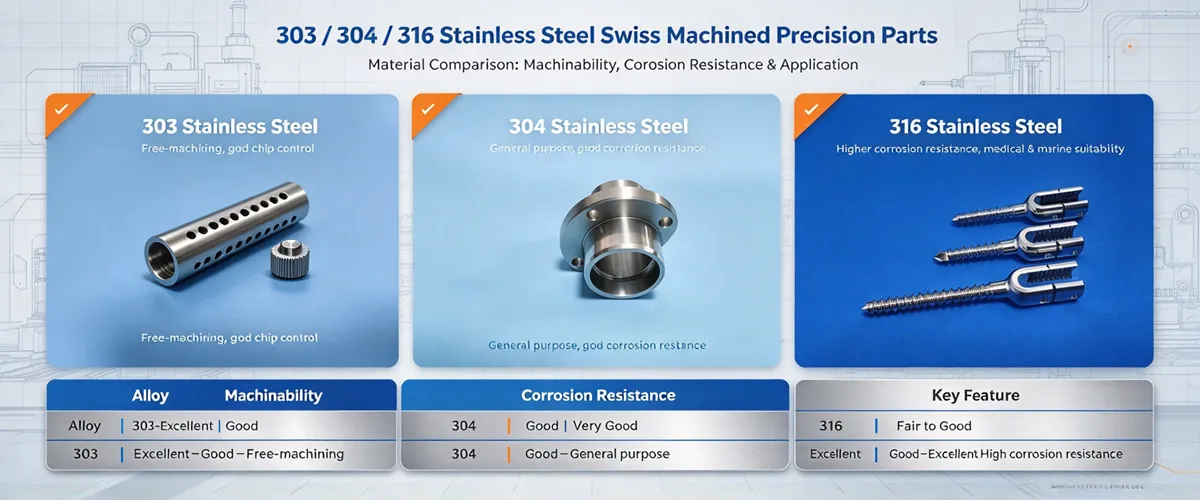
Among common stainless steel grades used for precision components, 303 stainless steel Swiss machining is often selected when manufacturing efficiency and consistent cutting performance are key requirements. This type of free-cut stainless steel contains sulfur additives, which provide good chip breaking properties and lower cutting resistance than the usual austenitic grades.
For 303 stainless steel machining, the improved machinability provides several advantages in Swiss machining applications, especially for components with complex turned features, threads, grooves, and repeated production requirements. The better control in chip breaking means that there are fewer interruptions due to excessive long chips.
303 stainless steel is easier to machine than 304 and 316 grades due to its intended composition that emphasizes cutting performance as opposed to maximum corrosion resistance. As a result, it is often used for components where resistance to corrosion is not as important as for 316 stainless steel.
Typical applications for 303 stainless steel Swiss machined parts include:
Precision shafts and pins
Bushings and spacers
Connectors and fittings
Threaded components
General industrial hardware
Even so, when choosing materials, it is important to take the final application requirements into account. While 303 gives very good machinability, it has a lower resistance to corrosion than the 304 and 316 grades. In applications in which the use of medicines, chemicals, or materials in very corrosive conditions is likely to take place, the engineers may consider using the other grades of stainless steel.
Material choice for stainless steel Swiss machining requires knowledge of how machining, corrosion resistance, and part requirements can be balanced to ensure the consistency of production results.
Among the many types of stainless steels, 304 stainless steel has probably the widest usage among all others types. In 304 stainless steel Swiss machining, it is normally chosen when the corrosion-resisting properties of 303 stainless steel grade are insufficient, though there is no need for the superior properties of 316 grade.
Compared with 303 stainless steel, 304 stainless steel machining is more challenging because it does not contain sulfur additions that improve chip breaking. 304 stainless steel has higher propensity to undergo work hardening which requires proper handling of cutting parameters.
Nevertheless, even though 304 is worse in terms of machinability compared to 303, it is still very popular among engineers due to high level of corrosion resistance and versatility of applications. Engineers use 304 stainless steel materials when dealing with such devices and machines as industrial-grade equipment, electronics, food processing systems and high precision assemblies.
Common 304 stainless steel Swiss machined components include:
Precision shafts and pins
Connectors and fittings
Bushings and sleeves
Fasteners and threaded components
Small mechanical parts requiring corrosion resistance
When choosing materials for Swiss machining operations, engineers must think about both the manufacturing needs and the end-use scenario. Although 304 takes more precision in the choice of the tools and stability of the process than simpler grades of materials, it offers excellent durability and resistance to corrosion. For projects requiring different stainless steel options, review our Swiss machining materials capabilities to compare available grades and applications.
316 stainless steel is chosen frequently for making precision parts with corrosion resistance and longevity possibly being more important than machining efficiency. In 316 stainless steel Swiss machining, this grade is commonly used for parts exposed to chemicals, saltwater, medical environments, and other demanding operating conditions.
Molybdenum enhances the pitting and corrosion resistance of 316 stainless steel compared to 304 stainless steel. However, these features make 316 stainless steel machining more challenging. The material has higher cutting resistance and a higher propensity for work hardening, requiring strict process control for consistent machining.
When it comes to machining, 316 shares the disadvantage of lower machinability compared to 303 and 304 stainless steels; however, its outstanding capability of resisting corrosion is the reason for its great popularity in applications requiring dependable materials. Correct choice of tools and machining methodologies is pivotal in Swiss machining operations involving parts with small diameters, hip walls, or sophisticated characteristics.
Typical applications for 316L stainless steel Swiss machining include:
Medical instruments and surgical components
Fluid control components
Chemical processing parts
Marine and corrosion-resistant assemblies
Precision fittings and connectors
316L, an iteration of the low carbon variant of 316 stainless steel, is primarily preferred in medical applications and precision works because the processing improves its corrosion resistance and its welding properties. When comparing the stainless steel grades of 303, 304, and 316, it can be said that usually the last grade is chosen whenever the environmental requirements are given preference over speed.
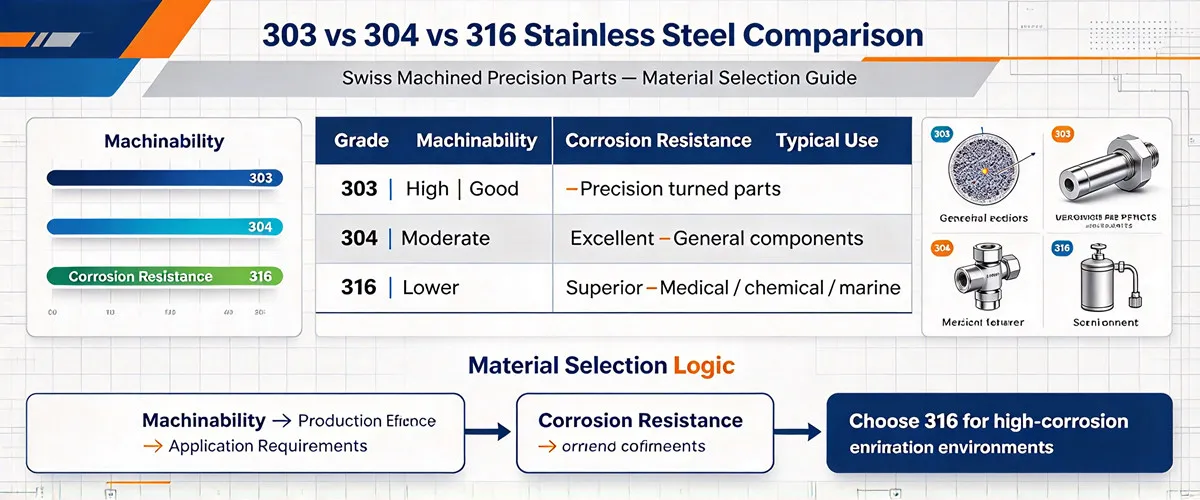
Machinability is only one consideration when choosing a stainless steel grade for Swiss machining. Other factors that must be assessed include corrosion resistance, how the part will function, tolerance requirements, and production efficiency. A comparison on machinability of stainless steel steel gives engineers insight into the differences between 303, 304, and 316 when manufacturing a part.
The table below highlights the general characteristics of each grade:
| Factor | 303 Stainless Steel | 304 Stainless Steel | 316 Stainless Steel |
| Machinability | Excellent | Moderate | Lower |
| Corrosion Resistance | Good | Excellent | Superior |
| Work Hardening Tendency | Lower | Higher | Higher |
| Chip Control | Easier | More challenging | More challenging |
| Surface Finish | Excellent | Good | Good |
| Typical Applications | Precision turned parts, shafts, fittings | General corrosion-resistant components | Medical, marine, chemical components |
303 stainless steel plays the role of the prime choice for high-volume precision parts when the emphasis is on machining efficiency due to its cutting capability and chip control. However, if corrosion resistance of the product becomes a priority, then one can consider switch to 304 and 316 stainless steel.
When machined, there is no one best material among 303, 304 and 316 for all applications. The choice depends upon the tradeoff between machinability, environmental requirements, and performance of the part.
For example
Choose 303 when production efficiency and machining consistency are the main priorities.
Choose 304 when balanced corrosion resistance and mechanical properties are required.
Choose 316/316L when components must withstand aggressive environments or require medical-grade corrosion resistance.
Material selection also influences achievable precision and process stability. For tight tolerance components, engineers should consider how each stainless steel grade affects dimensional control, surface finish, and inspection requirements. Learn more about maintaining accuracy in production through our Swiss machining tolerances guide.
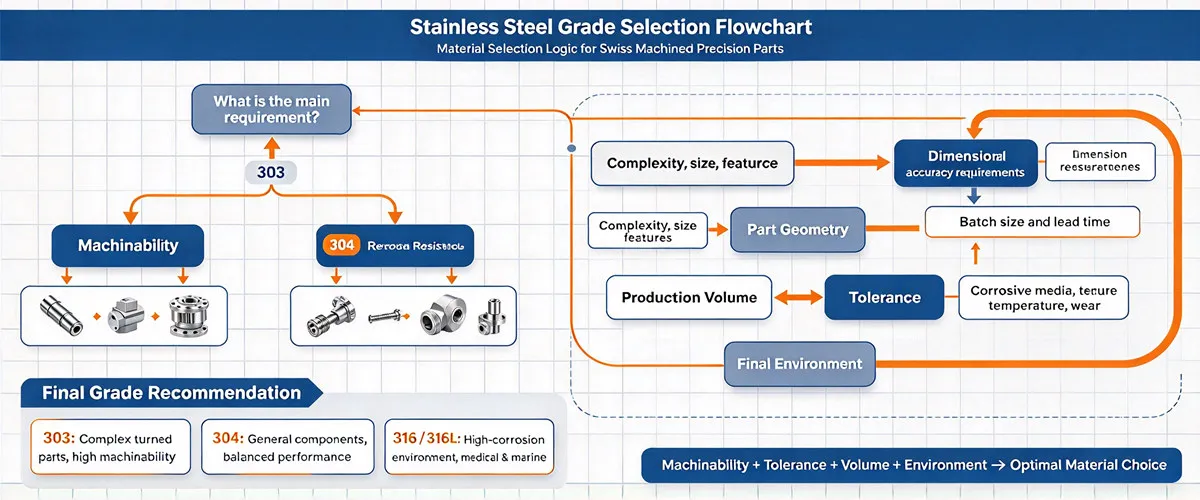
Choosing the best stainless steel for Swiss machining involves more than just looking at resistance to corrosion or strength of the material. The entire process of manufacturing should be taken into account - the design of the part, requirements of machining, production volume and a final working environment.
In case of precision parts manufacturing, selecting the suitable type of material enhances machining stability and minimizes production difficulties whilst also helping maintain the production quality during manufacturing. Different types of Swiss machining stainless steel grades have various advantages that vary based on the requirements of the application.
A practical selection approach includes the following considerations:
| Requirement | Recommended Grade | Reason |
| Maximum machinability and production efficiency | 303 stainless steel | Excellent chip control and easier cutting performance |
| General corrosion resistance and balanced performance | 304 stainless steel | Good combination of durability and manufacturability |
| Harsh environments or medical applications | 316/316L stainless steel | Superior corrosion resistance and chemical durability |
For mass-produced Swiss machined parts with conventional environmental specifications, grade 303 seems to be optimal in terms of productivity. However, in specific applications where parts are exposed to dampness, chemicals, or difficult environmental conditions, grades 304 or 316L can be more reliable over time at the expense of increased difficulty of machining.
The choice of materials must also take into consideration the presence of design details such as small diameters, thin walls, threads, and strict geometrical tolerances that may be responsible for tool wear, surface quality, and dimensional stability.
Engineers are able to pick the most appropriate stainless steel grade that can guarantee proper functioning of Swiss machining both by considering the specifics of material properties and manufacturing process. Browse through our capabilities in Swiss machining materials to find out all options and their applications.
Send us your drawings, material requirements, and quantities.
Our team can review the part design and recommend a suitable stainless steel grade for your application.
Request a Swiss Machining Quote →
303 stainless steel typically provides superior machinability, chip control, and production efficiency than 304 stainless steel, although 304 provides higher corrosion resistance and may be preferable in conditions of moisture or corrosive environments.
The machining of 316 stainless steel is generally considered to be more difficult than that of 303 and 304 due to its diminished machinability and its propensity for work hardening. Proper tooling and cutting conditions, along with effective chip control, are imperative when machining high accuracy components made of 316 and 316L.
303 stainless steel is widely regarded to be the simplest of the three grades when it comes to machining. This is due to its sulfur content, which assists with chip breaking and cutting, making it most appropriate for precision turned parts and mass production.
What works best may depend on the application. The 303 grade is often selected if machining is the foremost concern, 304 is a compromise solution, whereas 316/316L grade is chosen when highest corrosion resistance is needed.