English
  日本語
日本語  한국어
한국어  français
  Deutsch
  Español
  русский
  العربية

May
Learn More
10

In today’s manufacturing landscape rapid scaling of production efficiently, accurately, and affordably is the competitive edge that distinguishes the leaders. Prototyping and small volume CNC machining are important to research and development, but the hard part begins when high demand occurs. This is when high volume CNC machining goes from optional to strategic.
This article discusses large batch CNC machining production, engineering principles, competitors advantages, and important considerations to use this effective manufacturing technique for your manufacturing needs.
High volume CNC machining is the fabrication of large quantities of precision parts, typically using CNC equipment, and ranged production runs which are thousands to millions of parts. Low volume projects may use standard 3-axis mills and lathes, while high-volume production runs are an intricate dance of specialized machinery, automated systems and sequence processes.
High volume CNC machining refers to a manufacturing process called mass production machining or mass production CNC production. The precise machining method is employed when mass amounts of parts must be produced with advantages such as CNC Swiss machining, used for small and narrow parts, and multi-axis machining center for complexity realizes unique geometries.
With high volume precision CNC machining the goal is not to make many parts, but to make many the same exact same high-quality parts, repeatedly, with acceptable tolerances.
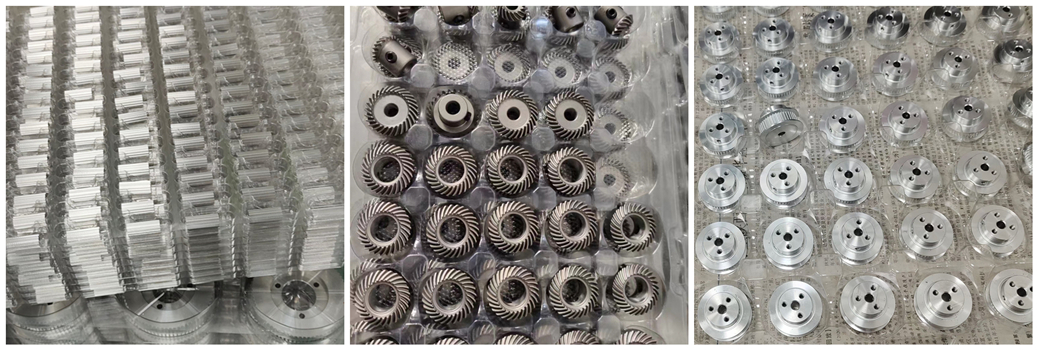
The engineering feat of high volume CNC precision machining is to replicate perfection, which brings up the question: How to maintain tolerances down to a thousandth of an inch within 100,000 parts? The answer is technology and process centered around;
Technology: High volume CNC production services serve utilize advanced CNC Swiss screw machines and multi-axis machining centers. Swiss lathes are engineering specifically to manufacture a high volume of turned parts because of factors like: the bar stock is held close to the cutting tool are capable of retaining stability and accuracy, minimizing and deflection that hindered production. Also, the Swiss lathe can operate multiple simultaneous, complex operations, or turn and mill at once.
Automation and Untended Operation: The economics of high volume manufacturing depends on the ability to reduce labor cost per part. The majority of high-volume machining systems incorporate advanced automation components in either a bar feeder, gantry load, or pallet changers to allow parts to run for several hours, even days unattended, “lights-out manufacturing”. This technological competency is a crucial component of a precision machined component manufacturing at scale.
Process Control and Repeatability: From the outset of the production process is construct around repeatability which entails
Fixturing: A custom fixture and collets designed specifically hold the parts exactly the same way for each cycle.
Tool Management: Automated tool wear monitoring and pre-set tooling ensuring each cut is machined to the highest tolerances in order.
In-process checks: Automated probing and vision systems verify critical dimensions during the machining cycle, allowing any drift from tolerances ensuring scrap levels are kept to a minimum.
From a business stand point, working with a high-volume CNC machining partner will provide measurable bottom-line benefits.
Massive Cost Savings: The most powerful benefit comes from the economies of scale. The initial cost for set-up (programming and fixturing) in high-volume manufacturing is an investment; however, the cost per part is driven down because that initial cost will be spread across the thousands of units produced. Direct labor is minimized, plus cycle times are optimized to make each part less expensive.
Reliability: When working with a company specializing in high-volume CNC machining services, you can secure your supply chain. You can rest assured you have reliable source of high-volume custom parts from a supplier that can service forecasted demand, mitigating production hardships and stock-outs. This level of dependability listed above is critical for industries such as medical devices and automotive.
Consistency and Quality: The industries that require no room for error demand consistency. A professional high-volume machining provider will have standard quality systems in place (ISO 9001 and AS9100), for precise components for aerospace and medical uses, each and every piece ( from the first to 50,000th) is held to the same specification requirements.
Speed to Market: After the production line is set-up and confirmed, all parts can be produced at an astronomical speed - allowing you to pivot with customer demand, develop faster products and fulfill large product orders to get a significant market advantage.
The need for scalable CNC services exists across many advanced industries.
Medical Device Manufacturing: Millions of parts must be made exactly the same produced with biocompatible ultra-precision CNC machining. That is, surgical instruments, implants, bone screws, etc. are perfect industries for high-volume precision machining.
Aerospace and Defense: Extreme conditions are the requirement for high-volume durable parts. Engine components and avionics housings, etc. have zero tolerance and fabricated at high volume.
Automotive Industry: The changing landscape of electric vehicles, driver-assistance systems (ADAS) leads to high-volume CNC machining of sensor housings, connectors and powertrain parts.
Electronics and telecommunications: Consumers produce connectors, heat sinks and shielding components as well as infrastructure in extreme volumes, opening up the door for automated CNC machining.

Not all machine shops are applicable for high-volume CNC machining. Look for:
Experience: Portfolio of successful high-volume projects in your industry sector.
Technology: The machines should be modern CNC Swiss screw machines, multi-axis mills, and integrated automation.
Quality Systems: Quality process should be documented and there should be obtainable certification.
Supply Chain Management: Have access to materials for long lead times for high volume and deliver on schedule.
Collaborative Engineering: Provide Design for Manufacturability (DFM) feedback to ensure part optimization to be cost effective for high-volumes.
High volume CNC machining isn’t just about quantity of parts. It is an intricate discipline combining engineering ingenuity with operational excellence to generate unrivaled economic value. Mastering the dynamic CNC Swiss machining, extensive automation, and strict process capability to achieve the scale, efficiency, and quality necessary to be successful in the global economy today.
If a company is ready to move from prototype to high volume production, your search for a high volume CNC machining provider is more than a tactical or operational decision of procurement; it serves as your company’s strategic investment for growth, stability, and long-term success.
Are you ready to scale your production with precision and efficiency? Reach out and connect with Falcon CNC Swiss to discuss your high volume CNC project and find out more about how a large-scale CNC manufacturing solution can serve your business.