English
  日本語
日本語  한국어
한국어  français
  Deutsch
  Español
  русский
  العربية


Jun
Learn More
02

Industrial applications of lightweight, accurate and reliably performing precision aluminum parts are well-known. This case study examines how Falcon CNC Swiss produced custom aluminum precision components for industrial applications requiring exceptionally strict tolerances and quality assurance.
The materials used in the CNC machining of precision aluminum parts included 6061-T6. The project was accomplished using precision CNC technology with engineering support and strict compliance with quality standards. Falcon achieved its goals in providing the components needed according to the client's specifications.
This project starts with prototype development and ends with the production of aluminum parts. The conclusions made from the project prove Falcon is an aluminum precision components manufacturer suited for industrial applications in need of high-quality CNC aluminum precision components.
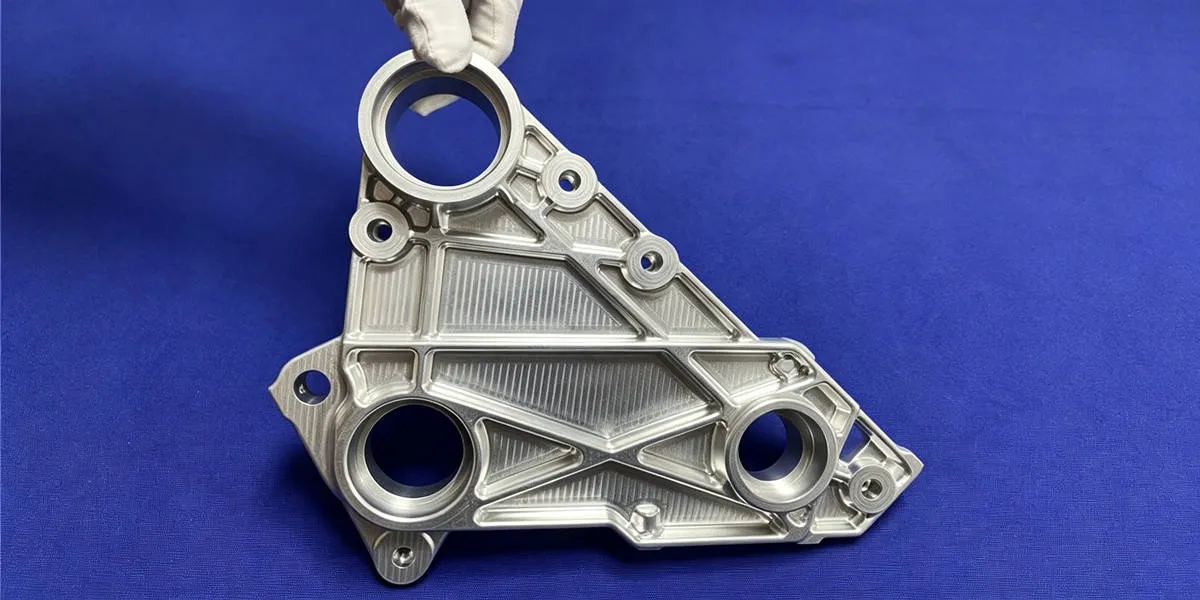
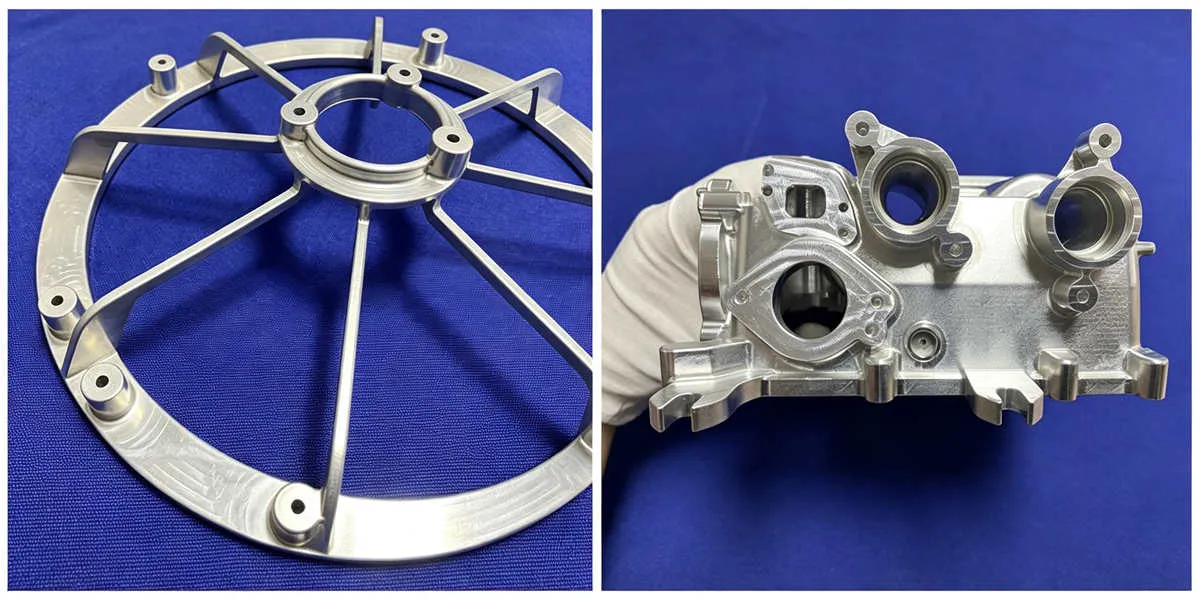
The goal of this project was to create a high-strength aluminum structural bracket intended for various mechanical tools, automation systems, and robotics. The device needed to possess a combination of lightweight, high rigidity grade, and accurate dimensional control of components to provide reliable performance of a device in operation.
The consumer requested a custom aluminum precision part with complex geometry, several mounting surfaces, and reinforced structure. In order to meet all the requirements related to the functionality, Falcon optimized the design for CNC manufacturing and kept the necessary mechanical durability of the part.
| Item | Specification |
| Part Name | High‑strength Aluminum Structural Bracket |
| Processing Technology | 5‑Axis CNC Milling |
| Material | Aluminum Alloy 6061‑T6 |
| Surface Finish | Precision machined as‑finished surface |
| Key Features | Lightweight rib‑reinforced structure, multi‑mounting holes, high rigidity |
| Tolerance | ±0.02 mm for critical dimensions |
| Application | Mechanical equipment / Automation / Robot component |
| Manufacturable Batch | Prototype & Mass production |
| Notes | DFM‑optimized rib design for weight reduction while retaining mechanical strength |
By combining 5-axis CNC machining, engineering optimization, and precision inspection, Falcon successfully produced aluminum structural components that met the customer's requirements for accuracy, strength, and production consistency.
When manufacturing precision high-strength aluminum parts, it is essential to consider part design, material properties, process stability, and dimensional accuracy. In this particular aluminum bracket case, the main issue faced was how to implement a light-weight structural solution without losing rigidness and precision.
Sophisticated Structural Design and Weight Reduction
The component is based on a ribbed design aimed to minimize the weight while preserving the necessary strength. However, the processing of thin-walled elements and ribs needed precise cutting techniques which allowed to control vibrations, deformations, and forces affecting the material.
Tight Dimensional Requirements
The set goal for the project was to manufacture tight tolerance aluminum components with very tight tolerances and measuring dimensions with an accuracy of ±0.02 mm. In order to achieve that, it was necessary to select the proper machining settings and design appropriate fixtures, as well as to carry out constant process control.
Multiface Processing Features
Since the bracket has several bolts and several other complicated features at various surfaces and faces, ordinary processing would imply performing it many times and thus increasing the possibility of errors during performance. Therefore, 5-axis CNC machining process was chosen in order to guarantee properly positioned parts without any secondary operations.
DFM Implementation Needed to Guarantee Precise Manufacturing
Before the manufacturing process, Falcon Company analyzed the part design and produced DFM recommendations to increase the suitability of the design, to avoid unnecessary operations and to achieve stable quality of the product from the prototype to mass production.
The success of the project was based on the cooperation between engineers and application of optimal technologies in operation in manufacturing.
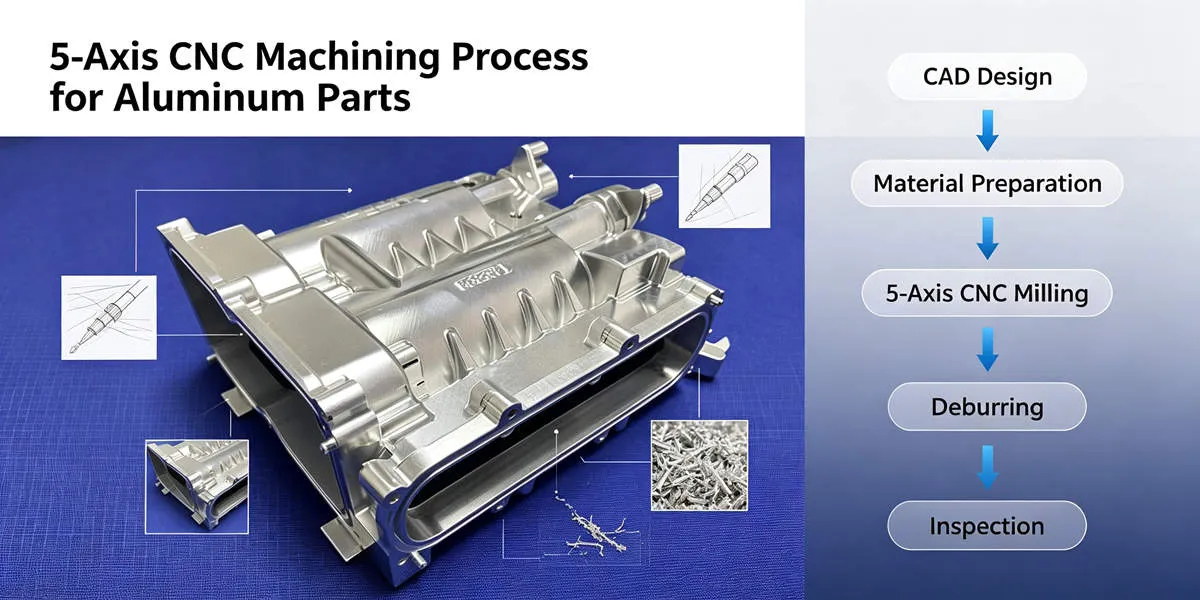
The fabrication of this aluminum structural bracket has necessitated the precise management of the entire production process, beginning with the preparation of raw parts to the inspection of finished components. The optimal combination of advanced CNC machining and effective planning made it possible for Falcon to achieve tolerances in parameters necessary for this structure.
The project was utilizing aluminum alloy 6061-T6 due to its good combination of properties, including strength, machinability, good resistance to corrosion, and dimensional stability. Prior to the commencement of fabrication, Falcon followed the drawing of the product and determined all significant dimensions and structural traits in order to develop an effective plan of production.
The DFM analysis focused on:
Reducing unnecessary machining operations
Improving tool accessibility
Optimizing rib structures
Ensuring stable clamping during machining
Due to the bracket’s multi-face features and reinforced rib design, 5-axis CNC milling was selected as the primary manufacturing process. This allowed the component to be machined from multiple angles in a single setup, improving positional accuracy and reducing alignment errors.
The process included:
Rough machining to remove excess material
Semi-finishing to establish key features
Precision finishing for critical dimensions
Drilling and machining of mounting holes
Edge finishing and deburring
Throughout machining operations, cutting parameters, fixture conditions, and tool states were kept under control for ensuring consistency. This was mainly the case for aluminum components featuring thin ribs and lightweight designs as high cutting forces could create negative impact on the accuracy of components.
The improved process of CNC machining allowed Falcon to produce CNC aluminum components up to the maximum quality required for prototype production and series production.
Choosing the correct aluminium alloy is crucial for precision components that need a combination of strength, machinability, weight and stability. In this case, the best decision was to use aluminium 6061-T6 which has great overall properties in terms of performance of industrial equipment and automation applications.
6061-T6 aluminum offers several benefits for CNC manufacturing:
Excellent machinability for complex precision features
Good strength-to-weight ratio for lightweight structural designs
Stable dimensional performance during machining
Good corrosion resistance for industrial environments
Compatibility with various surface finishing processes
These characteristics make 6061-T6 a preferred material for aluminum precision components, where accuracy and reliability are more important than maximum tensile strength.
6061-T6 aluminum has an edge over 7075 in terms of its machinability and resistance to corrosion. Hence it is recommended for many designs in industry and automation. Although 7075 aluminum is a stronger material, it is best applied in aerospace or high-load applications where ultimate mechanical performance is necessary.
In this project, 6061-T6 aluminum perfectly balanced the structural rigidity, production effectiveness, and affordability required by Falcon to manufacture high-quality machined aluminum products for prototyping and production purposes.
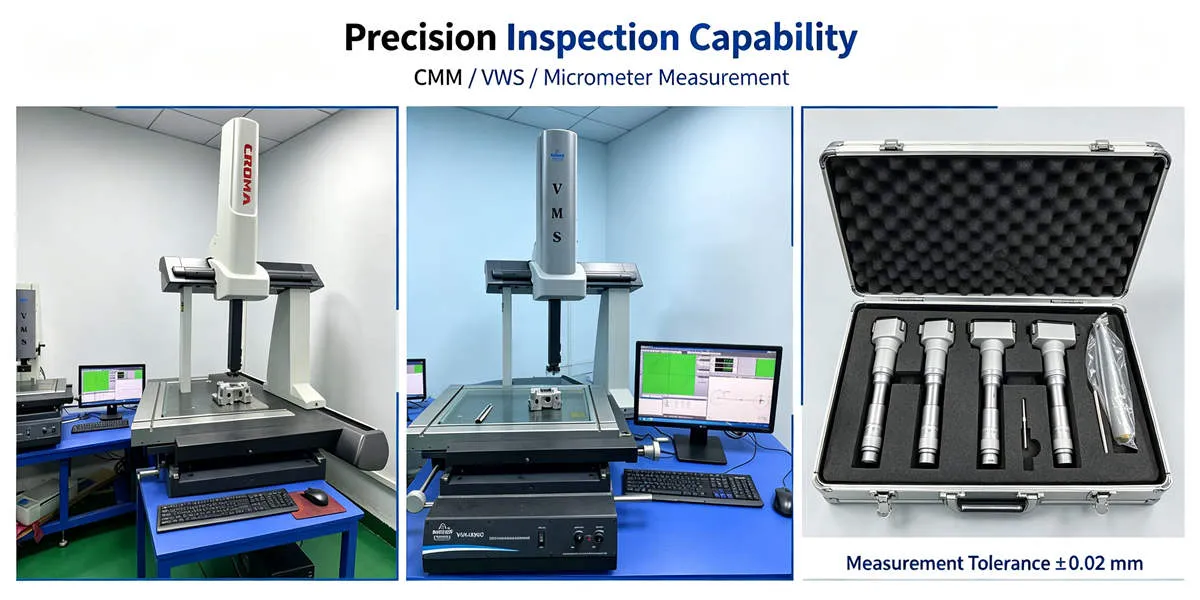
For the production of aluminum parts for industrial equipment and automation, consistency in accuracy is very important. Falcon developed a quality control system in order to carry out necessary checks of significant dimensions, geometric accuracy, and part performance.
The structural bracket required critical dimensions within ±0.02 mm, making inspection accuracy a key part of the manufacturing process. Falcon used precision measurement equipment to verify important features, including:
Overall dimensions
Mounting hole positions
Flatness and alignment
Critical machining features
Surface quality
Coordinate Measuring Machines (CMM), micrometers, calipers, and other inspection tools were used to ensure that each component met the customer's drawing requirements.
Quality control was integrated throughout the machining process rather than performed only after completion. Process monitoring included:
First article inspection
In-process dimensional checks
Tool condition monitoring
Final inspection before shipment
This approach helped maintain repeatability for both prototype production and larger manufacturing batches.
For customers who need steady supply, constant capabilities in production are necessary. Falcon follows ISO-based quality management practices to facilitate the conformity of CNC machined aluminum parts throughout their lifecycle from the first stages of development to large-scale manufacturing.
With the application of accurate measurement systems and regulated manufacturing methods, Falcon can offer precision CNC machining service with the desired level of accuracy and reliability for strict industrial applications.
The surface finishing process is significant for achieving a better durability, look, and long-lasting functioning of aluminum precision parts. For the project discussed, the components were supplied with a precise machined surface, thus keeping the original features of machining intact and meeting the requirements posed by the customer while functioning correctly.
Depending on the application environment, aluminum components can also be enhanced through additional finishing processes such as anodizing, bead blasting, or protective coatings. These treatments can improve:
Corrosion resistance
Surface durability
Wear resistance
Visual appearance
Environmental protection
Anodized aluminum precision components are often chosen for certain applications needing better protection since anodizing forms a long-lasting oxide layer that enhances the performance of the surface while retaining the lightweight benefits of aluminum.
When selecting an aluminum surface finishing, engineers should take into account the conditions in which the product will be used; the dimensions of the product; how the product will be assembled; and how it has to look. Thickness of surface treatment should also be taken into consideration because it may affect the dimensions of the product.
Falcon provides its clients with aluminum components which meet all functional and esthetical needs through the use of combination of precision CNC machining and suitable finishing solutions.
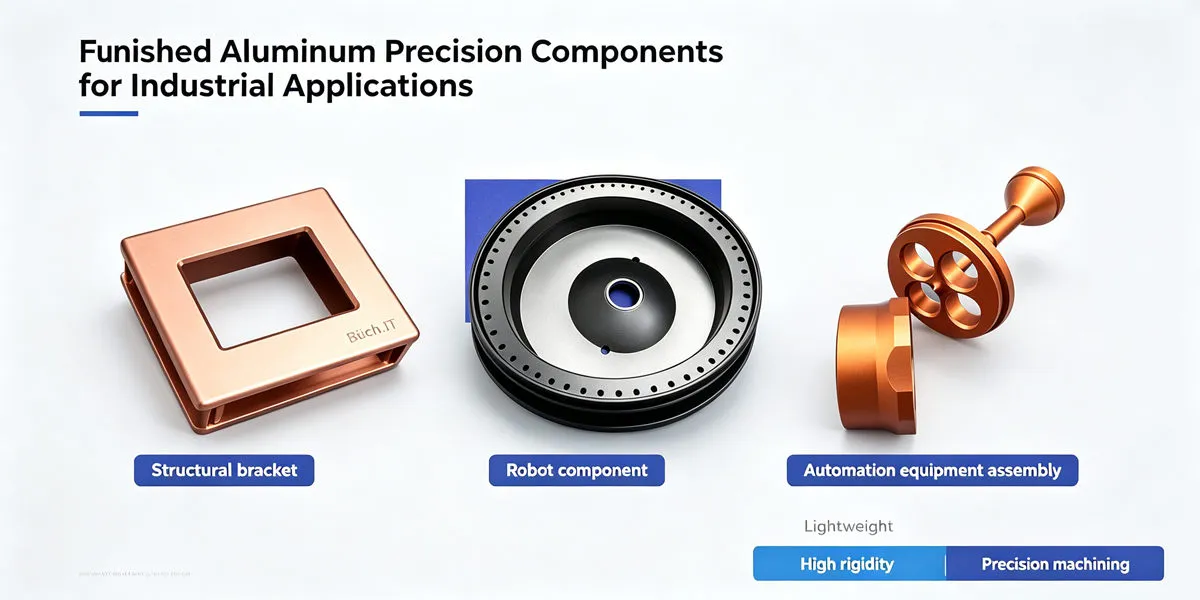
Falcon has been able to offer precision aluminum components that met the client’s requirements for precision, structural performance, and overall reliability through engineering collaboration, enhanced CNC machining processes, and thorough quality control systems. Falcon helps customers develop reliable custom aluminum precision components from initial prototypes through production with flexible contract manufacturing support.
The aluminum structural bracket portrays a dimensional tolerance of ±0.02 mm. It also has a lightweight ribbed design. Falcon has helped improve the manufacturability of the product, reduced unnecessary machining processes, and created a solid manufacturing process using DFM optimization.
Key project benefits included:
High-precision aluminum components with consistent dimensional accuracy
Reduced weight while maintaining structural rigidity
Improved production efficiency through optimized machining strategies
Reliable transition from prototype development to mass production
This project demonstrates Falcon's capability as an aluminum precision components supplier supporting industrial equipment, automation, and robotics. With its expertise in the provision of precision CNC machining services, innovative machining technologies, and engineering-driven manufacturing solutions, Falcon is able to provide its clients with reliable aluminum components and parts from the prototype to the production stage.
It is critical for businesses needing dependable custom aluminum precision parts to choose the correct manufacturing partner like Falcon who possesses the ability to utilize cutting-edge CNC machining technology, as well as have access to engineering know-how, and high-quality management systems so that they can implement tricky aluminum parts projects from their design stage, all the way to the production stage.
Capabilities here include CNC milling services, 5-axis machining services, turning services, and Swiss machining services that make it possible for Falcon to fabricate different kinds of custom aluminum parts with complicated designs as well as high accuracy and standards.
Our manufacturing advantages include:
Engineering support and DFM optimization before production
Advanced CNC machining for complex aluminum geometries
Stable production processes for prototype and mass production
Professional inspection and quality control procedures
Integrated surface finishing solutions including anodizing and other treatments
As an experienced aluminum precision components manufacturer, Falcon serves clients in various sectors, including industrial machinery, automation, robotics, and electronics, providing effective machinery solutions.
Starting with the design stage and ending with the production stage, Falcon uses a well-integrated manufacturing method in providing its clients with high-level aluminum components.
Need custom aluminum precision components for your next project? Falcon provides CNC machining solutions for prototypes and production parts with tight tolerances, complex designs, and consistent quality.
Send us your drawings or project requirements. Our engineering team will review your design and provide a suitable manufacturing solution.
Aluminum precision components are particular parts obtained by the special manufacturing technology. The main feature about them is that strict framework is used in the processes of production. The techniques applied include CNC milling, CNC turning, and five-axis machining. These components are installed in machines and robots used for different industrial purposes.
The level of tolerance is influenced by various factors. Among these factors there are the following: part features, material properties, production methods, and inspection procedure. Using cutting-edge technology in CNC machining services, professionals can create components made of aluminum of high precision that meet the world standards. In addition, such factors as fixturing, tools, and temperature control play a significant role as well.
Choosing the aluminum alloy depends on the requirements of the customer. Aluminum 6061-T6 is the most popular option among manufacturers, because it is easy to process, it is durable and it has good geometrical stability. Aluminum alloys can be used in cases where more durable materials are required, for example, aluminum 7075.
The whole process can be divided into a number of stages. First of all, the engineering stage is performed and then the selection and production of the parts starts. Manufacturers also provide additional recommendations concerning the design of the product so that the process of manufacturing goes successfully.