English
  日本語
日本語  한국어
한국어  français
  Deutsch
  Español
  русский
  العربية
Mar
Learn More
13

Few components are more important and widespread in the field of power transmission and motion control than the spline shaft. It is little wonder that these shafts crafted with great care are virtually unheralded workers in the machinery of countless applications from the automobile transmission to the actuators in airplane power plants. Falcon CNC Swiss specializes in the precision manufacture of these important parts. In this exhaustive article, we will take up in detail the subject of what is a spline shaft, what it does, what types there are, and what manufacturing processes are used to manufacture them in order to get optimum results.

A spline shaft, in its simplest definition, is a mechanical member designed to transmit twisting force and maintain speed ratio between two members. It has a number of ridges or teeth, to which we give the name splines, ground parallel to the axis of the shaft. It meshes in the appropriate female member, gear or hub, and provides a joint affording torque transmission and also a slight amount of axial displacement.
It will be seen that a single point of contact is provided in the key and key seat assembly. The spline shaft, on the other hand, has many points of contact about its circumference. This uniformly distributes the load, resulting in a stronger, more dependable and higher torque capacity connection. In short, the spline shaft is a modern, highly developed solution to problems which occur in the high performance of the heavy power applications of rotary motion.
There are several essential functions to which a splined shaft is adaptable in mechanical assemblies.
(1) Torque Transmission: This is its main field of endeavor. It is intended to be used in transmitting rotary motion from driving member to driven member, as from a motor to a transmission.
(2) Compensation for Axial Misalignments: Splined shafts are capable of providing for slight misalignments between parts to which they are connected to reduce the wear and tear and stress to which the parts would otherwise be subjected.
(3) Linear Motion: While transmitting torque, splined shafts permit the part mating with them to be given linear motion, that is to say, to slide along the length of the shaft. This is of paramount importance in such applications as collapsible steering columns and transmission shift devices.
(4) Phasing and Indexing: The accurate disposition of the splines provides that the parts mate in a definite position thus providing for the correct phasing necessary in such applications as timing devices.
(5) Increased Load Capacity: By distributing the load across several splines it is possible to transmit significantly higher torque than with a keyed shaft of the same diameter.
Spline shafts are classified according to the shape of the ridge or teeth and the major diameter of the splined shaft. The more custom splined shaft manufactured by Falcon commonly used types are:
(1) Involute Splines: This is the predominating type. The teeth have an involute curve, which is the same curve expressed as used in gear teeth. They are strong, self-centering in their mounting, and capable of accommodating slight misalignments. They are of standardized sizes and shapes for interchangeability. ANSI B92.1 and DIN 5480 are specifications under which involute spline shafts may be produced.
(2) Straight-Sided Splines: These, as may be guessed from the name, have side teeth which are straight, but parallel with each other. They are more easily produced in manufacture in some cases, but they are inferior to the involute page 2 splines as to their competency in respect to misalignment and strength as compared with their size of tooth.
(3) Serrated Splines: These splines have teeth having a triangular form and are used in the case of lighter duty and where permanent press fit assembly is employed.
(4) Ball Splines: This is something new and consists of a splining of recirculating balls in grooves that provides for practically frictionless linear motion under working conditions, with torque transmission. This shaft is capable of use in high precision of work, as in automation and robots.
In the manufacture of good quality spline shafts there is much care in machining them. In Falcon CNC Swiss, we have available different modern methods of processing:
CNC milling: With our Multi-Axis CNC milling centres we can accurately machine complex spline profiles, which is especially suited to prototypes and low- or medium-volume manufacture.
CNC Turning and Hobbing: For mass production use is made of close turning with hobbing, which is a gear-generating process where a hob cutter progressively cuts the spline teeth in the rotating blank. This is very economical for involute splines.
Broaching: In this case, a tooth tool (the broach) is pushed or pulled linearly over the shaft in order to broach the spline in one operation. This is quick, is extremely accurate, and is a very common process for internal splines, or some external splines.
Grinding: The finest accuracy and surface finish is easily obtained on certain hard steels preferably by means of Profile Grinding. This process will obviously involve very close tolerances which are necessary on splined shafts used for the aerospace and medical specification.
CNC Swiss Machining: This is our speciality with Swiss-type lathes having great stability and accuracy in the manufacture of long slender shafts. The guide bushing holds the material just back of the cutter, thus avoiding any deflection, and allowing simultaneous production of splines, threads, etc., in the one work set-up.
In view of the fact that the performance and durability of spline shafts is in large measure dependent on the material in which they are made, the following are the usual materials in use:
Alloy Steels (4140, 4340 Alloys): This is the standard material used in the industry for high strength applications, and these show combinations of good strength, toughness and wear resistance, which respond well to heat treatment.
Carbon Steels (1045, 1215 Alloys): In these cases this is often the less costly method of providing the applications for which they are required, where not great taxation of the material is necessitated. Strength and good machineability are the basis of the application of these products.
Stainless Steels (303, 304, 316, 17-4PH): In general the softer products of the above are used in this class for spline shafts, their great point of selection evidently being resistance to corrosion. The 17-4PH is precipitation hardening in its own right, since it develops such great strength after heat treatment.
Aluminium Alloys (6061, 7075 Alloys): A natural step in the reduction of weight, which is of importance in respect to aerospace and robots. These products are marked by their good strength to weight ratios.
Exotic Alloys (Titanium, Inconel): Are valued in the extreme environments on heavy pressure, as for example (in Jet Engines and Chemical Processing), where weight ratio, high strength, heat and corrosion resistance is a matter of paramount importance.
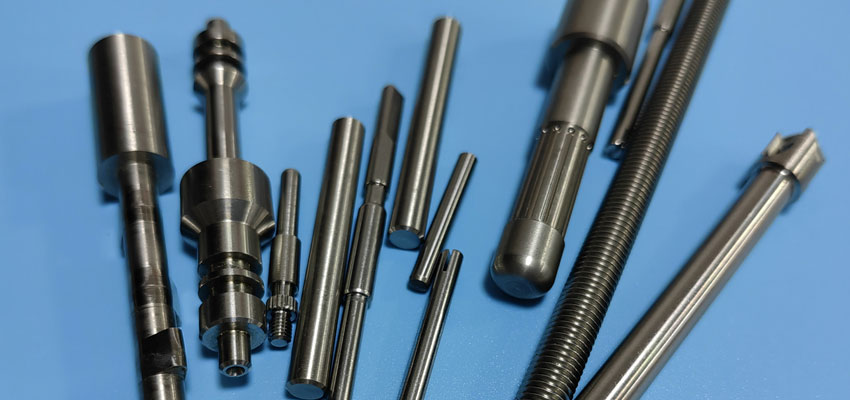
Heat treatment is often a very necessary element in the effecting of special properties in the spline shafts in use.
Through Hardening (Quenching & Tempering): This improves the strength and hardness of the Complete shaft, and is ideal for applications, where great wear and load capacities are required.
Case Hardening (Carburizing, Nitriding): This produces a hard, wear-resisting outer case, while the core is made tough and ductile. This has results of great importance in the case of splines, where a hard outside surface is necessary to cause resistance to wear, but where the core must have sufficient toughness in order to be able to take sudden shock loads.
Induction Hardening: This by method only affects the splined part of the shaft, all the rest being left in the original condition. This process has such a great factor of nearness, that it does away with the junctions of longer heat treatment processes.
Effect: The proper heat treatment of splined shafts greatly increases their great surface hardness, and also their resistance to fatigue and wear, which results directly in a length of life increase on the service of the cached component under heavy loaded conditions.
Spline shafts are required in every engineering field:
Automotive: Transmissions, drive shafts, differentials, power steering, transfer cases.
Aerospace: Actuators for flight control surfaces, landing gear systems and engine components.
Industrial Machinery: Pumps, compressors, machine tool spindles and conveyors.
Robotics, Automation: Robotic arm joints, linear actuators, precision positioning stages.
Medical: Surgical power tools, adjustable hospital beds, imaging devices.
Falcon CNC Swiss doesn't just manufacture parts, we manufacture solutions. Our Swiss CNC machining and multi-axis milling expertise provides an ideal partner in your custom spline shaft needs. We know that all applications are unique and we work closely with you from design to delivery.
Precision Tolerances: We maintain tight tolerances for precise fit and function.
Wider Material Selection: We use all standard and many exotic materials.
Full Service Manufacturing: We work from machining to heat treating, plating and grinding executed in a complete process.
Quality Assurance: Every part is quantitatively closely checked to maintain the highest quality standards.
Work with us to receive reliable high performance material shafts to your specification. Call for a quote today and discover how we can bring precision and quality to your project.
The spline shaft is a true feat of mechanical design to solve the very complex problem of transmitting torque while allowing for movement with elegance. Ultimately the success of the spline shaft is dependent upon accuratly engineered parts, material selection and, most importantly, the manufacturability of the product. By knowing the types, functions, and machining processes, the engineer is empowered to approach the design of more reliable and efficient systems. Manufacturers requiring uncompromised quality and precision performance will find a specialist in the area of spline shaft applications such as Falcon CNC Swiss the only solution to optimum performance and reliability.
1. What is the difference between a spline shaft and a keyed shaft?
A keyed shaft transfers torque through a key inserted in a keyway with unrelieved points of contact producing a wrought point of high stress. A spline shaft has multiple teeth for transferring load distributed evenly throughout, producing greatly increased torque capacities, better concentricity of parts and yet allowing for linear movement.
2. How do I decide between involute or straight sided splines?
Involute splines are the norm for high torque applications due to their self-centering characteristics, better stress distribution and the much wider selection of tools available for mass production. Straight sided splines are simpler, but usually seen in lower torque loaded parts or special application areas.
3. What information do I need to supply for a custom quote for a spline shaft?
As much as possible is the golden rule, but a comprehensive quote is more easily obtained if the following information is submitted:
- Engineering drawings with details for GD&T if applicable to design.
- Spline configuration (i.e. Involute 30° PA, 10/20 pitch).
- Specified material.
- Quantity required.
- Any secondary operations required (heat treating, plating, etc.).
4. Do you manufacture splines on hardened steel?
Yes. We manufacture splines on pre-hardened steel but not easily, by using hard turning or profile grinding techniques for requiring accuracies with ease and finish required.