English
  日本語
日本語  한국어
한국어  français
  Deutsch
  Español
  русский
  العربية


Jul
Learn More
03

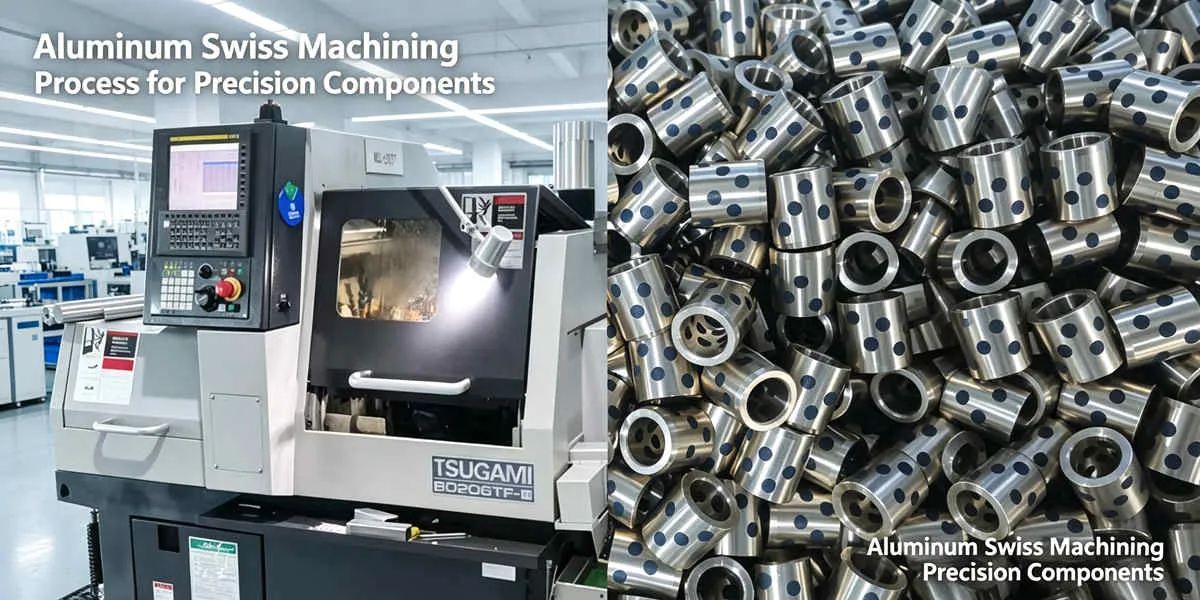
In precision engineering, engineers deal with the same two questions: Is aluminum good for Swiss machining? And when should they choose aluminum Swiss machining instead of conventional CNC turning?
The answer is obvious. Aluminum is among the leading materials used in Swiss machining, thanks to excellent properties such as machinability, light weight, corrosion resistance, and dimensional stability. Aluminum together with Swiss-type machines makes it possible to do the machining of small and complex parts.
Falcon CNC Swiss specializes in aluminum Swiss machining implying the production of small precision parts that can be used in electronics, automation, medical devices, and industrial equipment. What is more, the Swiss machining technology has proved to be advantageous in producing parts with complex shapes and geometries and in executing large batches of manufacturing operations.
The following guide describes the process of Swiss screw machining aluminum, the right choice of aluminum alloys for the purpose, major design issues to solve as well as possible types of applications for the technology. Whether you are going to order parts made of aluminum through Swiss machining or are evaluating custom aluminum Swiss machining an order for a new project, this guide offers practical information on the topic.
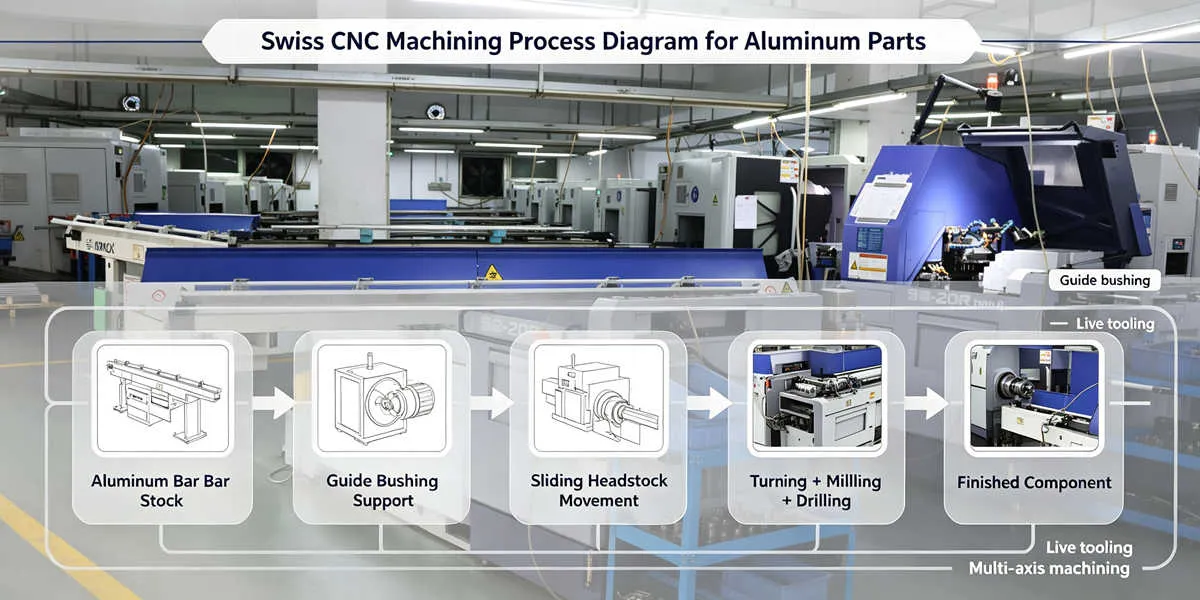
Swiss-type machining, widely referred to as Swiss screw machining or sliding headstock machining, is specifically developed for maching small, complex and highly accurate components. Unlike traditional CNC turning which uses fixed fixation of the workpiece in a chuck, Swiss machines use a guide bushing to feed stock bar into the machinery while the cut-off tool moves in the area to be machined.
Such a design achieves continuous support of the work piece close to the cutting point which leads to minimized vibration, deflection of the processed material and thereby reduced dimensional changes of the component being machined. This technology is particularly advantageous for aluminum part Swiss machining since aluminum is lightweight and highly machinable but more sensitive than other metals to cutting forces and types of deformation when thin wall or elongated parts are machined.
The Swiss machining process typically includes:
Bar Stock Feeding
Aluminum bar material is automatically fed through the guide bushing to maintain stable positioning during machining.
Precision Turning and Milling
Multiple tooling stations and live tooling allow Swiss machines to perform turning, drilling, milling, threading, and other operations in a single setup.
Continuous Production
The sliding headstock design enables efficient production of repeated components with consistent dimensional accuracy, making it ideal for prototype development and high-volume manufacturing.
Improved Machining Stability
The guide bushing provides close support during cutting, minimizing chatter and improving surface finish quality when machining aluminum components.
Complex Parts in a Single Setup
Multi-axis Swiss machines can manufacture complex features such as cross holes, grooves, threads, and milled surfaces without multiple repositioning operations.
High Production Efficiency
Automatic bar feeding and reduced secondary operations make Swiss machining an efficient solution for producing large quantities of precision aluminum parts.
For applications requiring small aluminum parts Swiss machining, Swiss technology provides an effective combination of precision, repeatability, and manufacturing efficiency.
Opting to utilize Swiss machining aluminum instead of traditional manufacturing techniques translates to achieving incredible levels of accuracy, efficiency, and production capabilities. Swiss machining offers useful benefits for engineers working on intricate, small, or highly precise components.
Great Accuracy in Making Small and Complex Parts
One of the main positive aspects of Swiss machining is its capacity to observe tight tolerances on parts with smaller diameters. The guide bushing support mechanism minimizes any deflection that part might undergo during the machining which means the manufacturers can create the perfect aluminum products using Swiss machining even those that provide complexities of various shapes and types.
So, this feature is very valuable for manufacturing devices like electronic connectors or precision fittings, as well as components for medical devices and aircraft, where precise making of the item is essential.
Excellent Quality of Surface Finish
Aluminum is one of the most suitable materials for the Swiss machining method because of its great machinability along with its potential for reaching high cutting speeds. Because of the extraordinary torsional powers of Swiss machines, it is possible to get high-quality surface finishes during machining operations without the need for other additional methods afterwards.
A perfectly machined surface can help eliminate the need for additional finishing procedures, which leads to improvement in the overall effectiveness of production.
Efficient Production for High-Volume Aluminum Parts
For manufacturers requiring repeated production of precision aluminum components, Swiss machining provides outstanding efficiency. Multiple operations, including turning, drilling, milling, and threading, can often be completed in a single setup.
This reduces secondary operations, improves process consistency, and makes Swiss machined aluminum parts more economical for prototype runs, low-volume production, and high-volume manufacturing.
Compared with traditional Aluminum CNC machining, Swiss machining provides additional advantages for small-diameter and complex aluminum parts.
Reduced Amount of Material Wasted and Cost Reduction
Swiss machines were designed for the efficiency of material usage. Since the cutting devices do not move too far away from the guide bushing, there is no excessive amount of unused bar material.
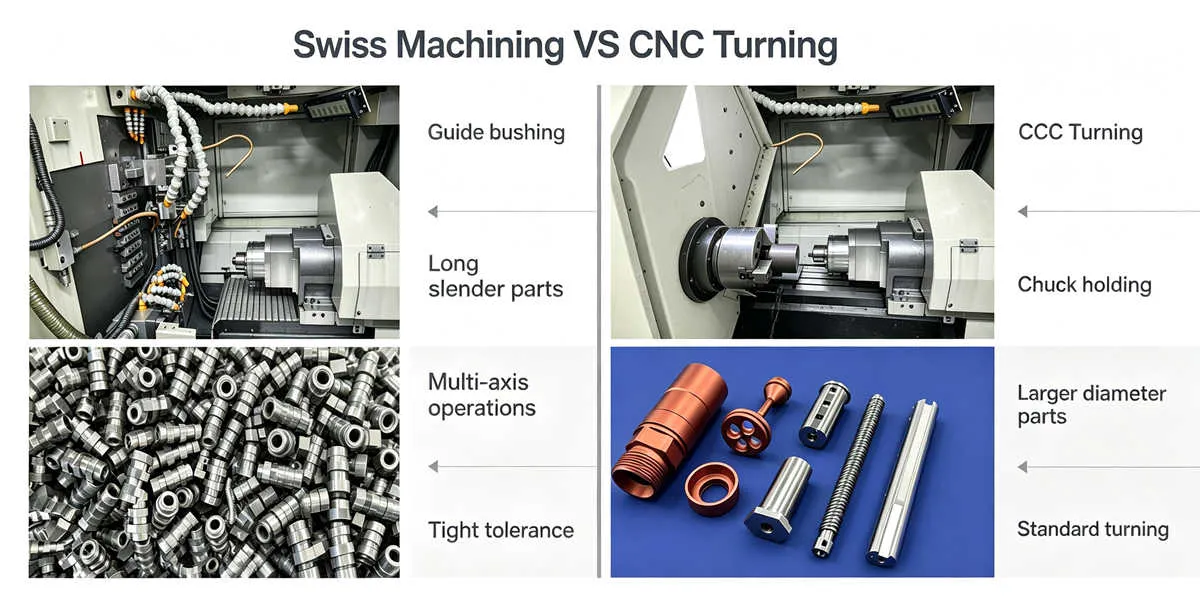
Choosing between Swiss machining and CNC turning processes depends on the project requirements such as part shape, tolerances, quantities, and complexity involved in the manufacturing process. Although both methods allow getting precision aluminum parts, they are designed for different applications.
As a rule, Swiss machining is an appropriate method for small-diameter parts with complex geometries since it is essential to maintain accuracy and reduce the secondary processing. In contrast, CNC turning is preferred for parts produced in larger quantities in a simpler way having larger and shorter dimensions.
The following comparison highlights the key differences:
| Feature | Swiss Machining Aluminum | CNC Turning Aluminum |
| Part Geometry | Ideal for long, slender, and complex components requiring drilling, milling, threading, or off-center features in one setup. | Better suited for shorter, larger-diameter parts with simple rotational profiles and fewer secondary features. |
| Precision & Tolerance | Excellent for maintaining tight tolerances on small and slender parts due to guide bushing support, making it suitable for precision aluminum components. | Provides very good accuracy but may experience greater deflection on parts with high length-to-diameter ratios. |
| Machining Capability | Multi-axis Swiss machines integrate turning, milling, drilling, and threading operations in a single cycle. | Primarily focused on turning operations, with additional milling or drilling often requiring secondary setups. |
| Production Volume | Highly efficient for repeat production, especially for large quantities of identical precision parts. | Flexible for prototypes, low-volume production, and medium-volume projects with simpler designs. |
| Cost Considerations | Higher initial setup cost, but lower unit cost for complex parts produced in volume due to fewer operations. | Lower setup investment, but complex parts may require additional operations that increase total cost. |
Swiss machining is the preferred solution when your aluminum components require:
Small diameters and long lengths
Tight dimensional tolerances
Complex features in a single setup
High repeatability for production runs
Reduced secondary machining operations
For instance, the accuracy and precision of Swiss-type machining benefits Swiss machined aluminum parts used in the fields of electronics, medical, automation systems, and precision machinery. CNC turning may provide a more economical solution for simpler aluminum components.
On the other hand, conventional CNC turning is a more economical option for standard aluminum pieces that are simple, have significantly larger diameters, and use straightforward machining for geometry.
When determining whether aluminum Swiss machining vs CNC turning should be adopted, the factor that is of key importance is the details of the required part and not the technology. At Falcon CNC Swiss, engineering offerings are helping to choose the most appropriate technology based on the design of the part, tolerance, and purpose of manufacture.
Our expertise in Swiss machining enables Falcon to manufacture high precision aluminum part components at any stage of production from prototyping to mass production.
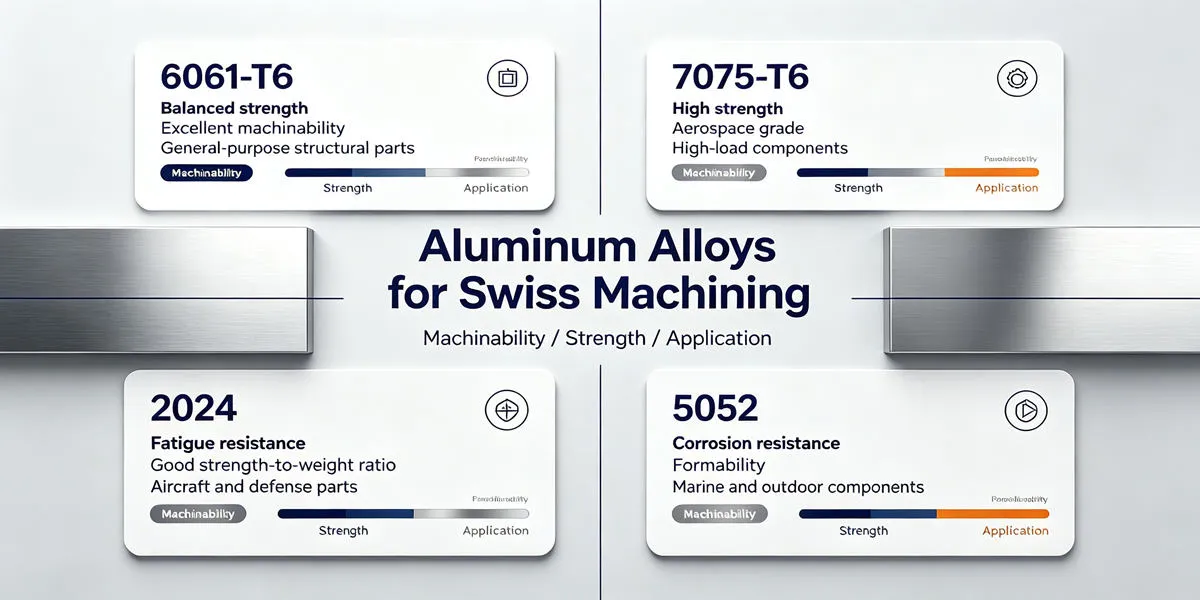
The correct aluminum alloy is very important in aluminum Swiss machining. Different alloys offer different characteristics, including strength, machinability, corrosion resistance, surface finish properties, and cost. The choice of the right aluminum alloy must meet the requirements set for the final product, which may be defined as mechanical properties, dimensional requirements, volume of production, and operation conditions.
When it comes to aluminum machining as part of CNC Swiss machining processes, there are several alloys that are most frequently used.
6061-T6 aluminum
6061 aluminum machining is very popular among machinists due to its unique properties, such as corrosion resistance, strength, good machinability, and availability on the market. Thus, it can be used in various industries, including aerospace and electronics.
The performance of this alloy is known and predictable, which makes it a great choice for both prototypes and serial production.
7075-T6 aluminum
7075 aluminum machining is characterized by high strength-to-weight ratio and is extensively used in aviation applications. Moreover, in comparison with 6061-T6, this alloy offers increased mechanical strengths, but it is harder to machine and has lower corrosion resistance.
This alloy is good for precision components made from aluminum that should possess superior strength characteristics, such as aviation components.
2024 aluminum
This alloy is known for fatigue resistance and is widely used in aviation. The alloy is rather easy to machine, however, its corrosion resistance is below average and other means should be taken to protect the product.
5052 aluminum
This alloy is famous for its corrosion resistance and formability; however, it is poorer in terms of strength.
Free-machining aluminum alloys. These alloys such as 2011-T3 were specially developed for machining in order to form smaller chips and increase tool life and surface quality.
Choosing the correct aluminum alloy is a means of obtaining the required equilibrium in terms of performance affordability and manufacturability.
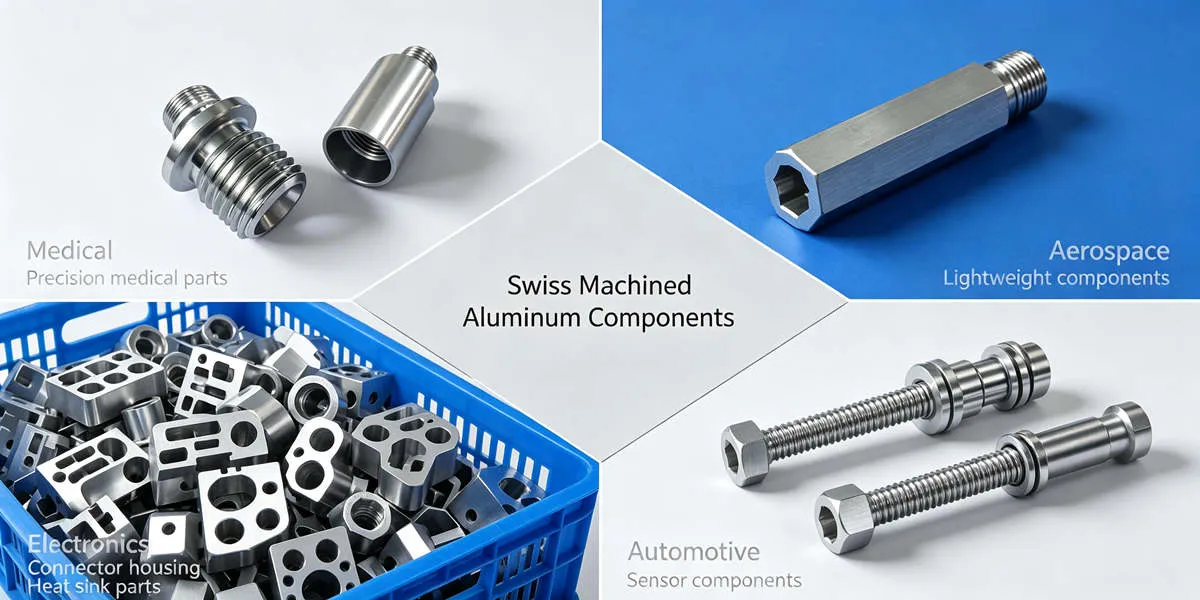
Aluminum swiss machined components offer an optimal combination of weight, durability, and precision. For manufacturers that require complexity in their machining process, Swiss machining is useful because it helps create small but highly precise components.
Medical and Dental Components
In the medical industry, Swiss machining of aluminum finds applications in making highly precise components like instrument handles, components of endoscopy equipment, and parts for dental equipment such as connectors. All these factors, along with aluminium's incredible properties of weight and resistance to corrosion, make it an appropriate material for applications in medicine.
Swiss machining is an excellent alternative for applications where precision and ability to repeat the process are needed, as it allows creating small and geometrically complex components while achieving exact dimensions.
Aerospace and Defense Components
Aluminum is the finest choice for the aerospace and defense industry due to its high strength-to-weight ratio and outstanding performance. Commonly used Swiss-machined aluminum precision components include sensor housings, bodies of connectors, lightweight structures, and tiny actuators.
High-strength alloys like 7075-T6 aluminum are often used when the strength and weight of an item are two critical factors.
Electronics and Semiconductor Components
In electronics and semiconductor fields, aluminum components are widely used within the scope of applications such as sensor housings, heatsinks, RF shields, and components used in precision measurement instruments.
The features of the Swiss machines to provide small shapes and complex forms while meeting the specific tolerance requirements make them appropriate for the production of miniaturized electronic devices.
Automobile and Industrial Components
The automobile industry is also inclined toward using aluminum parts manufactured with the help of Swiss machining due to the high efficiency and excellent quality of the resulting components.
Whether in prototype production or in mass manufacturing processes, Swiss machining serves as a dependable means to manufacture aluminum components.
A good design of a component is quite important to ensure that the right combination of product quality, cost, and production efficiency gets achieved. By taking into account the manufacturing requirements at the design stage, engineers can prevent difficulties in the machining process, guarantee uniformity of production, and ensure reduces cost of precision parts manufacturing.
The following design for manufacturability recommendations can help get the maximum out of manufacturing aluminum parts via Swiss machining:
1. Optimize Length-to-Diameter Ratio
Swiss machines are highly efficient when it comes to working with long and thin parts as they maintain support during the machining process thanks to the guide bushing. However, longer-than-necessary length-to-diameter ratios could create certain difficulties concerning machining process.
When it comes to small aluminum parts characterized by long shapes, it is advisable to communicate with your manufacturer to make sure that the proportions are appropriate for successful machining.
2. Use Tolerance According to Functional Needs
Applying high precision tolerances is mandatory for certain features, however the application of high precision tolerances everywhere could add to the costs of production. Instead of putting tight tolerances everywhere, choose the features that have direct relation to the assembly, performance, and functions.
Utilizing industry standard tolerances where possible may help manufacturers optimize the process of production while still ensuring a certain level of performance of the parts.
3. Consider Chip Removal at the Design Stage
Aluminum could produce good results in terms of machining, however some of the geometries could still affect the chip removal process. For instance, deep and thin holes could create difficulties during the machining process since chips may not escape easily.
Careful consideration of the depth and diameter of certain features as well as availability of access for working tools may improve chip removal and ensure successful machining.
4. Take Advantage of Standard Tooling
Utilization of standard cutting tools instead of custom ones could reduce setup and tooling costs. When designing the internal corners and complicated features, it is important to think about standard tooling diameter and corner radii. Eliminating the necessity for custom toolings can boost production efficiency.
5. Think of Final Surface Finishing Requirements
If the finished aluminum components are to be anodized or have surface treatments applied, the manufacturers should need to be informed about that to allow for the thickness of the coating beforehand which could affect final dimensions of the parts made with tight tolerances.
Cooperation with an experienced producer ensures that machining is carried out in a proper way that allows for getting the right final part parameters.
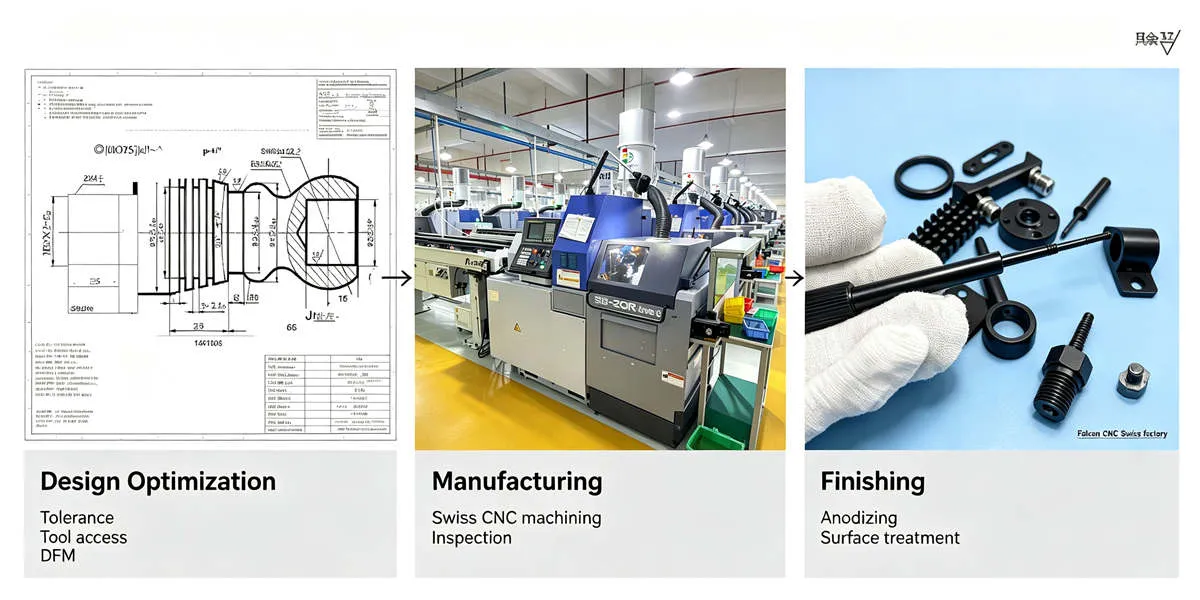
The role of surface finishing in the enhancement of the aesthetics, longevity, and functionality of Swiss machining aluminum parts cannot be overemphasized. Although aluminum has good anti-corrosive properties and machining characteristics, proper surface finishing would also help to maintain the resistance against wear and protect the surface of the product while providing the necessary visual properties.
Here are some of the most popular techniques of finishing aluminum Swiss machining parts:
Aluminum Anodizing
Anodizing is one of the most common surface processes used for aluminum parts. This is an electrochemical process that results in the formation of a protective oxide coating, thus ensuring enhanced resistance to corrosion, surface hardness and availability of various colors.
Type II anodizing is the most widely exploited for manufacturing general industrial components and electronic parts while the Type III hard coat anodizing improves wear resistance for harsh operating conditions.
In relation to high-precision parts, thickness of the coating should be taken into account when making the parts, in order to follow the customer requirements as to the dimensions of the finished products. Learn more about Anodizing Aluminum CNC Parts.
Surface Texturing and Bead Blasting
Bead blasting is meant to eliminate any marks of machining and provide the surface with uniform matte finish. It is usually applied along with anodizing to achieve a high-quality professional look.
Machined and Polished Finishes
If a specific smoothness or reflective silver surface is required, polishing can improve surface quality. Nevertheless, it is possible that the machined finish obtained through Swiss machining will be sufficient and no further treatment would be needed.
Choosing the best method of finishing will be based on the environment where the product is used, its successful functioning, dimensional accuracy, and appearance.
Selecting the ideal partner for manufacturing precision aluminum components is crucial when dealing with parts that demand very close tolerances, consistent qualities, and dependable production output. With Falcon CNC Swiss, we integrate state-of-the-art Swiss machining technology and professional engineering know-how, hence making it easier for our clients to evolve from the concept stage through to successful manufacturing.
Our experience in aluminum Swiss machining enables us to cater for different projects ranging from the production of small precision parts to creating parts that require mass production. Besides machining, our qualified engineers work on optimizing the processes, manufacturability, and complete quality control to prepare solutions for each project in accordance with its specifications.
Our tremendous advantages derived from partnering with Falcon are:
Engineering Support and DFM Optimization
The engineers at Falcon conduct the analysis of the design of the component and the materials in the early stages of development as the time of manufacture is coming. Our application of DFM methodology allows for determining possible manufacturing problems and problems with part fabrication.
Quality Control and Process Traceability
Precision manufacturing means strict control of processes. The procedures of inspections, checking materials, and control of production run of Swiss machined aluminum components used by Falcon ensure that every batch of manufactured aluminum parts is as per detailed customer specifications.
Prototype to Production Capability
Falcon has already proved its ability to provide swiss machining features not only for prototypes, low-volume production, and massive manufacture but also to be a flexible partner in different kinds of projects. So it means that Falcon can use its advanced machines and experienced engineers to help to make the transition from development to production as smooth as possible.
By using modern Swiss CNC machining equipment and experienced engineers along with a commitment to delivering the best quality service Falcon can provide the customers with aluminum parts for electronics, automation, medical devices, and heavy machinery.
If you want to design your project of aluminum precision machining, or just want to partner with a reliable company that will guarantee precision manufacture, the engineering team at Falcon is obviously ready to carry out all needed activities and offer you the best option.
Contact us now to get a quote and learn how to work on your aluminum machining project in partnership with Falcon.
Aluminum Swiss machining employs the Swiss-style CNC machines to form high-precision small parts from aluminum, which are produced under tightly controlled tolerances. Unlike standard CNC turning processes, the Swiss machines work on the principle of supporting the material with a guide bushing as close as possible to the cutting tool, consequently reducing vibrations and ensuring greater dimensional stability.
The method is used in a wide range of applications for producing parts that require complex shapes, fine diameters, and consistent quality of production.
Aluminum is one of the most popular materials for manufacturing components with the use of Swiss technology due to its good machinability, low weight, corrosion resistance, and ability to be treated properly.
The most frequently used alloys are 6061-T6, 7075-T6, and 2024 T6. They have been chosen based upon such criteria as strength, durability, and application.
The selection of the favorable aluminum alloy depends on the specified application.
6061-T6 aluminum is the most widely used alloy when it comes to manufacturing general-purpose parts due to its good strength and machinability.
7075-T6 aluminum is preferred for parts requiring high strength.
2024 aluminum is employed for production of parts requiring resistance to fatigue.
In selecting an alloy, an engineer needs to take into account the following: mechanical properties, resistance to corrosion, finishing requirements, and volume of production.
The level of tolerances that can be reached depends on several factors: the features of the part, material specifications, the capabilities of a machine, and requirements for inspection.
It should be noted that Swiss machining technology allows manufacturing very small precision parts under strict dimensional control of certain features. Considering this fact, the engineer has to set precise functional tolerance requirements if any critical features of the part are going to be manufactured.
Swiss machining is the preferred option for manufacturing long and complex parts with the required features since the technology allows performing several operations at a time.
The CNC turning may be a more suitable option for manufacturing larger and simpler rotating parts without many features. The choice depends on size and shape of the component, tolerances that are required, and the number of parts needed to produce.
Yes. The aluminum Swiss machined parts may undergo anodizing process in order to obtain better corrosion resistance, surface protection, and appearance, but the thickness of the coating has to be taken into consideration because it might change final dimensions.
Submitting technical documentation, material specifications, tolerances, requirements for finishing, and volume of production is necessary in order to start working on a project. Falcon CNC Swiss will review the design, analyze it and propose a suitable manufacturing solution.