English
  日本語
日本語  한국어
한국어  français
  Deutsch
  Español
  русский
  العربية


Mar
Learn More
29

The international robotics business is growing rapidly. Humanoid robots are being mass produced in 2026, creating explosive development in almost all component sectors. An expected 300 million humanoid robots will exist globally by 2050; this means there will also be billions of custom parts that must be machined, delivered and assembled.
If you are working on developing a service application humanoid, an industrial robot for factory automation or medical robot custom parts for surgical support, the quality of the components you use will determine the following: how well the robot moves, how efficiently it uses power, how long it will last and how safe it will be.
This guide is meant for engineers, product designers and purchasing agents needing consistent performing custom robot parts. It includes information about the primary machining challenges when machining robotic components, how to use practical multi-axis approaches to create complex structures, ideas on how to build durable joints, and what you should seek in suppliers of custom robot parts.
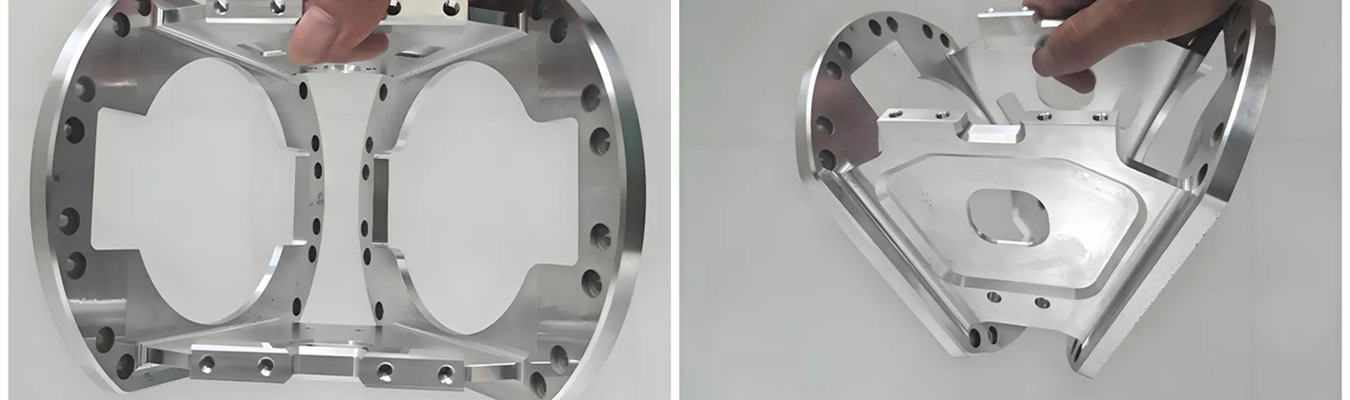
Machining components for humanoid robots presents several unique challenges that go far beyond standard CNC work.
Challenge 1 - Internal complexity due to multi-axis robotic components:
A majority of the mechanical elements produced, such as actuator bodies and custom robotic joint housings, frequently require, among many other things, multiple different product attributes (freeform surfaces, deep cavities, etc.), but traditional three-axis machining cannot produce all of these attributes in a single set-up, necessitating the need for multiple repositioning and subsequent occurrences of accumulated error due to tolerances and increased labour.
Challenge 2 - Micron tolerances of motion-producing robotic components:
There are many joints in each humanoid robot and even the smallest discrepancies in the accuracy of each component will lead to lagging, stuttering, and binding in the robot kinematic chain; therefore, all motion-producing components will have extremely precise tolerances, typically requiring ±0.005mm - ±0.01mm; and if the goal of the robot is to reduce friction in order to increase the longevity of both components, the maximum allowable surface roughness for any component that contacts another component shall be Ra≤0.4μm.
Challenge 3 - Weight vs. strength vs. machinability balance:
The addition of one gram to the weight consumes increased energy and decreases battery life; however, lightweight materials are generally more difficult to manufacture; thus the engineering of custom robotic parts has used many materials; for example:
Aluminium (6061/7075-T6): Aluminium materials provide a superior strength-to-weight ratio with good machinability; however, when cut using increasingly aggressive cutting we will deform.
Titanium (Ti6Al4V/Grade 5): Titanium is a material of exceptional strength and biocompatibility, but due to its poor thermal conductivity, titanium will produce rapid wear on tools used to machine it due to rapid tool wear, and will work harden during machining.
Stainless-Steel (304/316/17-4 PH): Stainless Steel is very strong in resisting to wear and impact; however, it is a relatively heavy material, and very difficult to machine to very tight tolerances.
Engineering Plastics (i.e. PEEK, Delrin, Ultem): Engineering Plastics are lightweight and have insulating properties; however, engineering plastics should not create excessive heat when machined, as they can melt and create burrs.
Challenge 4 - Thin-walled components are susceptible to vibrations and/or structural deflection:
To reduce overall weight, many of the robots’ structural components utilize a thin-wall configuration; therefore, the structural components of the robots will vibrate and/or deflect during machining, thus requiring the use of proper working strategies and tool-path strategies.
Falcon CNC Swiss combines advanced technology, engineering discipline, and hands-on experience to find solutions for your challenges:
We utilize 5-axis CNC machining to reach complex features in one setup, which reduces potential errors caused by the need to reposition parts and improves the quality of the output.
Our Swiss-type CNC lathes use specialized coolants to precision machine small-diameter components made from titanium and stainless steel with micron tolerances.
In-process probing followed by CMM inspection of critical dimensions (at the middle of the run) provides the opportunity to make offset adjustments to components before they go out of spec.
Our fixture strategies for machining thin-walled components minimize vibration and help to prevent distortion to these components while they are being machined.
We are able to provide prototypes or high-volume production of custom robot arms or unique robot parts for your new humanoid platform with our engineering-led approach, helping ensure consistently high quality throughout the entire run for bespoke robot parts production. Explore Falcon precision CNC machining capabilities for custom robot manufacturing.
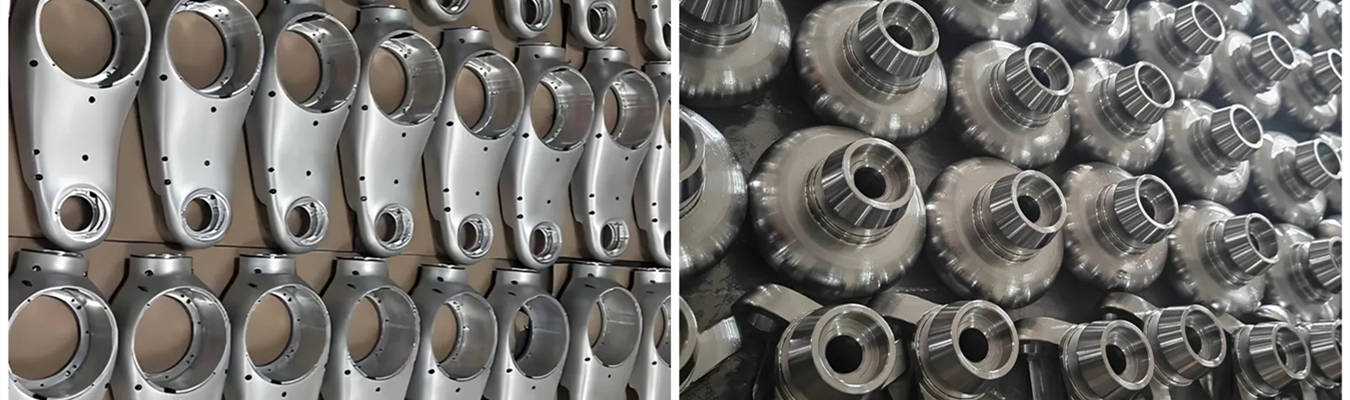
Many of the most challenging robotic custom parts—from custom robot gripper fingers to custom robot frame structural elements—cannot be effectively machined on 3-axis equipment.
5-axis CNC machining allows the cutting tool to approach the workpiece from multiple angles in a single setup. This delivers several critical advantages for industrial custom robot parts:
| Advantage | How It Helps Robotic Components |
| Single-setup production | Eliminates tolerance stacking from multiple clampings; critical for coaxial bores and bolt circles |
| Access to undercuts and deep cavities | Enables complex custom robot joint housings with internal features |
| Better surface finishes | Continuous tool contact reduces scalloping marks on freeform surfaces |
| Reduced fixture complexity | Fewer custom fixtures mean faster setup and lower cost |
| RTCP capability | Maintains tool orientation accuracy regardless of how the machine rotates |
Strategy 1: Define an Integrated Datum System Before Any Cutting Activity
Many aspects of a part; such as bolt circles, mounting surfaces and bearing bores; need to reference a common “datum” (origin), regardless of how the part has been positioned (flipped upside down or rotated). Prior to initiating any cutting activity, create a datum system that will be utilized consistently throughout all machining processes.
Strategy 2: Design Your Toolpath Symmetrically for Thin Wall
When machining lightweight, custom robotic frame components, using symmetrically designed machining paths will provide an equal distribution of cutting force and reduce the chances of deformation. For example; approach thin walls from both sides instead of cutting all of one side first, which will minimize the chances of the part becoming distorted.
Strategy 3: Utilize High-Pressure Coolant When Machining Challenging Materials
When machining titanium or stainless steel for medical robot custom parts or high load capacity custom robotic arms, the use of high-pressure coolant tooling is mandatory. High-pressure coolant tooling 1) blasts chips from cutting area; 2) reduces heat build up; and 3) prevents work hardening at surface of material.
Strategy 4: Verify Dimensions Prior to Unclamping
A dependable process consist of 5-axis machining with 1 setup per part and performing verification prior to removing the part from the machine. Early detection of dimensional issues allows for the prevention of scrap parts from being produced.
Selecting the right material for your custom robot parts is just as important as selecting the right machining strategy. Here is a quick reference table:
| Component Type | Recommended Material | Why |
| Custom robot arm links and structural frames | Aluminum 7075-T6 | High strength-to-weight ratio; corrosion-resistant |
| High-load joints and hip components | Titanium Grade 5 (Ti-6Al-4V) | Exceptional strength with biocompatibility |
| Wear surfaces and actuator housings | 17-4 PH stainless steel | Heat-treatable; excellent wear resistance |
| Insulating spacers and lightweight fill components | PEEK or Delrin | Low weight; electrical insulation; chemical resistance |
| Custom robot gripper jaws | Aluminum with hard anodizing | Lightweight actuation; durable gripping surface |
Robot joints undergo the greatest amount of stress. Each hip joint of a humanoid robot experiences a large amount of torque during standing and walking. The ankle joint also receives repetitive impact and has to provide precise angular control. Furthermore, from the shoulder joint to the wrist joint, all joints experience millions of cycles before a failure occurs.
Dynamic load capacity and fatigue life are the two primary factors in determining the robustness of a joint component. Joint components must be capable of withstanding millions of load cycles without experiencing a failure. In general, the contact fatigue life of a joint can be increased as a result of the measures taken to control the residual compressive stress during the machining process.
Principle 1 – Avoid Sharp Internal Corners
Every sharp internal corner on a machined part is susceptible to stress concentration. Most fatigue cracks start at sharp internal corners. Therefore, when specifying custom robot joints that are machined on a CNC (computerized numerical controlled) machine, specify an internal corner radius of at least one millimeter (or greater if the joint has high amounts of load). The small design change of an internal corner radius can result in a significant increase in part life.
Principle 2 – Use Matching Materials for the Load Path
The stress on different regions of a joint are different. Using finite element analysis (FEA), identify the highest-stress area of a joint, and match the material to that area of the joint. Using a combination of aluminum and titanium—aluminum for the lower-stress structural areas of a robot joint and titanium for the higher-stress load-carrying areas of a robot joint—will give the best weight-to-durability balance.
Principle 3 – Specify Surface Finish Requirements
Surface finishes that contact moving components—such as bearing raceways, bore pins, and sliding surfaces—should be machined to Ra less than or equal to 0.4 micrometres or finer. A surface that has a rougher than Ra 0.4 micrometre surface finish will not only increase the friction of the part but will also produce higher amounts of heat and cause wear to the contact surfaces. At Falcon CNC Swiss, we can readily produce such fine surface finishes on complex machined robot joints.
Principle 4 – Plan for Testing and Iteration
Top-level robotic developers use CNC-machined prototype joints to evaluate the functional performance of design concepts before proceeding to final tooling for production. Using prototypes for evaluating design, fatigue tests can be used to optimize not only the design of joints but to modify the tooth profiles on machined gears to reduce peak stresses in the gear teeth. Prototype fatigue test results serve as input for the machining of production parts, ensuring durability targets for production parts are met.
An example of the application of these principles comes from our manufacturing floor. A customer required a lightweight, high-strength actuator housing with an elaborate cooling channel and precise tolerances. By virtue of having 5-axis CNC machines, we machined the actuator housing from 7075 aluminum while maintaining all the requisite tolerances and critical surface finishes. The completed actuator housing fits perfectly on the actuator, thereby enabling our customer to produce a smaller and lighter robot joint. Learn more about our CNC machined humanoid robot parts manufacturing.
As an experienced robotic custom parts manufacturer, we provide end-to-end solutions for robotics projects of all sizes—from initial prototype to full production.
| Capability | Specification |
| Equipment | 5-axis CNC mills, Swiss-type CNC lathes (Citizen, Star), multi-axis turning centers, EDM/WEDM |
| Precision | Tolerances down to ±0.005mm; surface finishes to Ra 0.2μm |
| Materials | Aluminum (6061, 7075), titanium (Grade 5, Grade 23), stainless steel (303, 304, 316, 17-4 PH), engineering plastics (PEEK, Delrin, Ultem) |
| In-house finishing | Anodizing (clear, black, custom colors), passivation, bead blasting, polishing, silk-screening |
| Quality system | ISO 9001:2015, ISO 13485, ISO 16949; full CMM inspection and traceability |
| Volume flexibility | Prototype to high-volume production; zero-MOQ prototyping available |
Our experience spans a wide range of robotic components:
Custom robot arm assemblies and articulated links
Custom robot joint housings and articulating connections
Custom robot gripper fingers and end-effectors
Custom robot frame structures and skeletal frameworks
Custom robot motor mounting plates and brackets
Actuator housings and servo mounts
Gear housings, couplings, and transmission components
Sensor brackets and structural connectors
DFM engineering support:
Our engineers review your design before quoting and suggest changes that improve manufacturability without sacrificing performance.
Single-source accountability:
Machining, finishing, and inspection are all under one roof—no coordination headaches with outside vendors.
Rapid prototyping:
Need custom robot parts for sale quickly for a proof-of-concept? We offer expedited prototyping with lead times as short as 3–5 days.
Scalable production:
From 10 units to 10,000+ per month, our production systems scale with your demand.
Global shipping:
We serve clients across North America, Europe, and Asia with reliable delivery timelines.
For industrial custom robot parts, custom robot parts for drones, or specialized medical robot custom parts, we bring the same engineering discipline to every project.
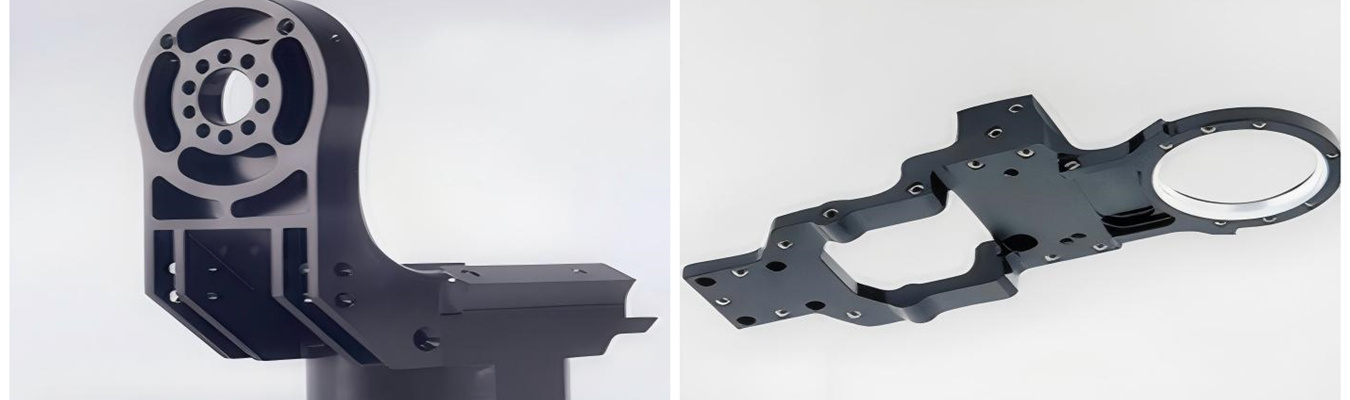
Selecting the right custom robot part suppliers is a critical decision. Here is a practical checklist you can use to evaluate potential partners.
| Selection Criteria | What to Look For |
| Materials experience | Proven track record with aluminum, titanium, stainless steel, and engineering plastics for robotics |
| Equipment depth | 5-axis machining capability for complex robotic custom parts; Swiss-type lathes for small precision components |
| Quality systems | ISO 9001 certification minimum; ISO 13485 for medical robotics; full CMM inspection |
| DFM support | Will they review your design before quoting and offer cost-saving suggestions? |
| In-house finishing | Can they plate, anodize, or passivate without outsourcing? |
| Volume flexibility | Do they handle both prototypes and production runs? |
| Communication | Responsive technical questions? Clear quoting process? |
A reliable custom robot parts manufacturer will offer free DFM analysis, provide material certifications and inspection reports, and maintain rigorous quality control at every stage. Check out Falcon CNC Swiss custom robot parts manufacturing.
When seeking affordable custom robotic components, proceed with caution; sacrificing tolerances for cheaper options will lead to difficulties with assembly, performance, and final life of the component. However, there are valid methods for decreasing component production costs:
Design for manufacturability: There are design factors that will shorten machine processing time based on minimal adjustments to your CAD designs (adding fillets, standardizing hole sizes, and allowing for more relaxed non-critical tolerances) that will not affect your overall design.
Material selection: Using aluminum will be much less expensive than utilizing titanium. Use titanium only in applications where strength-to-weight ratio or biocompatibility mandates its use.
Quantity planning: The initial setup cost is less when spread over larger quantity production orders, so obtaining multiple quantity tier pricing can save you money.
Use a DFM Provider: The best robotic suppliers will identify potential production issues prior to quoting a price for your robotic part, allowing you to avoid potential expensive fixes later in the production process.
For wholesale buyers who are purchasing components and producing in mass, implementing several of the strategies listed will allow you to achieve good per unit cost without sacrificing overall quality.
Custom robot parts require more than just machining—they require engineering discipline, material expertise, and a supplier who understands that every component must perform reliably over millions of cycles.
At Falcon CNC Swiss, we combine advanced 5-axis and Swiss-type machining, rigorous quality control, and hands-on engineering support to deliver custom robot parts that meet your specifications—on time and on budget.
Whether you are building a humanoid for service environments, an industrial robot for factory automation, or custom robot parts for drones for aerial applications, we are ready to help.
Upload your CAD file for a free DFM analysis and competitive quote
Explore our full precision CNC machining service to see our complete capabilities
Contact our engineering team to discuss your specific robotics project requirements
CNC machining is a subtractive manufacturing process that operates on the principle of removing material from a solid block (metal or plastic) utilizing computer-controlled cutting tools. This process starts with a 3-dimensional (3D) computer-aided design (CAD) model that is then converted into tool paths or machine instructions (G-code) for controlling the CNC machine to cut the material according to the specified design. Typically, 5-axis CNC machines are used to manufacture custom robot parts, such as joint housings and articulated arms, since they can create complex geometries within a single setup.
For custom robot components that are motion-critical, e.g., robot joint housings and bearing surfaces, tolerances of +/- 0.005mm to +/- 0.010mm are achieved. Surface finishes on motion-critical parts for minimizing friction/wear in moving assemblies are typically Ra 0.2μm or better, while most structural parts need tolerances of +/- 0.020mm to +/- 0.050mm.
The materials commonly selected for lightweight robot frames are aluminium 6061 or 7075-T6; both provide good rigidity with maximum weight. Both of these materials machine very well and can be anodized for corrosion protection. When higher strength-to-weight ratios or superior performance are required, Titanium Grade 5 has become the industry standard for manufacturing frames; however, Grade 5 requires more advanced machining techniques and is therefore more expensive to manufacture.
Yes! We manufacture anywhere from 1 piece (prototype) to as many as you need (hundreds of thousands of pieces) for custom robot parts. Our normal leadtime for custom robot prototypes is 3 to 10 business days depending upon complexity. We can provide opportunities for you to either order or buy custom robot parts for resale in quantity.
We use a 3-step quality process: First Article Inspection (FAI) - the first part is measured against the print; In-Process Inspection - the critical dimensions of the part are monitored during the entire run using prescribed methods (e.g., touch probes); and an end-of-run inspection is done using a Coordinate Measuring Machine (CMM) to measure the entire batch to confirm that all dimensions meet specification. All parts manufactured by us are 100% inspected and a copy of the inspection report is available upon request.
Yes! We perform all finishing services in-house—this ensures no delays/import issues associated with outsourced work, and that we maintain quality in all aspects of our work. We provide the following finishing services: anodizing (clear, black, and custom colours), bead blasting, passivating for stainless steel, polishing, and silkscreening. By performing all of our finishing services in-house, we make it easier for our customers to plan their operations and provide them with a single source for accountabilit.