English
  日本語
日本語  한국어
한국어  français
  Deutsch
  Español
  русский
  العربية


Jul
Learn More
23

Guide pins are an overlooked component of precision tooling and automation and linear guidance systems. Guide pin material including hardened steel for use in high-cycle die sets, carbide for abrasive-use environments, and chrome-plated for corrosion resistance all require a specific manufacturing process that ultimately impacts your machine uptime and part quality. Falcon CNC Swiss combines the ability to manufacture guide pins through Swiss machining along with its expertise in manufacturing Swiss screw machine parts to create guide pins with micron tolerances, repeatable hardness, and mirror finishes.
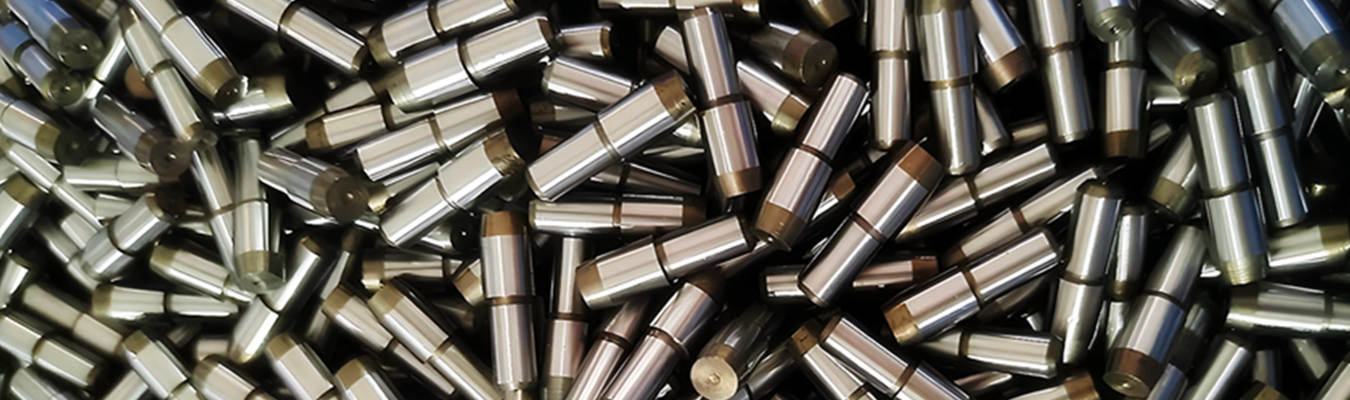
Guide pins are not simply an off-the-shelf part. Their performance directly relates to the ability to achieve final alignment, wear life, and positioning accuracy within dies, molds, jigs/fixtures, and linear guiding systems. A guide pin that has been poorly manufactured can produce galling, early wear, misalignment, and scrap parts. Alternatively, a precision-ground guide pin, manufactured with the proper clearance and surface finish will create, at least, twice the life of the tool and provide less frequency of maintenance.
Swiss-type automatic lathes (or Swiss screw machines) are optimal for making guide pins and fulfill any other specifications or requirements of guide pin manufacturers. Swiss Machining supports the workpiece next to the cutting tool with no deflection resulting in unparalleled length-to-diameter ratios (25-to-1). At Falcon CNC Swiss, we offer custom guide pin supplier solutions-from individual prototype guide pins to high volume guide pin supply runs (500,000+) with 100% quality repeatability.
Guide pins, referred to as dowel pins, alignment pins, or leader pins, are cylindrical components that create linear guidance, positioning, and alignment between two related parts. Die sets, mold halves, and fixture plates all have guide pins; they are used to ensure that the die set, mold half, or fixture plate will always return to the same position at each cycle of closing. Additionally, in linear guidance systems, guide pins work in conjunction with bushings or ball bearings to restrict movement with very low friction.
Key functions of guide pins:
Alignment – Maintaining concentricity between upper and lower tool plates
Load bearing – Resisting side loads during stamping, forming, or injection molding
Wear resistance – Providing a hard, low-friction surface for repeated sliding contact
Positioning – Locating workpieces, fixtures, or automated end effectors
Falcon CNC Swiss is a industrial guide pin factory that specializes in manufacturing pins used as industrial guides or guide pins for die sets and molds as well as jigs and fixtures, press tools, and systems that rely on precision linear motion.
While the term “pins” covers many categories (dowel pins, taper pins, spring pins, etc.), this section focuses on alignment guide pins and press tool guide pins used in tooling and linear guidance.
Below is a technical comparison of common guide pin types:
| Pin Type | Typical Material | Hardness (HRC) | Primary Application |
|---|---|---|---|
| Die set guide pins (shoulder type) | Hardened steel (52100, SUJ2) | 58-62 HRC | Progressive stamping dies |
| Mold guide pins (straight type) | Stainless steel (440C, 420) | 50-55 HRC | Injection molds, compression molds |
| Jig and fixture guide pins | Case-hardened steel (8620, 20MnCr5) | 58-62 HRC core, 60-64 surface | Drill jigs, assembly fixtures |
| Carbide guide pins | Solid carbide (K10, K20) | 89-92 HRA (~70 HRC equiv.) | Abrasive wear, high-temperature guides |
| Coated guide pins | Hardened steel + TiN, TiCN, CrN | 65-70 HRC (coating dependent) | Gall-prone materials, dry running |
| Chrome plated guide pins | Steel + hard chrome (5-15 μm) | 65-70 HV equivalent | Corrosive environments, long-life linear bushings |
| Ground guide pins (centerless ground) | Any hardened steel | Various | Final OD tolerance +-0.002 mm |
| Automotive guide pins | Case-hardened or stainless | 58-62 HRC | Assembly line pallets, engine fixture locators |
We are guide pins maker who specializes in the manufacturing of precision even in the most stringent tolerances. Our company offers OEM guide pins production when an OEM customer requires a specific geometry, as well as when they require a guide pin with a special undercut, lubrication groove, or mounting threads.
Explore more information about Falcon precision Swiss machined components.
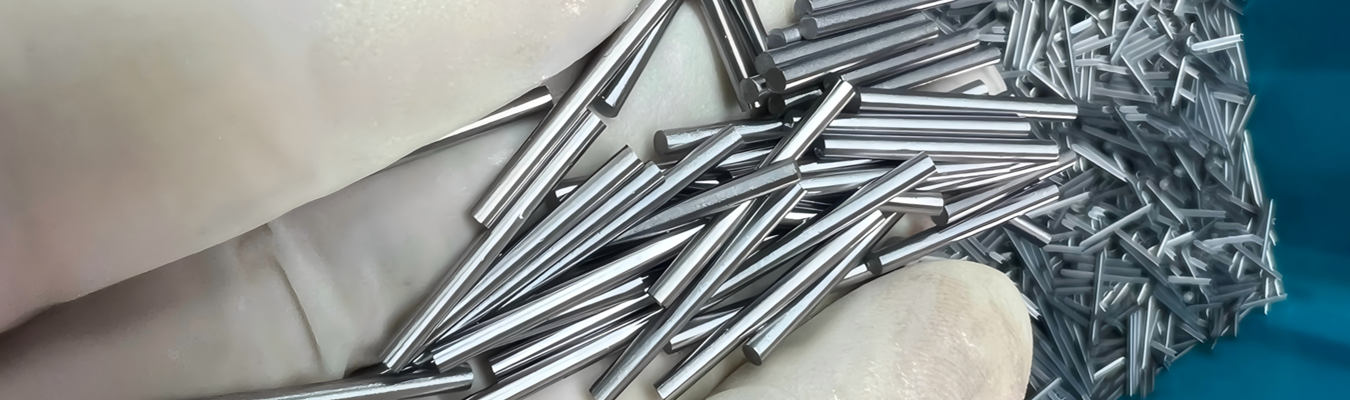
When specifying guide pins, engineers must define five interdependent parameters. Below is how Falcon CNC Swiss addresses each:
The tolerances of the guide pins are what determines the fit between each of the pins and the bushings or the mounting holes.
The Standard Tolerance Classes (per JIS B 0408 or ISO 286) for guide pins are:
m6 – Interference Fit (press-fit into fixed plate)
f7 or g6 – Sliding Fit (with clearance of 5 to 15 micro-meters on each side of the guide pin).
Most of the commonly manufactured guide pins have a diameter that range from 1 mm to 50 mm in steps of either 0.5 mm or 1 mm. At Falcon CNC Swiss, a custom guide pin can also be produced using Swiss turning for all round sizes between 0.8 mm and 32 mm; and if tolerances greater than +/- 0.003 mm are required, the guide pin centreless ground after Swiss turning.
After being hardened, precision guide pins are centreless ground in order to provide:
Roundness: +-0.001 mm (1 micron)
Cylindricity: +-0.002 mm over 100 mm length
Surface finish: Ra 0.05 to 0.20 μm for sliding contact; Ra 0.40 μm for general guidance.
The surface finish of guide pins directly affects friction and produces wear debris and retaining quality of lubrication. For high cycle die sets, we suggest an Ra of 0.10 μm and a plateau honed finish.
The hardness of guide pins is normally recorded using the Rockwell hardness scale (HRC). The following examples serve as general criteria for guide pin hardness in die or mold component applications:
Through-hardened Components (e.g., 52100) using HRC 58-62
Stainless Steel Components (e.g., 440C, 420) using HRC 50-55
Through-hardening Case-Hardened (e.g. 8620 Steel) using surface = HRC 60-64 and core = HRC 35-45
Carbide Guide Pins = 70-72 HRC equivalents (note that they are very brittle)
For hardened steel guide pins we use vacuum heat treatment to minimize distortion and achieve uniform hardness. Stainless steel guide pins are passivated after grinding for corrosion resistance.
The space created between the Guide pin and its mating bushing is a balancing act between free movement and accuracy of alignment. The standard clearances for steel on steel or steel on bronze bushings are:
Low Speed/High Force Press Tools: 0.5% - 1.0% of the diameter of the guide pin and each side
High Speed Stamping: 0.2% - 0.4% of the diameter of the guide pin with forced lubrication and each side
Mold Guide Pins (Injection): 0.3% - 0.5% of the diameter of the guide pin
Example: If the guide pin is 0.03 mm on both sides, that is .06 mm total (for a 20 mm pin @ 0.3% of Clearance) and the Falcon Swiss CNC machine can achieve this consistently through repetitive production.
Selecting the right base material and surface treatment extends tool life and prevents seizing. Below are our most requested combinations:
| Material / Coating | Hardness | Friction Coefficient (vs steel) | Best Suited For |
|---|---|---|---|
| Hardened steel (52100) | 60-62 HRC | 0.55 (dry), 0.12 (oil) | High-load die sets, press tools |
| Stainless steel (440C) | 56-58 HRC | 0.60 (dry) | Molds exposed to moisture or cooling lines |
| Carbide guide pins | 89-92 HRA | 0.25 (dry, against carbide) | Abrasive slurries, high-temperature guides |
| TiN coated | ~80 HRC equivalent | 0.35 (dry) | Stamping of aluminum, copper, soft steels |
| CrN or DLC coated | 70-85 HRC | 0.10-0.15 (dry) | Dry running, cleanroom applications |
| Hard chrome plated | 65-70 HRC | 0.50 (dry), 0.10 (oil) | Corrosive environments, linear bearing systems |
| Phosphate coated (manganese) | Oil-retaining | 0.35 (oil impregnated) | Break-in aid for new die sets |
We work with certified coating partners to provide smooth and uniform coated guide pins; without edge buildup. For chrome plated guide pins, we use a pre-plated surface finish of ≤0.1 μm Ra which provides optimum adhesion.
Need a reliable custom guide pin supplier for a new die set or automation fixture? Share your 2D drawing or 3D model. Our engineers will recommend optimal material, hardness, clearance, and surface finish within 24 hours. Get your free DFM review →
Falcon CNC Swiss serves customers in stamping, molding, automation, and automotive sectors. Here is how guide pins are used in each:
Shoulder-type die guide pins are inserted into the bottom of the die shoe and fit through bushings on the top of the die shoe to hold the die in alignment under side load conditions. Mold guide pins have a straight configuration that is secured in one mold half and guided by the other mold half as it closes. Both styles of guide pins can be manufactured per customer request with either oil grooves or ball bearing guides.
In drill jigs and assembly fixtures; the jig/fixture guide pin is used for locating either the workpieces or tooling plates. These pins are usually made from a headed design and are case hardened to resist wear due to repeated loading. Explore our pins and shafts capabilities →
To be suitable for press tooling applications, the guide pins must operate under severe shock loads and last for millions of cycles. We create the guide pins out of vacuum hardened 52100 steel which has been precision-ground on the outside diameter of the pin and has been matched to the inner diameter of the bushing to within 0.005 mm tolerances. When used in automotive applications (e.g., Adelphi fixture guide pins for body shop assembly fixtures and open machine test stands), guide pins can be supplied in either stainless steel or coated versions to provide protection from oils, coolants, and salt spray. See our automotive precision machining →
Guide pins are an important component of custom work holding frameworks and pallet locating systems; therefore, they are used primarily for these applications. In a linear guide system, guide pins are either used to keep an object from rotating or simply slide the object using a low-cost method. In these cases, ground guide pins with a permissible tolerance of g6 and maximum surface finish of Ra ≤ 0.1 μm are supplied.
Learn more of our high volume Swiss machining capabilities.
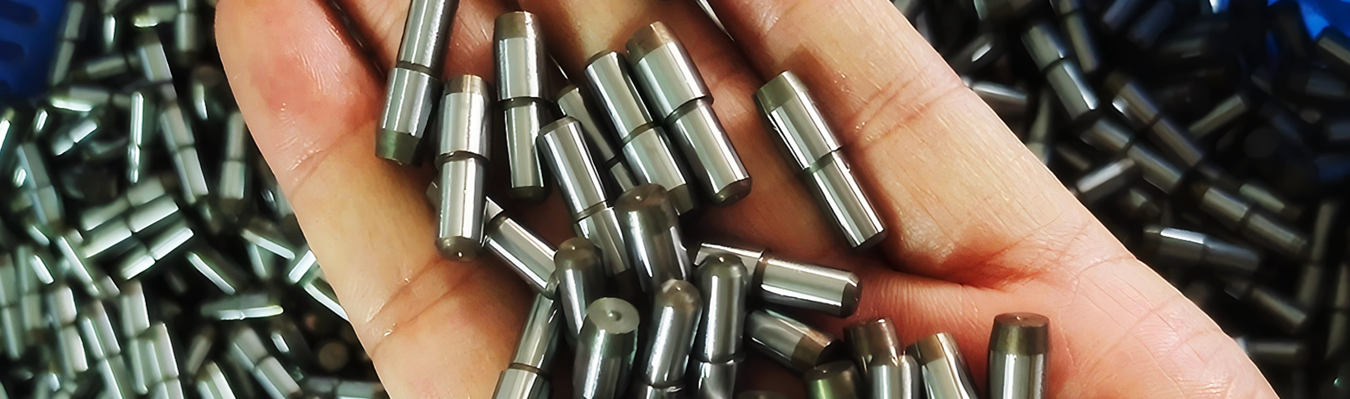
As an industrial guide pin factory with over a decade of Swiss machining experience, we offer capabilities that set us apart:
| Capability | Falcon CNC Swiss Standard |
|---|---|
| Diameter range | 0.8 mm – 32 mm (up to 50 mm with secondary grinding) |
| Length range | 2 mm – 300 mm |
| Typical diameter tolerance (as-machined) | ±0.005 mm |
| Grinding tolerance (upon request) | ±0.001 mm (1 micron) |
| Surface finish (turned) | Ra 0.2 μm |
| Surface finish (ground) | Ra 0.05 μm or better |
| Hardness capability | Through-hardened 58-62 HRC; case-hardened 60-64 HRC |
| Maximum quantity per order | 1,000,000+ pieces (high volume guide pin supply) |
| Prototype lead time | 5-7 days for precision guide pin makers trial runs |
| Quality certifications | ISO 9001:2015, IATF 16949 compliant processes |
Secondary machining processes such as thread rolling, centerless grinding, cross-hole drilling, groove cutting, and ball cage with O-Ring guide pin assembly are also included. We provide tier pricing and kanban delivery schedules for wholesale guide pins and OEM manufacture of guide pins.
Whether you need 100 pieces for a prototype mold or 500,000 pieces for a global automotive program, Falcon CNC Swiss delivers. Get a firm quote with lead times and engineering recommendations. Submit your RFQ now →
Rigorous inspections are performed on each batch of Falcon CNC Swiss Guide Pins, including:
• 100% of diameter measured by laser micrometers with a resolution of 0.003mm
• Statistical process control (SPC) of critical dimension(s)
• Hardness testing (HRC) of every batch either through files or Wilson Rockwell hardness tester
• Surface roughness measurements (Ra and Rz) measured using a contact profilometer
• Geometric tolerances such as roundness and cylindricity checked using a CMM or Talyrond.
For precision ground guide pins, we also provide a dimensional inspection report with each shipment, including actual OD readings at three positions along the pin length.
The simplest definition is that a guide pin is a cylindrical part that has precision and is used for alignment, guidance, and/or location of parts that are moving in dies, molds, jigs, fixtures and linear motion systems. Guide pins are designed to hold components in the same position during multiple cycles of use, reducing the chance of misaligning, thus, causing premature wear.
Guide pins are not the only type of pin. Other common types of pins are: dowel pins (for precise location), spring pins (roll pins), taper pins, cotter pins, clevis pins, and location pins. Guide pins are the most prominent pins used in tooling and linear guidance applications. The various types of guide pins available include shoulder pins, straight pins, carbide pins, coated pins, and chrome plated pins.
Guide pins are made from different materials depending on the specific application. For stamping dies subjected to very heavy loads: 52100 hardened steel (58 - 62 HRC) / For molds: Stainless steel 440C / For very abrasive environments: Carbide guide pins / For corrosion resistance: 316 stainless steel or hard chrome plated steel.
The typical tolerances for guide pins are: f7 or g6 for an inside diameter (sliding fit) and m6 for an outside diameter (press fit). Precision ground guide pins can be manufactured with tolerances of ± 0.001 mm total.
Yes, Falcons CNC Swiss is a custom manufacturer of guide pins in low to high quantities. We are a supplier of custom guide pins for prototypical runs with a unit quantity of 10 or more pieces, with very quick lead times.
Whether it is die set guiding pins for stamping presses, or automotive guides for assembly lines, the quality of your guiding pins will affect all variables of the tool’s durability, the consistency of parts produced, and the amount of uptime available throughout the production process itself. When you utilize Falcon CNC Swiss to manufacture your pin/guides using Swiss machining, you will have control of all variables related to your guiding pin: material used, hardness, clearance, surface finish and geometric accuracy.
Be our partner by working with an Industrial Guide Pin manufacturer that understands the mind of an engineer; send your specification now; we will provide you with a complete proposal that includes material recommendations, tolerance analysis and a firm price.
Don’t let poorly made guide pins ruin your tooling or automation investment. Contact Falcon CNC Swiss for a no-obligation quote. We speak GDT, heat treat, and coating specifications. Request your consultation