English
  日本語
日本語  한국어
한국어  français
  Deutsch
  Español
  русский
  العربية
May
Learn More
17

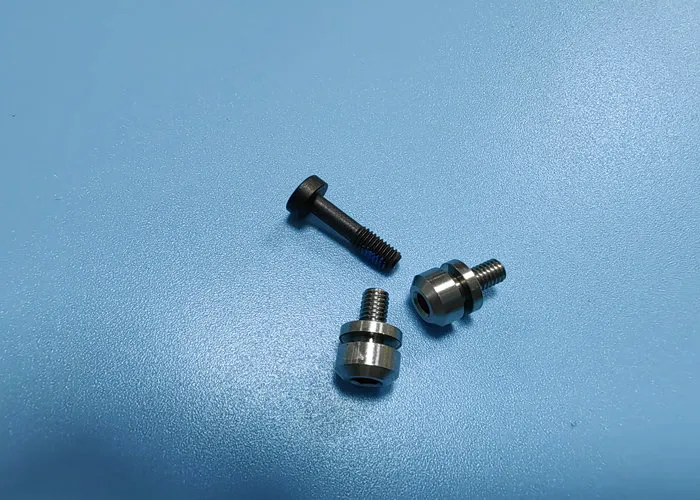
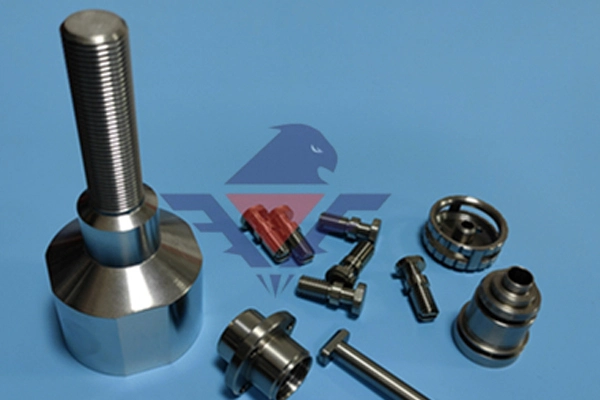
Coaxial cables, antennas, and high frequency circuits are all connected via RF connectors, and any changes in the way it is produced - either its geometry, surface finish or the consistency of the materials used to make it will negatively affect the quality of an RF signal; as well as increase insert loss and decrease shielding. As an rf connector manufacturer, Falcon CNC Swiss uses Swiss screw machining to produce precision machined RF Connectors (including pin connectors, housing, shells and dielectric inserts) that maintain return loss while minimising EMI leakage (from DC - millimeter wave bands) through the RF Connector in question.
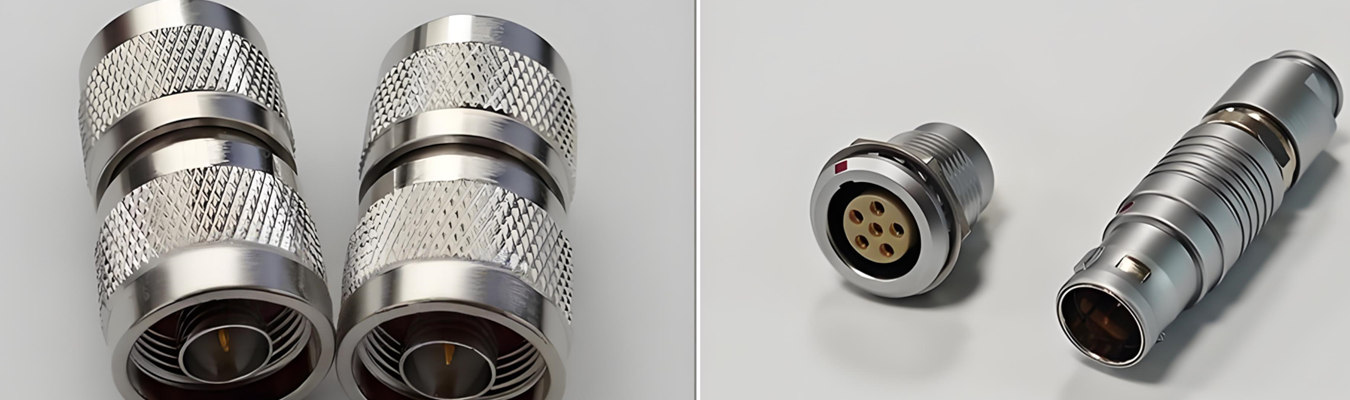
Every micron absolutely counts in the world of RF connectors when dealing with frequencies (in the GHz range). If an RF connector contact pin is mis-machined, impedance discontinuities will occur. If the wall thickness of the RF connector housing is not consistent, radiation will occur. When using RF coaxial connectors, engineers are looking for connectors that meet their very stringent VSWR (Voltage Standing Wave Ratio) and Passive Intermodulation (PIM) specifications.
Swiss-style automatic lathes (also referred to as screw machines) have the perfect capability for precisely machining RF components because they will eliminate workpiece deflection, produce surface finishes better than sub micron, and hold 0.005 mm concentricity. At Falcon CNC Swiss, we combine 12+ years of industry experience with an ISO 9001:2015 certification to provide RF connector manufacturers with custom RF connector fabrication runs (from prototype to from prototypes to high-volume rf connector maker production).
A Radio Frequency Connector (RF Connector) provides an Electro-mechanical connectivity between Coaxial Cables or Transmission Lines as they are utilized at Radio Frequencies while preserving a Controlled Impedance (generally 50 Ohms or 75 Ohms) at all Operating Frequencies. The signal must be preserved in RF applications via reflection Minimization, Leakage Minimization, and Loss Minimization; whereas low-frequency connectors are often used without these considerations.
The Common Families of RF Connectors are SMA, BNC, TNC, N-type, MCX, MMCX, and 2.92mm (K-Connector). Each family has been established by MIL-PRF-39012 and IEC 61169 as an area Specific Standard for Mechanical and Electrical Characteristics for each Family of RF Connectors.
RF Antenna Connectors are RF Connectors that mechanically attach an Antenna to Transmitters, Receivers, and Transceivers. Some examples include Wi-Fi Router Antenna Ports utilizing SMA Connectors and Cellular Base Station Antenna Connections utilizing N-Type Connectors. The same Considerations for Precision apply: Low Insertion Loss, High Repeatability, and Weatherproofing will apply when utilizing RF Connectors Outdoors.
A complete RF connector consists of several precision-machined and molded parts.
Below is a breakdown of the critical rf connector parts manufacturer must produce with tight tolerances:
| Component | Function | Typical Material | Key Tolerances |
|---|---|---|---|
| RF connector contact pins (male center pin) | Signal conductor, mating interface | Beryllium copper, brass, phosphor bronze | Diameter ±0.005 mm, surface finish Ra ≤0.2 μm |
| RF connector housings (body, nut) | Mechanical support, impedance matching | Stainless steel, brass, aluminum (passivated) | Thread class 2A/2B, concentricity ≤0.01 mm |
| Dielectric inserts for rf connectors | Insulation, impedance control, center pin support | PTFE, PEI, PEEK, Teflon | ID/OD concentricity, no voids |
| RF connector shells / outer contact | Shielding, grounding, shell-to-shell mating | Brass with nickel or silver plating | Inner diameter for ferrule, snap ring grooves |
| Coaxial connector internal parts (washer, ferrule, gasket) | Strain relief, sealing, alignment | Copper alloy, rubber, stainless | Wall thickness consistent |
| RF connector pins supplier – spring-loaded or slotted contacts | Low-force mating, high cycle life | Beryllium copper (heat treated) | Slotted finger geometry, stress relief |
As a dedicated rf connector parts manufacturer, Falcon CNC Swiss machines all metal components from bar stock, then coordinates in-house or partner plating and passes components to customers for final assembly with plastic dielectric inserts.
Electrical performance and environmental durability depend heavily on material selection. Below are the standard choices for low loss rf connector materials and platings.
Beryllium copper (C17200) – This is the gold standard for beryllium copper RF contacts due to excellent spring force, resistance to fatigue, and conductivity (22% IACS). Used for center pins, slotted contacts, and grounding fingers. It has been heat-treated to have a hardness of 38-42 HRC while remaining electrically conductive.
Brass (C36000) – Cost-effective for housings, nuts, and non-spring components. It is easy to plate and has good machinability. Conductivity ~28% IACS.
Stainless steel (303, 304) – For stainless steel RF components requiring high mechanical strength, corrosion resistance, and passivation. It is used for coupling nuts and shells in outdoor RF connectors or marine.
Tellurium copper (C14500) – High conductivity (90% IACS) and good machinability. Used for low-loss center pins where spring force is not crucial.
In high-reliability applications such as aerospace, medical, and test equipment, gold-plated RF connector parts are preferred. Hard gold (0.5-2.5 um thick) is plated on nickel and provides good oxidation resistance, low contact resistance, and a long mating life (over 500 matches).
Other plating options are available:
Silver — high conductivity but will tarnish; most often used in higher power RF connectors (broadcasting).
Nickel — used for outer cases and shells; has good corrosion resistance and moderate cost.
Passivation — stainless steel components to remove free iron and improve corrosion resistance.
A continuous conductive path from the outer shell down through the cable braid is necessary for optimal shielding performance; Our rf connector shells factory standards standards with sharp internal corner radii and uniform wall thickness to minimize EM leakage.
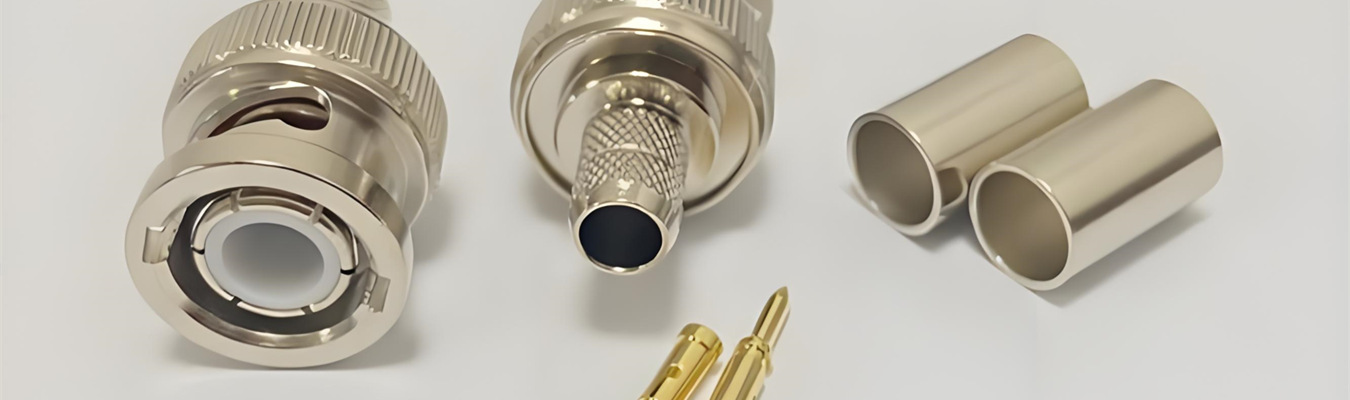
Three machined-component characteristics directly affect RF signal integrity:
Concentricity of center pin: The tolerance from the center pin’s tip to the dielectrically-supported pin diameters must be ≤ 0.01 mm TIR. Off-centered pins will cause an impedance mismatch.
The surface finish of mated interface: The finished mating surfaces must have a finish of ≤ 0.2 Ra μm with the option of having a finished finish of ≤ 0.1 Ra μm. This will reduce contact resistance and PIM associated with non-smooth surfaces.
Thread Quality of Mounting Couplings: Loose mounting threads will produce intermittent ground connections from poor thread fit. The threads will be manufactured to a class 2A/2B with a go/no-go gauge inspection process.
In addition, the performance of the shielding will also depend on the finish of the inner bore of the outer shielding casing. Any burr or irregularity will produce field distortion. The Swiss Machines will create free-cutting brass and stainless steel outer shells with razor-sharp edges that will be automatically deburred.
Designing a new rf coaxial connectors manufacturers series? Send us your 2D/3D CAD. Our RF machining specialists will provide a DFM report including material recommendations, plating options, and impedance-critical dimension callouts.
Request your free DFM analysis →
Many high-volume rf connector maker companies use progressive stamping for simple contacts and cold heading for pins. However, Swiss CNC machining offers distinct advantages for complex, precision RF components:
| Feature | Swiss Machining | Stamping / Cold Heading |
|---|---|---|
| Complex 3D shapes (stepped diameters, undercuts, cross-holes, slotted fingers) | Yes – standard | Limited or impossible |
| Tight concentricity (≤0.005 mm) | Yes – due to guide bushing support | Difficult to achieve |
| Prototype and low-volume cost | No hard tooling, economical from 50 pcs | High tooling fees ($1k-$5k) |
| Material flexibility (beryllium copper, stainless, brass, exotic alloys) | Wide range | Limited to ductile materials |
| Surface finish (turned vs. sheared edge) | ≤0.2 μm Ra standard | Sheared edges may need secondary finishing |
| Lead time for custom parts | 5-7 days prototypes, 2-3 weeks production | 4-6 weeks after tooling |
For custom rf connector fabrication requiring high reliability (medical, radar, 5G infrastructure), Swiss machining is the preferred method. Falcon CNC Swiss operates a fleet of Citizen and Tsugami lathes with live tooling for cross-holes, slots, and polygonal features.
Falcon CNC Swiss serves engineers across multiple RF-intensive industries:
Antennas for Massive MIMO (5G) and Radio Heads (Remote) require 5G infrastructure connectors to have low insertion loss (less than or equal to 0.05dB per connector), and to provide stable PIM performance (less than or equal to -160dBc). Beryllium copper center pins (gold plated) and stainless steel couplers are used to manufacture these parts to meet the demanding standards required. View our connectors and fittings capabilities →
We manufacture bulk OEM volume RF connectors for our telecom RF customers (base stations, backhaul links), specifically SMA, N-type and 4.3-10 connectors. Typically, the lead time for our RF component products is 3 weeks for production quantities with the ability to expedite.
Electropolishing removes contaminants from the surface of stainless steel and titanium components that we manufacture in our facilities using a semiconductor grade stainless steel and titanium material. These components are used in MRI coils, ablation catheters, and wireless patient monitors, and therefore must meet biocompatibility and sterility requirements to be used with medical device RF connectors. See our precision machining for electronic applications →
The tram and rain of the sky demand that military and weather radar systems possess connectors with matched pairs as well as extreme durability. Our contacts and shells are Swiss manufactured, conform to MIL-PRF-39012 specifications, and we can show you material certification and dimensional inspection reports on a lot-by-lot basis.
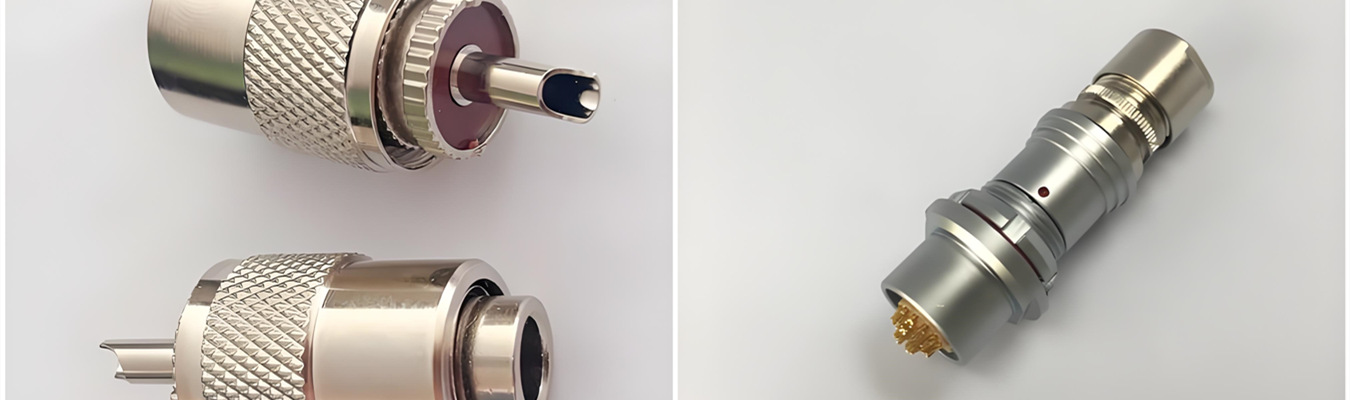
As an experienced rf connector manufacturer and industrial rf part production specialist, we offer:
| Capability | Falcon CNC Swiss Standard |
|---|---|
| Part diameter range | 0.5 mm – 32 mm (up to 50 mm with secondary ops) |
| Length range | 2 mm – 300 mm |
| Diameter tolerance (as-machined) | ±0.005 mm |
| Concentricity (pin to dielectric diameter) | ≤0.01 mm TIR |
| Surface finish standard | Ra 0.2 μm (0.1 μm on request) |
| Materials in stock | Beryllium copper C17200, brass C360, stainless 303/304/316, tellurium copper |
| Plating partners | Hard gold, silver, nickel, passivation – with thickness reports |
| Quality certifications | ISO 9001:2015, IATF 16949 compliant processes |
| Prototype lead time | 5-7 days for custom rf connector fabrication |
| Volume capacity | 100 to 1,000,000+ pieces – high-volume rf connector maker ready |
We have numerous opportunities for secondary operations that include cross-drilling, slotting, knurling, and thread rolling, in addition to the assembly of a center pin into PTFE dielectric mesh inserts (with customer-supplied mesh insulators). Explore more details about our high volume Swiss machining capabilities.
A: RF Connectors consist of Coaxial Connectors that connect the line over which RF Signals are transmitted to maintain characteristic impedance (50Ω or 75Ω) while providing the maximum transfer of Power / Loss of Signal, Reflections and Leakage of EMF (Electromagnetic Interference) (Examples of RF connectors are SMA, BNC, TNC, N-type).
A: RF Antenna Connectors are any RF Connectors utilized to connect to Antennas to connect them to a radio, router or base station. They must provide some level of Insertion loss / Repeatability along with an ability to withstand the elements (Weather Resistant) (Examples of RF Antenna Connectors include: SMA, N-type, RP-SMA).
A: Beryllium Copper (C17200) for spring pins to give a long-cycle; Tellurium Copper (C14500) for high conductivity pins; Brass (C360) for low-cost applications to make an RF Connector Pin. In addition to the above, the normal coating for RF Connector Pins is Gold on only the Contact Area.
A: Swiss Machining combines the ideal alignment tolerance of the concentricity of the center pin and outer shell of the RF Connector to produce RF Connectors with very good surface finishes (Ra ≤0.2 μm (micro-meter) and creates consistently accurately Impedance Critical Geometry that has lower VSWR (Voltage Stand WP to RF Connector PINS (VSWR) = 1.2 and lower PIM (Passive Intermodulation) (comparing to Stamped or Cold headed RF Contacts)).
A: Yes. We are manufacturers responsible for the RF Connector components manufactured in a quantity range from a few pieces that range from 10K up to 1M, with both just-in-time and that follow a Kanban supply chain model.
A: Custom RF Components are typically manufactured with a manufacturing lead time of 5-7 days (for prototypes 50 to 500 pieces) and four to five weeks (for large production quantities). We provide expedite service as needed.
All RF systems have the same need for their components to maintain signal integrity and provide robust shielding, whether it is a connector component for 5G infrastructure or a connector for medical device RF. Swiss screw machining from Falcon CNC Swiss provides the geometric accuracy, material science, and process control necessary to meet the needs of high frequency RF applications.
Let us know if you have interest in partnering with a Manufacturer of RF connector parts who understands VSWR, PIM and mechanical tolerances to the micron level. Send us a drawing or sample and we will provide you with a detailed DFM review and formal quote.
Don’t leave signal integrity to chance. Contact Falcon CNC Swiss for a no-obligation consultation. We produce rf coaxial connectors manufacturers trust – from critical center pins to complete shell assemblies. Get your custom RF component quote now →